In This Program
The Concert
Thursday, January 22, 2026, at 7:30pm
Friday, January 23, 2026, at 7:30pm
Saturday, January 24, 2026, at 7:30pm
Inside Music Talk with Alicia Mastromonaco
On stage at 6:30pm before each performance
John Storgårds conducting
Outi Tarkiainen
The Rapids of Life (2023)
United States Premiere
Dmitri Shostakovich
Piano Concerto No. 1 in C minor, Opus 35 (1933)
Allegretto–
Lento–
Moderato–Allegro con brio
Seong-Jin Cho piano
Mark Inouye trumpet
Intermission
Ludwig van Beethoven
Symphony No. 5 in C minor, Opus 67 (1808)
Allegro con brio
Andante con moto
Allegro–
Allegro
Lead support for this concert series is provided by the Phyllis C. Wattis Fund for New Works of Music.
The January 24 concert is presented in partnership with

Inside Music Talks are supported in memory of Horacio Rodriguez.
Program Notes
At a Glance
Dmitri Shostakovich’s mischievous Piano Concerto No. 1 is in fact nearly a double concerto for piano and trumpet, performed here by pianist Seong-Jin Cho and the SF Symphony’s Principal Trumpet Mark Inouye.
Ludwig van Beethoven’s Symphony No. 5 needs no introduction, as it introduces itself with the four most famous notes in classical music. But what Beethoven does with them next—how he varies and transforms his indelible motive—is what gives the symphony its expressive force and lasting power.
The Rapids of Life
Outi Tarkiainen
Born: 1985, in Rovaniemi, Finland
Work Composed: 2023
US Premiere
Instrumentation: 3 flutes, 3 oboes, 3 clarinets, 3 bassoons, 4 horns, 2 trumpets, 3 trombones, tuba, timpani, percussion (cymbals, suspended cymbal, gong, tam-tam, glass wind chimes, shell chimes, egg shakers, ratchet, bass drum, glockenspiel, bowed vibraphone, and tubular bells), 2 harps, celesta, and strings
Duration: About 10 minutes
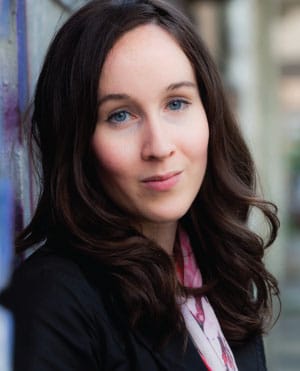
Few pieces in Western art music depict one of the most intimate and life-altering events, the birth of a child. Robert Schumann circled the topic in his lieder cycle Frauenliebe und -leben, in the songs “Süsser Freund, du blickest,” in which the woman tells her husband she is pregnant, and the following song, “An meinem Herzen, an meiner Brust,” in which she is basking in the newborn phase of motherhood. American composer Libby Larsen wrote a song cycle called The Birth Project that includes songs about childbirth, but Outi Tarkiainen’s work is unique in its visceral depiction of the instinctive nature of birth in an orchestral context.
Tarkiainen writes: “The Rapids of Life is a work about that paramount moment, about a female’s instinctive birth-giving and a little child of nature who opens his eyes for the first time. The form of the work imitates the physiological delivery and its different stages, carried along by the ever-shifting waves.” The piece depicts Tarkiainen’s own experience with the Ferguson reflex, an “enormous surge” that she described to her husband as “the rapids of life I had to shoot—as a precipice over which I was pushed; and in the process I realized how little I knew about the strength of the human body.”
Tarkiainen evokes the surges of contractions with periods of rest during labor, building and relaxing again and again until birth.
As Tarkiainen was composing the piece, she learned her fellow Finnish composer Kaija Saariaho had died. Saariaho (1952–2023) was an important influence on Tarkiainen’s life, and the younger composer decided not only to dedicate the piece to Saariaho, but to incorporate a “flash” from Saariaho’s cello concerto into the cello solo at the opening of the piece, and to incorporate instruments that were important to Saariaho throughout.
Tarkiainen’s compositional style is highly evocative of the natural landscape of her beloved Lapland. Like her Finnish forebear Sibelius, the music’s affect makes the listener feel as though they are within the landscape, seeing and feeling the natural beauty through the sounds she creates. Tarkiainen’s natural beauty in this piece is the wonder of giving birth to her little “child of nature.” Tarkiainen acknowledges Sibelius by incorporating the first bar of his Fourth Symphony in the brass near the end of the piece. The Rapids of Life bears witness to the beauty and power of birth and the impact of loss as we progress through the stages of life.
Piano Concerto No. 1 in C minor, Opus 35
Dmitri Shostakovich
Born: September 25, 1906, in Saint Petersburg
Died: August 9, 1975, in Moscow
Work Composed: 1933
SF Symphony Performances: First—December 1946. Pierre Monteux conducted with Jorgen Nielsen and Charles Bubb as soloists. Most recent—September 2016. Michael Tilson Thomas conducted with Yuja Wang and Mark Inouye as soloists.
Instrumentation: solo piano, solo trumpet, and strings
Duration: About 22 minutes
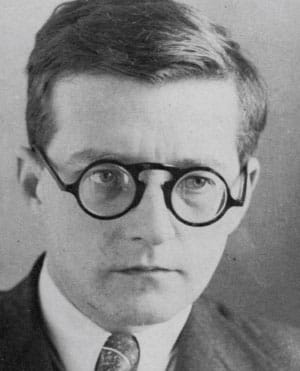
In addition to his formal musical education, Dmitri Shostakovich spent many of his formative years playing in cabaret clubs, accompanying silent films, and composing incidental music for revues and plays. These experiences made him an adept composer in a wide variety of genres, and influenced his compositional style throughout the rest of his career. From the highbrow symphonic and operatic repertoire to blatnye (street) tunes, Shostakovich was a musical polyglot. The composer, who was still years away from being squeezed under the watchful eye of the Communist Party, was able to incorporate several of his musical influences and inspirations into his First Piano Concerto.
Shostakovich began work on his First Piano Concerto on March 6, 1933, four days after he finished the last of his 24 Piano Preludes, Opus 34. He told a student that he originally conceived of the piece as a trumpet concerto but found writing for the instrument very difficult, so he turned it into a double concerto with piano. Eventually the piano became the more prominent instrument, but the trumpet retains a crucial voice in the work.
After an opening call from the piano and trumpet, the first movement begins with a musical quotation from Beethoven’s Appassionata Sonata, referencing its opening phrase. Relevant to this program, the Appassionata contains in it the famous motive from his Fifth Symphony. Although Shostakovich does not use it, being a virtuoso pianist himself, he would have known the implications of using this quotation. The second movement is a slow waltz, almost romantic in its lyricism. The opening is a respite from the freneticism of the first movement, but soon enough, the music shifts into a più mosso (faster) section with octave runs in the piano. The trumpet joins with a muted melody down to the lowest register of the instrument, not often heard from a trumpet soloist. The third movement serves as a short intermezzo that sets up the fourth movement. The end of the third movement, in almost a dreamlike state, flutters directly into the finale, which creates a dramatic change in affect.
The final movement interpolates numerous musical quotations from other pieces, ranging from Shostakovich’s own earlier works to Gioachino Rossini’s William Tell, Al Jolson’s “California, Here I Come,” the English folk song “Poor Mary,” Joseph Haydn’s Piano Sonata No. 50 in D major, and to round out the Appassionata quotation from the first movement, Beethoven’s Rage Over a Lost Penny. As if that were not enough Beethoven, the opening trill of the piano cadenza is the very same chord as the closing trill in the first movement cadenza from Beethoven’s Third Piano Concerto (a piece also in C minor). In addition to the clear quotations, Shostakovich also incorporates moments of ragtime-like syncopation in virtuosic stride piano passages. If it were another composer, the piece might come off as musical gibberish, but Shostakovich’s musical polyglotism was his own lingua franca.
Symphony No. 5 in C minor, Opus 67
Ludwig van Beethoven
Baptized: December 17, 1770, in Bonn
Died: March 26, 1827, in Vienna
Work Composed: 1804–08
SF Symphony Performances: First—November 1912. Henry Hadley conducted. Most recent—January 2024. Jaap van Zweden conducted.
Instrumentation: 2 flutes, piccolo, 2 oboes, 2 clarinets, 2 bassoons, contrabassoon, 2 horns, 2 trumpets, 3 trombones, timpani, and strings
Duration: About 32 minutes
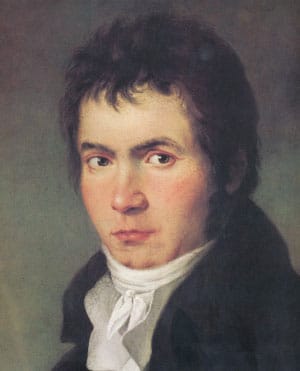
Deep in the winter of 1808, the Fifth Symphony had its rather inauspicious premiere. Beethoven, who had wanted to present an Akademie (a concert put on for one’s own benefit, at one’s own expense, and often, peril), got his chance on December 22. The composer, who eschewed a court position with noble patronage in favor of being a more freelance composer, hoped to earn up to a year’s salary in one concert. He wanted to parade the pieces he had composed over the last four years, some of the most prolific of his career. The concert lasted nearly four hours and included not only the Fifth Symphony, but also premieres of the Sixth Symphony, Fourth Piano Concerto, and Choral Fantasy.
In a time when candles provided illumination and heating a hall so cavernous as the Theater an der Wien was astronomically expensive, the audience’s tepid response stemmed not only from the length of time they were required to sit and the frigid temperatures they were expected to endure, but also the quality of performance itself. Because the best musicians in Vienna were already booked for another concert, Beethoven employed the second string of largely amateur musicians to play his four hours of music on one rehearsal. He grew enraged at the concert, and forced the players to start again when they didn’t meet his expectations. Despite its lackluster premiere, Beethoven’s innovation in the Fifth Symphony has shaped the course of Western classical music in immeasurable ways.
The Music
Rhythm takes hold of the listener from the first four notes. This motive, short-short-short-long, written as three eighth notes followed by a half note with a fermata, is repeated in nearly every measure of the first movement’s exposition (the first section). The unrelenting use of the motive is what makes the movement so recognizable. The ambiguity of the motive, its utter lack of resolution until the last few bars of the movement, is one of the reasons it is so compelling. And yet, even with this short four-note motive, British musicologist Donald Tovey notes how Beethoven creates unprecedentedly long musical syntaxes, drawing out the musical phrases. Brief snippets combine on a longer structural undergirding—this, too, is part of the brilliance of the work.
The second movement is a stately andante, pastoral in feel. When it finally starts to lyrically expand and breathe, the brass jostle their way to prominence, playing a theme that is immediately recognizable as the four-note motive from the first movement, altered to fit into a three-beat pattern.
The third movement opens mysteriously, a C-minor chord outlined in the low strings. But again, as in the previous movements, the horns interject with the motive, interrupting the C-minor outline. The scherzo arrives at a fugue section before returning to the original C-minor theme. However, the scherzo does not technically end at all—it undergoes a slow transition into the fourth movement. This is one of the many innovations that Beethoven is about to embark on in the final movement. In concert culture up until this point, symphonies were often performed one movement at a time, broken up by lighter musical fare between movements. By making the final two movements attacca (played without pause), Beethoven all but ensured that the audience would be forced to sit raptly at attention. It is not clear at first where the third-movement coda is headed, just that it cannot stay within the harmonies brewing and bubbling away, with the timpani intoning the motive underneath. Finally, the orchestra crescendos to the heroic C-major of the fourth movement.
The finale introduces several more innovations: the first use of the piccolo and contrabassoon in symphonic literature, and only the second time trombones were used in a symphony (the first was a few years earlier by a little-known Swedish composer). Beethoven thus expands the instrumental palate available to him and all following composers. He also is credited with pioneering the idea of a heroic journey through the four movements of a symphony. Before this, the movements of symphonies were not strictly related to each other, but Beethoven tied each movement together with not only the rhythmic motive, but also through tonality, moving from C minor to C major, from darkness to light. This has been a source of inspiration for many composers, ranging from Mahler to Shostakovich.
Perhaps it was not the supposed idea of “fate” that is the point of Beethoven’s Fifth Symphony, but rather releasing oneself from the burdens of it and overcoming in triumph. The years from 1803–15 are commonly known as Beethoven’s “heroic period,” a time when his progressing deafness was taking away his ability to perform and communicate easily with other people. In the cultural history of Beethoven’s life and reputation, the Fifth Symphony represents much more than just compositional innovation. It represents the triumph over darkness, of continuing in the face of adversity.
Whether or not this was exactly what Beethoven intended, perhaps this is one of the reasons why the piece has enjoyed such a place of privilege within the canon, and why it has become one of the most enduring pieces of the repertoire.
—Alicia Mastromonaco
Major to Minor
Both Beethoven’s Fifth Symphony and Shostakovich’s First Piano Concerto begin in C minor and end in C major, although the journeys from beginning to end follow far different trajectories and feelings. Beethoven’s symphony is a four-movement journey from darkness to light, with the glorious apotheosis of C major in the fourth movement.
Shostakovich, on the other hand, reaches C major in the coda of the fourth movement, with the orchestra and piano hammering out one C-major chord after another, and the trumpet insistently bugling a fanfare until the end of the piece. This is Shostakovich’s signature double speak. Yes, the piece moves from C minor to C major. But contrary to the euphoric ending of Beethoven’s symphony, Shostakovich’s repeated chords sound less heroic than relentless.
Alicia Mastromonaco is a Contributing Writer, Inside Music Speaker, and frequent guest horn player for the San Francisco Symphony. She is a member of the California Symphony, Monterey Symphony, and Marin Symphony, and is a horn lecturer at Sonoma State University. She earned a PhD in musicology from the University of California, Santa Barbara.
About the Artists
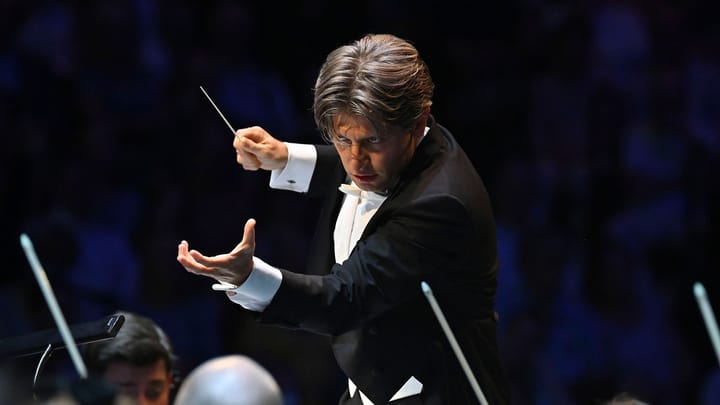
John Storgårds
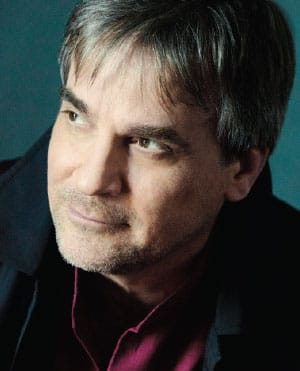
Chief conductor of the BBC Philharmonic and Turku Philharmonic, principal guest conductor of Canada’s National Arts Centre Orchestra Ottawa, and longtime artistic director of the Lapland Chamber Orchestra, John Storgårds has a dual career as a conductor and violinist. Most recently, he was announced as music director of the National Arts Centre Orchestra and principal conductor and artistic adviser of the Junge Deutsche Philharmonie, with both positions commencing next season.
Highlights of his 2025–26 season include two appearances at the BBC Proms with the BBC Philharmonic, a tour to the Beijing Music Festival, this week’s debut with the San Francisco Symphony, and a debut with Deutsches Symphonie-Orchester Berlin. He also returns to the Tokyo Metropolitan Symphony, Finnish Radio Symphony, Lahti Symphony, St. Louis Symphony, and Minnesota Orchestra.
Other recent appearances include the Berlin Philharmonic, Leipzig Gewandhaus Orchestra, Munich Philharmonic, Berlin Radio Symphony, Netherlands Philharmonic, Orchestre National de France, BBC Symphony, London Philharmonic, all the major Nordic orchestras, the Chicago Symphony, Cleveland Orchestra, New York Philharmonic, Detroit Symphony, Sydney Symphony, Melbourne Symphony, Yomiuri Nippon, and NHK Symphony. He frequently incorporates violin performances into his conducting engagements and gives recitals internationally with his regular duo partner, Kirill Gerstein.
Storgårds’s award-winning discography includes Sibelius and Nielsen symphony cycles with the BBC Philharmonic for Chandos, as well as an ongoing Shostakovich cycle. He earned a Grammy nomination and Gramophone Award in 2012. Storgårds was concertmaster of the Swedish Radio Symphony under Esa-Pekka Salonen before studying conducting with Jorma Panula and Eri Klas. He received the Finnish State Prize for Music in 2002 and the Pro Finlandia Prize in 2012.
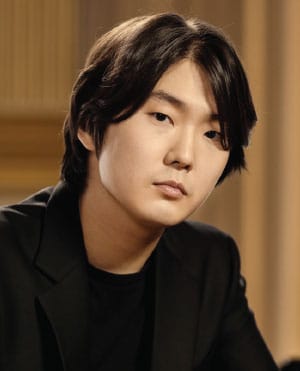
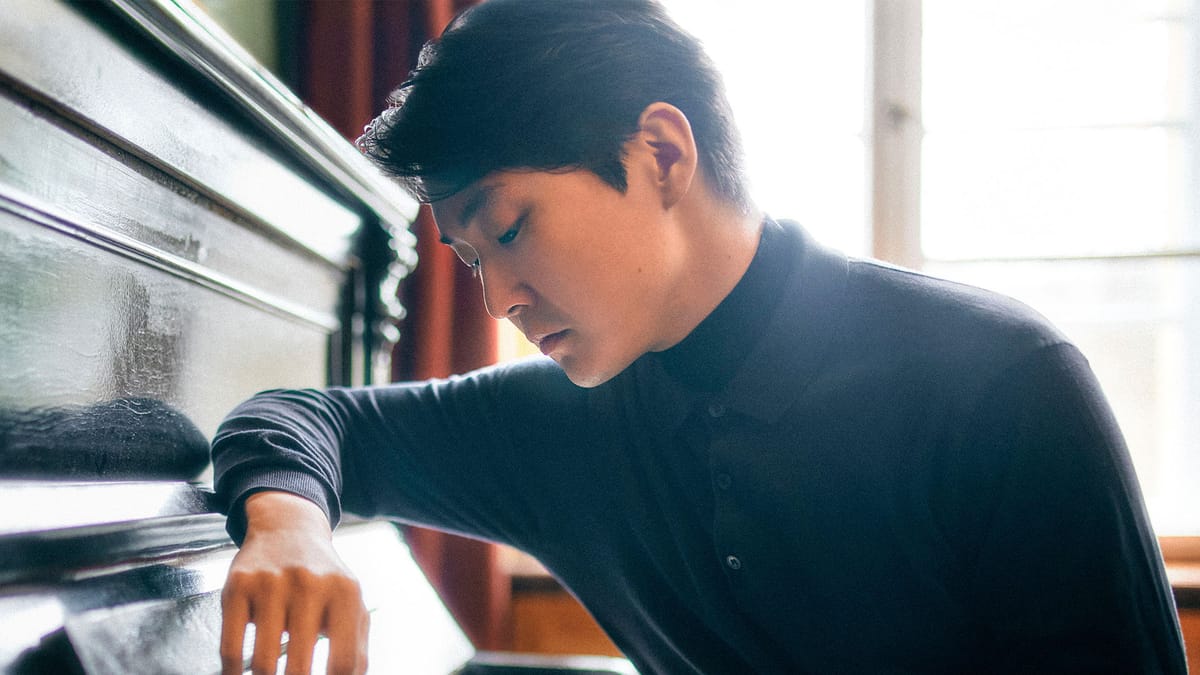
Seong-Jin Cho
Seong-Jin Cho won first prize at the Chopin International Competition in Warsaw in 2015, and his career has rapidly ascended since. In 2016 he signed an exclusive contract with Deutsche Grammophon, and in 2023 was awarded the Samsung Ho-Am Prize in the Arts in recognition of his exceptional contributions to the world of classical music. He has performed with the Berlin Philharmonic, Vienna Philharmonic, London Symphony, Royal Concertgebouw Orchestra, and Boston Symphony. He first appeared at Davies Symphony Hall on the Great Performers Series in November 2016, touring with the Warsaw Philharmonic, and debuted with the San Francisco Symphony in January 2024.
Last season, Cho held the position of artist in residence with the Berlin Philharmonic, and in 2025–26 is the London Symphony’s Artist Portrait. This season he also returns to the Pittsburgh Symphony including a tour to Carnegie Hall, and to the Los Angeles Philharmonic. He embarks on several international tours, including with the Czech Philharmonic to Taiwan and Japan, and with the Munich Philharmonic to Korea, Japan, and Taiwan.
In the 2024–25 season, Cho marked the 150th anniversary of Maurice Ravel’s birth by performing his complete solo piano music at venues including the Vienna Konzerthaus, Barbican Centre, Boston’s Symphony Hall, Disney Hall, Carnegie Hall, and Davies Symphony Hall. His Ravel recording for Deutsche Grammophon was recognized with an Opus Klassik “Instrumentalist of the Year” Award.
Born in 1994 in Seoul, Seong-Jin Cho began learning piano at the age of six and gave his first public recital at 11. In 2009, he became the youngest-ever winner of Japan’s Hamamatsu International Piano Competition. In 2011, at age 17, he won third prize at the International Tchaikovsky Competition in Moscow.
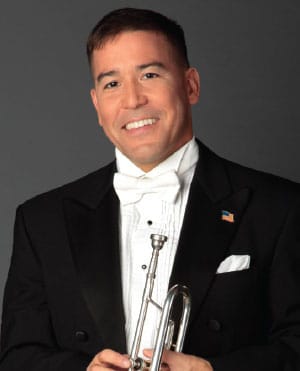
Mark Inouye
Mark Inouye joined the San Francisco Symphony in 1999 and became Principal Trumpet in 2008, holding the William G. Irwin Charity Foundation Chair. He was previously principal trumpet with the Houston Symphony and Charleston Symphony and has been a guest principal trumpet with the New York Philharmonic and Chicago Symphony. He has toured the United States with Toccatas and Flourishes, the acclaimed organ and trumpet duo, and was a member of the Empire Brass Quintet. Inouye graduated from the Juilliard School, where he transferred after two years as a civil engineering major at the University of California, Davis.
With the SF Symphony, Inouye has been a soloist in Copland’s Quiet City, Haydn’s Trumpet Concerto, Bach’s Jauchzet Gott in allen Landen, and Shostakovich’s Piano Concerto No. 1 on two previous occasions with Jean-Yves Thibaudet and Yuja Wang. He also led and soloed on a Summer with the Symphony program in both jazz and classical styles. As a composer, his works have been performed on the SF Symphony Chamber Music Series.
Equally at home in classical music and jazz, Inouye was a founding member of the Juilliard Jazz Sextet at Lincoln Center and a guest performer at the Hollywood Bowl in the Playboy Jazz Festival. He appeared as soloist in Wynton Marsalis’s video Marsalis on Music, on a Disney Channel production featuring the Who at Carnegie Hall, and released his own debut jazz album, The Trumpet & The Bull.