In This Program
The Concert
Sunday, April 12, 2026 at 2:00pm
Gunn Theater
California Palace of the Legion of Honor
Alexander Barantschik violin
Peter Wyrick cello
Anton Nel piano
Joseph Haydn
Piano Trio in A major, Hob. XV:18 (ca. 1794)
Allegro moderato
Andante
Allegro
Cécile Chaminade
Thème varié, Opus 89 (1898)
Carl Czerny
Variations on a Theme by Rode, La Ricordanza, Opus 33 (ca. 1820s)
Anton Nel piano
Intermission
Franz Schubert
Piano Trio No. 1 in B-flat major, D.898 (1827)
Allegro moderato
Andante un poco mosso
Scherzo–Allegro
Rondo–Allegro vivace
This series showcases the 1742 Guarneri del Gesù violin on loan to Alexander Barantschik and the San Francisco Symphony from the Fine Arts Museums of San Francisco.
Program Notes
Piano Trio in A major, Hob. XV:18
Joseph Haydn
Born: March 31, 1732, in Rohrau, Lower Austria
Died: May 31, 1809, in Vienna
Work Composed: ca. 1794
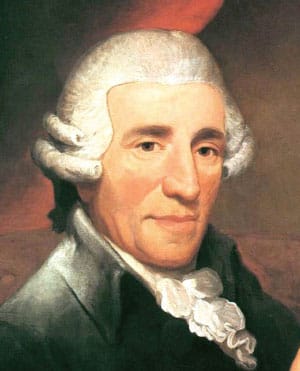
At 60 years old, Joseph Haydn had not tired of peppering his music with surprises and musical jokes. This A-major piano trio, for instance, starts with three bangs in the form of sudden, loud chords played by all three instruments. He wrote it around 1794 during a period marked by travel to London. Over two concert seasons there (1791–92 and 1793–94), his inventiveness reached new heights and music seemingly poured from his pen: more than a dozen piano trios, his last three piano sonatas, 12 symphonies, and many other works.
Over the course of Haydn’s life, the keyboard’s evolution from harpsichord to fortepiano led to the emergence of the piano trio as a genre. Until the Romantic era, piano trios were generally billed as sonatas for keyboard with violin and cello accompaniment. Early pieces simply doubled the harpsichord’s voices in the strings to enrich the sound. As keyboard instruments developed, new worlds of expression and color opened for composers. Unlike the harpsichord, the fortepiano could sustain notes and create dramatic dynamic contrast, making it an equal expressive partner to the strings. Mozart, for instance, took advantage of the new equality between the instruments in his trios, giving the violin and cello their own melodies.
Haydn, however, chose not to follow this path. The pianist and scholar Charles Rosen writes “Haydn was working against history” in his piano trios, and yet they became “along with the Mozart concertos, the most brilliant piano works before Beethoven.” Perhaps his introduction in London to the powerful new Broadwood fortepianos led to this piano-centric writing. At the time of its first publishing, the marketing of the A-major trio points to the genre’s growing pains. Publishers packaged it with two other trios, in London titling them in the old manner as “Three Sonatas for piano with violin and cello accompaniment,” but trying a new tack in Amsterdam with the title “Three Grand Trios.” Though the instruments’ roles suggest the former title, the grandiosity and creativity of Haydn’s musical ideas make a good case for the latter.
After its declamatory opening, the piano introduces a lilting melody, marked cantabile (singing), an effect that showcases the comparative advantages of the fortepiano over the harpsichord. The violin responds while the cello supports the piano’s bass line. Over the course of the first movement, Haydn takes us again and again through quickly shifting, unexpected harmonies. Just when he has mesmerized us with this harmonic wandering, he stops the piece’s progress all together with a slower tempo marking and a grand pause. This sudden stopping becomes its own motif in a way. Charles Rosen writes, “dramatic silence and the fermata [a hold or pause] play a greater role in [Haydn’s] music than in Mozart’s … the silence is in every case a preparation for something crucial.” Here the silence is perhaps another musical joke, as it is always followed by a straightforward ending statement, as if to say, “nothing unusual to see here!” Following the final occurrence, Haydn wraps up the movement definitively with scales and arpeggios.
The slow movement introduces an entirely new mood as he takes us into melancholy A minor. Dramatic pauses in the middle of phrases add to the questioning quality of the melody and create a dramatic contrast with the warm, easily-moving middle section in A major. The movement does not so much end as segue with a wink into the ebullient third movement (it is marked attacca—
literally “attack” but meaning “without pause”). With exuberance and wit, Haydn uses 3/4 meter and chirping gestures in the piano and violin to create a rollicking dance, reminiscent of the folksy Hungarian Romani style he loved to employ. In Rondo form, the theme returns several times interspersed with exploratory episodes. It bounces and buoys us along until the end.
—Allegra Chapman
Thème varié, Opus 89
Cécile Chaminade
Born: August 8, 1857, in Paris
Died: April 13, 1944, in Monte Carlo, Monaco
Work Composed: 1898
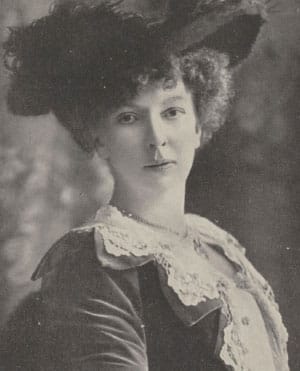
The Chaminade Music Club of Yonkers, New York, was founded in 1895 by music lovers “for the sole purpose of participating in piano and voice recitals to entertain themselves and others.” Still active today, the group was one of dozens formed in the late 19th century in honor of French composer Cécile Chaminade, whose music was a fixture at such gatherings. Chaminade’s heyday coincided with the Belle Époque and the flourishing of Paris’s salon scene, where her elegantly crafted piano miniatures found a natural home.
As a young musician, Chaminade was prohibited by her father from entering the Paris Conservatory, so she trained privately with esteemed composers such as Benjamin Godard. While she composed several symphonic works, including the Concertstück for piano and orchestra and a popular concertino for flute, she ultimately focused on the smaller-scale pieces that became her livelihood. She published nearly 400 works—primarily songs and piano pieces—building a devoted following through sheet-music sales, piano recitals, and piano roll recordings. This was a savvy strategy for a composer navigating the barriers of Paris’s musical establishment, where tradition and connections often dictated success.
Chaminade’s popularity extended beyond France to England and the United States, where she toured to great success in 1908, including a sold-out engagement at Carnegie Hall and a luncheon with President Theodore Roosevelt. Though she lived through both World Wars and the musical upheavals of Schoenberg and Stravinsky, her compositional style remained rooted in the melodic French Romanticism exemplified by her contemporaries Fauré, Massenet, and Saint-Saëns. In Thème varié, Chaminade takes a lilting Couperin-like theme of her own devising through a series of gracefully embroidered variations.
—Steven Ziegler
Variations on a Theme by Rode, La Ricordanza, Opus 33
Carl Czerny
Born: February 21, 1791, in Vienna
Died: July 15, 1857, in Vienna
Work Composed: ca. 1820s
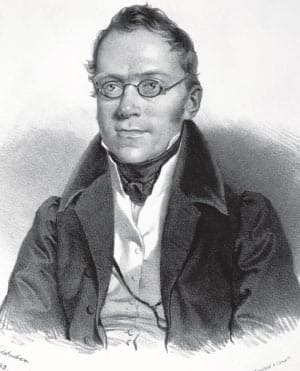
When pianists think of mindless finger exercises, they often think of Carl Czerny. Though he is perhaps fairly maligned as a torturer of piano students, Czerny was also one of the most influential piano pedagogues of all time and a prolific composer of nearly 1,000 works in almost every genre. His music straddles the Classical and Romantic eras, reflecting his unique position in music history between two revolutionaries: Ludwig van Beethoven, his teacher, and Franz Liszt, his pupil.
The Ricordanza variations are a cover of a cover. The inspiration came to Czerny second-hand from a performance in 1820s Vienna by one of the great coloratura sopranos of the day, Angelica Catalani. In a spectacular feat, she sang her own solo voice version of Air varié, Opus 10, a violin showpiece by the violinist-composer Pierre Rode. Czerny was so taken with Catalani’s vocalise arrangement that he wrote his own from his memory of her performance (Ricordanza means “remembrance”). The multi-layered lineage of this piece reflects the vibrant exchange of ideas that swirled around Czerny in Vienna. There was no greater form of flattery than imitation.
These pastiche pieces, usually themes and variations or fantasies, were in great demand by publishers in Czerny’s day. Nearly every composer wrote many based on popular melodies. The forms really derive from improvisation, an art that Czerny literally wrote the book on: A Systematic Introduction to Improvisation on the Pianoforte. The Ricordanza variations are a charming example of Czerny’s wonderful contributions to the genre.
The variations open with a poised main theme which is followed by five variations and a coda. Czerny follows his own guidelines from his book, and we can find many of the compositional techniques described in his chapter “Concerning Improvisation on a Single Theme.” The third and fifth variations are pure showy pianistic fun, full of bubbly broken octaves and cascading runs. The fourth variation, marked sostenuto (sustained), brings us into a more reflective state with a slower tempo and expressive, singing melody. Following the fifth variation, Czerny writes an extended flourish mimicking the soloistic cadenza of a concerto. It is an improvisation written down, without barlines or rhythmic meter, creating a moment out of time. He ends the piece with a re-statement of the main theme, lightly embellished—a final whiff of elegance.
—A.C.
Piano Trio No. 1 in B-flat major, D.898
Franz Schubert
Born: January 31, 1797, in Vienna
Died: November 19, 1828, in Vienna
Work Composed: 1827
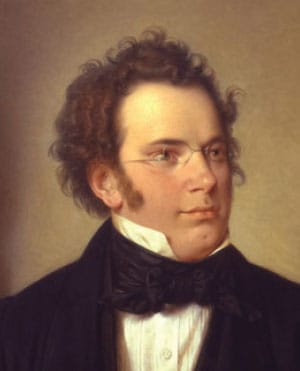
In the last full year of his life, at the young age of 30 and suffering from syphilis, Franz Schubert wrote a torrent of transcendental works. We can guess at its impetus: a heightened sense of mortality, both from his own progressing illness and from the death in 1827 of his greatest musical hero, Ludwig van Beethoven. Schubert marched as a torchbearer in Beethoven’s funeral procession where he heard a eulogy calling for a successor to emerge. As the musicologist Christopher Gibbs argues, Schubert likely recognized that many leading musicians of the day saw him as the natural heir to Beethoven’s musical legacy. His works from this time show an eye towards posterity: in Gibbs’s words, “he was now writing essentially for himself—and for the future.”
In Schubert’s lifetime, much of his music was only ever performed at Schubertiads, musical house parties centered around Schubert and his music. Schubertiads were a sustaining pillar of Schubert’s life and career, so it is no accident that he wrote most of his great works in the intimate genres of art song and chamber music (literally: living-room music). Though he may have written these works for a small audience of friends, many are cosmic in scope and evoke universal human themes, particularly those written towards the end of his life.
The manuscript of the B-flat major trio is lost, but we know that Schubert wrote all of his piano trio music in his final two years. Unlike the E-flat major trio, he did not promote the B-flat publicly and it was not published until 1836. It received its first performance in January 1828, just 10 months before Schubert’s death, at a gathering hosted by his lifelong friend, Joseph von Spaun to celebrate von Spaun’s engagement. Unbeknownst to the revelers, this party was to be the last Schubertiad of Schubert’s life.
The Music
When composer and critic Robert Schumann heard the B-flat trio for the first time, he wrote, “the troubles of our human existence disappear and all the world is fresh and bright again.” It is hard to reconcile the joyfulness of this trio with the misery that Schubert experienced while writing it. The 20th-century biographer Alfred Einstein identified a reference to Schubert’s drinking song “Skolie” in the trio’s final movement. The song’s lyrics capture this incongruity: “In the morning beams of May, let us enjoy the flower of life before its scent fades! As quickly as joy kisses us, death beckons us and it flies away.” We are reminded to admire the fleeting beauty of things that must die, a beauty perhaps inherent in mortality and in the temporal art of music. The song then asks “Should we be afraid of death?” It concludes “anyone who drinks this can laugh at death’s threats,” but any reassuring laughter must co-exist with the foreboding question that preceded it. This dichotomy between joy and despair, light and dark, pervades Schubert’s music from his final year. Schubert’s carefree moments strike us so powerfully because their effervescent beauty exists alongside the darker truths of human existence.
The trio begins blithely with a playful melody in the strings accompanied by vivacious chords and encouraging interjections in the piano. By the end of the first phrase, Schubert gives us a glimpse of wistfulness—we are suspended for the briefest moment at the high point of the violin’s melody and then drawn warmly back into the jovial conversation between the instruments. The second theme enters through the plaintive voice of the cello, hinting at what is to come in the second movement. Schubert continues developing these themes, often spinning us off into unknown lands through key changes. Towards the end of the movement, the syncopated accompaniment pattern suddenly becomes urgent and brings the whole group to a stop. The music reenters with a pleading moment in the strings and then returns to the prevailing blithe mood to finish the movement in high spirits.
An achingly beautiful cello melody begins the second movement. Floating and soaring, the violin and cello exchange this melody with gentle piano accompaniment until a troubled, minor-key middle section takes over. The clouds pass quickly, however, and we once again find ourselves amid the beauty of the main theme until the movement winds down with a gentle exhalation. In the third movement, Schubert gives us not one, but two dances: the ländler and the waltz. We can imagine ourselves at a Schubertiad or other 19th-century gathering. In the rondo form of the fourth movement, we meet an amiable theme that returns over and over with episodic flights of fancy in between. This theme is where Einstein identified the song “Skolie.” We can certainly hear the “delight” of the song’s lyrics. As we are caught up in the conversation between the instruments, time is once again suspended, but even these “heavenly lengths,” as Robert Schumann quipped of Schubert’s music, must finally come to an end.
—A.C.
About the Artists
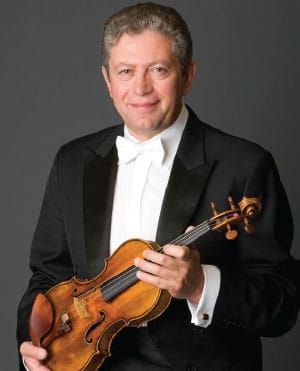
Alexander Barantschik
Alexander Barantschik began his tenure as the San Francisco Symphony’s Concertmaster in September 2001 and holds the Naoum Blinder Chair. He was previously concertmaster of the Bamberg Symphony Orchestra, London Symphony Orchestra, and Netherlands Radio Philharmonic, and has been an active soloist and chamber musician throughout Europe. He has collaborated in chamber music with André Previn, Antonio Pappano, and Mstislav Rostropovich. As leader of the LSO, Barantschik toured Europe, Japan, and the United States, performed as soloist, and served as concertmaster for major symphonic cycles with Michael Tilson Thomas, Rostropovich, and Bernard Haitink. He was also concertmaster for Pierre Boulez’s year-long, three-continent 75th birthday celebration.
Born in Russia, Barantschik attended the Saint Petersburg Conservatory and went on to perform with the major Russian orchestras including the Saint Petersburg Philharmonic. His awards include first prize in the International Violin Competition in Sion, Switzerland, and in the Russian National Violin Competition. Since joining the SF Symphony, Barantschik has led the Orchestra in several programs and appeared as soloist in concertos and other works by Bach, Mozart, Mendelssohn, Brahms, Beethoven, Prokofiev, Shostakovich, Walton, Piazzolla, and Schnittke, among others. Barantschik is a member of the faculty at the San Francisco Conservatory of Music, where he teaches graduate students from around the world in a special concertmaster program. Through an arrangement with the Fine Arts Museums of San Francisco, Barantschik has the exclusive use of the 1742 Guarneri del Gesù violin once owned by the virtuoso Ferdinand David, who is believed to have played it in the world premiere of the Mendelssohn E-minor Violin Concerto in 1845. It was also the favorite instrument of the legendary Jascha Heifetz, who acquired it in 1922 and who bequeathed it to the Fine Arts Museums, with the stipulation that it be played only by artists worthy of the instrument and its legacy.
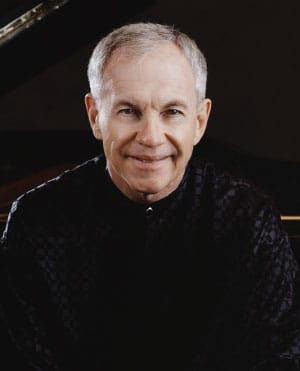
Anton Nel
Winner of the 1987 Naumburg International Piano Competition, Anton Nel tours as a recitalist, concerto soloist, chamber musician, and teacher. Highlights in the United States include performances with the Cleveland Orchestra, Chicago Symphony, Dallas Symphony, and Seattle Symphony, as well as recitals from coast to coast. He has appeared internationally at Wigmore Hall, the Concertgebouw, Suntory Hall, and major venues in China, Korea, and South Africa.
Nel holds the Joe R. and Teresa Lozano Long Endowed Chair at the University of Texas at Austin, and in the summers is on the faculties of the Aspen Music Festival and School and the Steans Institute at the Ravinia Festival. Born in Johannesburg, Nel is also an avid harpsichordist and fortepianist, and is a graduate of the University of the Witwatersrand, where he studied with Adolph Hallis, and the University of Cincinnati, where he worked with Béla Síki and Frank Weinstock. He made his San Francisco Symphony debut in 1994.
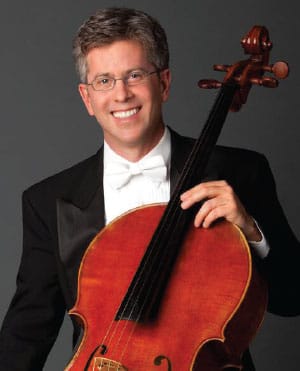
Peter Wyrick
Peter Wyrick was a member of the San Francisco Symphony cello section from 1986–89, rejoined the Symphony as Associate Principal Cello from 1999–2023, and retired from the Orchestra at the end of the 2023–24 season. He was previously principal cello of the Mostly Mozart Orchestra and associate principal cello of the New York City Opera. He has appeared as soloist with the SF Symphony in works including C.P.E. Bach’s Cello Concerto in A major, Bernstein’s Meditation No. 1 from Mass, Haydn’s Sinfonia concertante in B-flat major, and music from Tan Dun’s Crouching Tiger, Hidden Dragon Concerto.
In chamber music, Wyrick has collaborated with Yo-Yo Ma, Joshua Bell, Jean-Yves Thibaudet, Yefim Bronfman, Lynn Harrell, Jeremy Denk, Julia Fischer, and Edgar Meyer, among others. As a member of the Ridge String Quartet, Wyrick recorded Dvořák’s piano quintets with pianist Rudolf Firkušný on an RCA recording that received the Diapason d’Or and a Grammy nomination. He has also recorded Fauré’s cello sonatas with pianist Earl Wild for dell’Arte records. Born in New York to a musical family, he began studies at the Juilliard School at age eight and made his solo debut at age 12.