In This Program
The Concert
Thursday, March 5, 2026, at 7:30pm
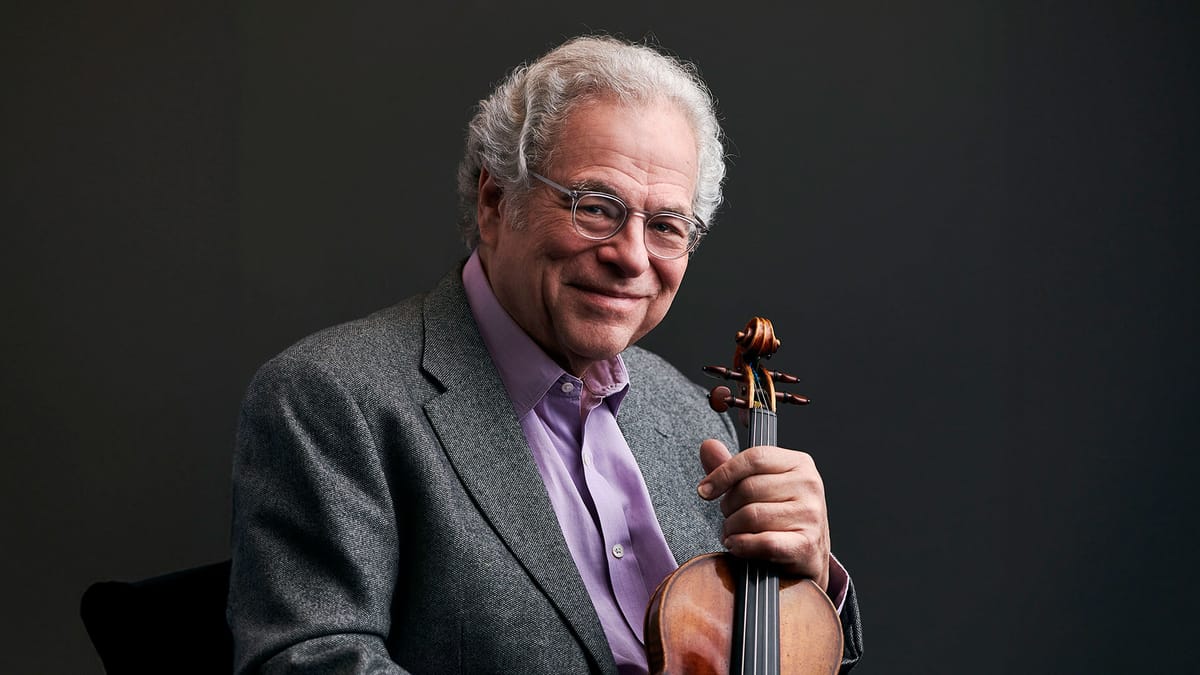
Itzhak Perlman conductor and violin
Johann Sebastian Bach
Violin Concerto No. 1 in A minor, BWV 1041 (ca. 1730)
[Allegro]
Andante
Allegro assai
Itzhak Perlman
Johannes Brahms
Academic Festival Overture, Opus 80 (1880)
Intermission
Antonín Dvořák
Symphony No. 8 in G major, Opus 88 (1889)
Allegro con brio
Adagio
Allegretto grazioso
Allegro ma non troppo
Program Notes
At a Glance
On the second half is Antonín Dvořák’s Symphony No. 8, probably his most popular and intriguing symphony besides the New World. Here Dvořák experiments with form, weaving together many short ideas, following his intuition more than using a traditional symphonic recipe.
Violin Concerto No. 1 in A minor, BWV 1041
Johann Sebastian Bach
Born: March 21, 1685, in Eisenach, Germany
Died: July 28, 1750, in Leipzig
Work Composed: ca. 1717–23 or 1730
Instrumentation: solo violin, string orchestra, and harpsichord
SF Symphony Performances: First—March 1932. Basil Cameron conducted with Paul Kochanski as soloist. Most recent—November 2019. Ton Koopman conducted with Alexander Barantschik as soloist.
Duration: About 15 minutes
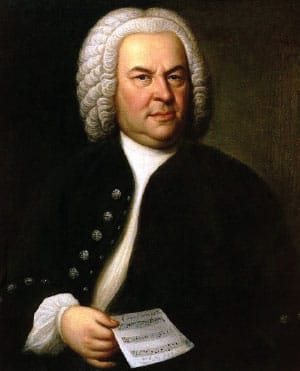
Johann Sebastian Bach was renowned as a keyboard virtuoso, but he was also a skilled violinist. His father, Johann Ambrosius Bach, had been a professional violinist in Erfurt and Eisenach, so our composer surely grew up surrounded by the sounds of the violin. It was as a violinist that Johann Sebastian obtained his first professional appointment, at Weimar in 1703, and when he died 47 years later he left in his estate a violin built by Stainer—probably the luthier Jacob Stainer whose instruments remain prized today. Bach’s son Carl Philipp Emanuel, responding to a biographical query in 1774, recalled of his father: “From his youth up to fairly old age he played the violin purely and with a penetrating tone and thus kept the orchestra in top form, much better than he could have from the harpsichord. He completely understood the possibilities of all stringed instruments.”
From 1717–23 he was in charge of secular music for the court of Cöthen, but the 13-member instrumental ensemble available to him there fell short of what we would consider a modern orchestra. In 1723 Bach moved to Leipzig, where his time was largely given over to composing and directing sacred music. But from 1729 through 1741 (with two year’s sabbatical) he also directed the city’s Collegium Musicum. It was a society of university students, interested amateurs, and a few professional musicians who met most Friday evenings to play music for their own pleasure, as well as for the delectation of members of the public who cared to drop by. Among similar organizations in Germany, the Leipzig group was renowned. Wrote Johann Heinrich Zedler, in his 1739 Grosses Universal Lexicon, “Such Collegia are to be found in various places. In Leipzig, the Bachian Collegium Musicum is more famous than all others.” Now Bach had an ongoing need for concerto repertoire, and he accordingly dipped into his own back catalogue of compositions when crafting “new” pieces for the Collegium to explore, sometimes refashioning them into versions that spotlighted the Collegium’s specific forces.
Scholars traditionally maintained that Bach’s solo violin concertos (in A minor, BWV 1041, and in E major, BWV 1042) were composed in Cöthen and revived for the Leipzig Collegium Musicum. The assumption is based on slender evidence at best, and some recent thought favors the possibility that they actually originated in Leipzig around 1730. There is no doubt that Bach’s keyboard arrangements of these three pieces date from his Leipzig Collegium Musicum years, when he turned the A-minor violin concerto into his G-minor harpsichord concerto, BWV 1058, and the E-major violin concerto into his D-major harpsichord concerto, BWV 1054. The work played in this concert continues to be heard to this day in both versions—as a concerto for violin and as a concerto for harpsichord. Both are accepted as authentic Bachian settings, but there is little question that, no matter when it was written, the violin version came first.
The A-minor violin concerto, densely concentrated and contrapuntally involved, betokens purposeful seriousness in its outer movements. The opening movement’s writing, with the soloist’s streams of 16th notes, is characteristic of an Allegro movement, although the surviving copyist’s manuscript lacks a tempo marking. It reflects a structure generally familiar from Vivaldi, in which an opening ritornello section returns as periodic punctuation; but in Bach, the returns are not literal and are knitted with the soloist’s music through overlaps and elisions. The same could be said of the third movement, a gigue in 9/8 meter. In the concerto’s central Andante, Bach provides a slow movement of greater relaxation, though not without a measure of tension, thanks to the dissonances that pile up over extended pedal-points: the eye of a hurricane, if you will—or if not a hurricane, at least a frisky wind-devil. In this work we find that Bach has absorbed the principles of the Italian concertos that wielded such a formative influence on late-Baroque music, but Bach’s brilliant interweaving of counterpoint is unmistakably his own.
Academic Festival Overture, Opus 80
Johannes Brahms
Born: May 7, 1833, in Hamburg
Died: April 3, 1897, in Vienna
Work Composed: 1880
Instrumentation: 2 flutes, piccolo, 2 oboes, 2 clarinets, 2 bassoons, contrabassoon, 4 horns, 3 trumpets, 3 trombones, tuba, timpani, percussion (triangle, cymbals, and bass drum), and strings
SF Symphony Performances: First—February 1918. Alfred Hertz conducted. Most recent—November 2010. Michael Tilson Thomas conducted.
Duration: About 10 minutes
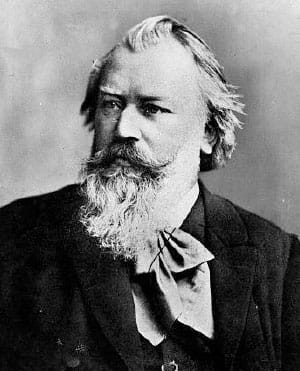
Johannes Brahms did much of his best work during his summer vacations, which he usually spent at some bucolic getaway in the Austrian countryside. His modus was to find a spot that agreed with him, spend a summer or two or three there, and then move on to another vacation locale, never “putting down roots” in his summer residences as he did in his adopted city of Vienna. He spent the summer of 1880 in Bad Ischl, the gateway to the Salzkammergut, a favorite getaway for aristocrats (including Emperor Franz Josef), celebrities, and people who wanted to be in their orbit. The weather was unusually cold and rainy during his months there, and when he came down with an ear infection he dashed back to Vienna, terrified that he might be going deaf like Beethoven before him. After his surgeon-friend Theodor Billroth took him to an ear specialist, Brahms promptly recovered and returned to Bad Ischl. Still, amid all the distractions he did manage to compose his two orchestral overtures, the Academic Festival Overture and the Tragic Overture—the first as jolly as the second is severe.
The Academic Festival Overture came first. One of Brahms’s old friends, a conductor and composer named Bernhard Scholz, lived in Breslau and had arranged for the University of Breslau to bestow an honorary doctorate on Brahms at a ceremony that took place on March 11, 1879. The diploma Brahms received declared him to be Artis musicae severioris in Germani nunc principi (“the most famous living German composer of serious music”). Few honors are really free, and in this case Scholz made it clear that the university would expect a new composition in acknowledgement. “Compose a fine symphony for us!” he wrote to Brahms. “But well orchestrated, old boy, not too uniformly thick!” A symphony was too much to hope for, but Brahms did at least come up with a piece that was not excessively intellectual or ponderous. Nor was it unusually thick in its orchestration, although he did make telling use of deep-voiced instruments such as violas, bassoons, and—in the orchestra’s lowest reaches—contrabassoon, bass trombone, and tuba.
Brahms never went to college himself, but back in 1853 he had spent plenty of time hanging around the University of Göttingen with his friend Joseph Joachim (who attended lectures there) and therefore had a good idea about what might enchant the scholars in Breslau. The resulting work is one of Brahms’s most delightful inspirations, one that incorporates no fewer than four student songs popular at the time, cleverly draped in robes bespeaking musical knowledge. Brahms described it as “a pretty medley of songs à la Suppé.” Possibly he was recalling that in 1863 the overture to Franz von Suppé’s operetta Flotte Bursche had employed the tune “Gaudeamus igitur,” which also caps off the Academic Festival Overture in the style of a grand chorale. The other student songs we hear are “Wir hatten gebauet ein staatliches Haus,” which trumpets and horns sing out, dolce, in the introduction (Allegro); “Hört ich sing” (aka the “Landesvater”) as the second theme in the main section (L’istesso tempo, un poco maestoso); and “Was kommt dort von der Höh” (aka the “Fuchslied”), announced by bassoons (animato). Song quotations notwithstanding, this is no idle potpourri; after a serious introduction (rather akin to the celebrated Rákóczi March), Brahms fashions his material into an evolved sort of sonata form—a marvelous melding of the popular and the academic.
Symphony No. 8 in G major, Opus 88
Antonín Dvořák
Born: September 8, 1841, in Nelahozeves, Bohemia
Died: May 1, 1904, in Prague
Work Composed: 1889
Instrumentation: 2 flutes (2nd doubling piccolo), 2 oboes (2nd doubling English horn), 2 clarinets, 2 bassoons, 4 horns, 2 trumpets, 3 trombones, tuba, timpani, and strings
SF Symphony Performances: First—October 1930. Basil Cameron conducted Most recent—February 2023. Herbert Blomstedt conducted.
Duration: About 35 minutes
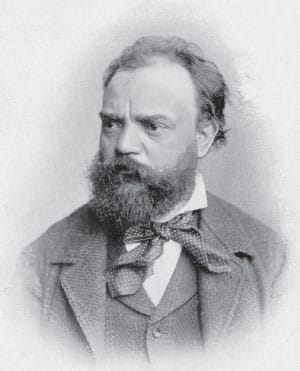
Antonín Dvořák’s publisher, Fritz Simrock, paid 3,000 marks for his Symphony No. 7 in 1885. When the composer finished his Eighth Symphony, which occupied him for about two and a half months during the late summer and fall of 1889, the firm offered him only 1,000 marks. The fact is that large-scale works like symphonies were expensive to publish and hard to market, and Simrock was understandably more interested in acquiring smaller-scale pieces, like piano collection or songs. Nonetheless, Dvořák considered the offer a huge insult. He was so provoked that he had the piece published instead by the London firm of Novello—a flagrant breach of his contract with Simrock, though eventually they reconciled. The circumstances of the publication gave rise to the fact that dusty volumes occasionally refer to this symphony as the “English,” a bizarrely inappropriate nickname for a work so audibly drenched in what, thanks in large part to Dvořák, we hear as inviolably Czech.
Compared to the somber Seventh Symphony, the Eighth is genial and upbeat. And yet, if we listen carefully, we may be surprised by how much minor-key music actually inhabits this major-key symphony, beginning with the richly scored, rather mournful introduction in G minor, which the composer added as an afterthought. But even here, joyful premonitions intrude, thanks to the bird-call of the solo flute. This develops into the ebullient principal theme of the movement; and yet, the mournful music of the introduction keeps returning as the movement progresses. This tempering of the bucolic spirit was a deliberate and hard-won device. When Dvořák initially sketched the movement it was unerringly cheerful. The minor-key introduction arrived as an afterthought, as did the more difficult trick of working reminiscences of it into the existing flow of the piece. In the end, this opening movement provides a splendid example of how the sun seems to shine more brightly after it has been darkened by passing shadows.
Similar contrasts mark the Adagio, which even in its opening measures displays considerable ambiguity of mood: lusciously warm-hearted string sequences leading to intimations of a somber march (still in the strings) and then perhaps indifferent bird-calls in the flutes. The folk-flavored third movement—a waltz, perhaps, though recalling the spirit of a Brahmsian intermezzo—is a bit melancholy, too, its wistfulness underscored by the minor mode (again the G-minor flavor that opened the symphony). This serves as the traditional scherzo section of a symphony, with its central trio section shifting to G major to present some of the most agreeably countrified material Dvořák ever penned.
Following an opening fanfare, the dance-like finale unrolls as a delightful set of variations (though interrupted by a minor-mode episode) on a broad, dignified theme. In his informed and approachable 1984 biography Dvořák, the German musicologist Hans-Hubert Schönzeler offers some precise insights to the finale in his discussion of the Symphony No. 8, which he considers overall “the most intimate and original” of Dvořák’s nine: “[the] last movement just blossoms out, and I shall never forget [the Czech conductor] Rafael Kubelík in a rehearsal when it came to the opening trumpet fanfare, say to the orchestra: ‘Gentlemen, in Bohemia the trumpets never call to battle—they always call to the dance!’”
—James M. Keller
Learn more about Brahms and Dvořák in the March feature article.
About the Artist
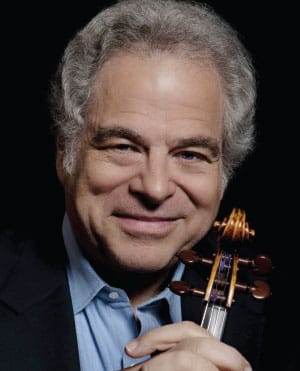
Itzhak Perlman
Undeniably the reigning virtuoso of the violin, Itzhak Perlman enjoys superstar status rarely afforded a classical musician. Beloved for his charm and humanity as well as his talent, he is treasured by audiences throughout the world who respond not only to his remarkable artistry but also to his irrepressible joy for making music.
Having performed with every major orchestra and at concert halls around the globe, Perlman was granted a Presidential Medal of Freedom—the nation’s highest civilian honor—by President Obama in 2015, a National Medal of Arts by President Clinton in 2000, and a Medal of Liberty by President Reagan in 1986. Perlman has been honored with 16 Grammy Awards, four Emmy Awards, a Kennedy Center Honor, a Grammy Lifetime Achievement Award, and a Genesis Prize. He made his San Francisco Symphony debut in February 1969 at the War Memorial Opera House and made his Davies Symphony Hall debut in 1982.
In the 2025–26 season, Perlman celebrates his 80th birthday season with a variety of programs. He brings his iconic PBS special In the Fiddler’s House program to New York, Boston, Philadelphia, Dallas, Santa Barbara, and Davis in celebration of the program’s 30th anniversary, alongside today’s klezmer stars. His orchestral engagements include Cinema Serenade programs with the Cleveland Orchestra, Louisville Orchestra, and Colorado Springs Philharmonic. He also makes a special appearance with the Colorado Symphony at Carnegie Hall. He continues touring An Evening with Itzhak Perlman, which captures highlights of his career through narrative and multimedia elements intertwined with performance, and plays recitals across the United States with longtime collaborator Rohan De Silva.
For more than 30 years, Perlman has been devoted to music education, mentoring gifted young string players alongside his wife, Toby, in the Perlman Music Program. He has taught at the program each summer since its founding in 1994. With close to 800 alumni, PMP is shaping the future landscape of classical music worldwide. Perlman holds the Dorothy Richard Starling Foundation Chair at the Juilliard School and has an exclusive series of classes with Masterclass.com as the company’s first classical-music presenter.