In This Program
The Concert
Wednesday, January 21, 2026, at 7:30pm
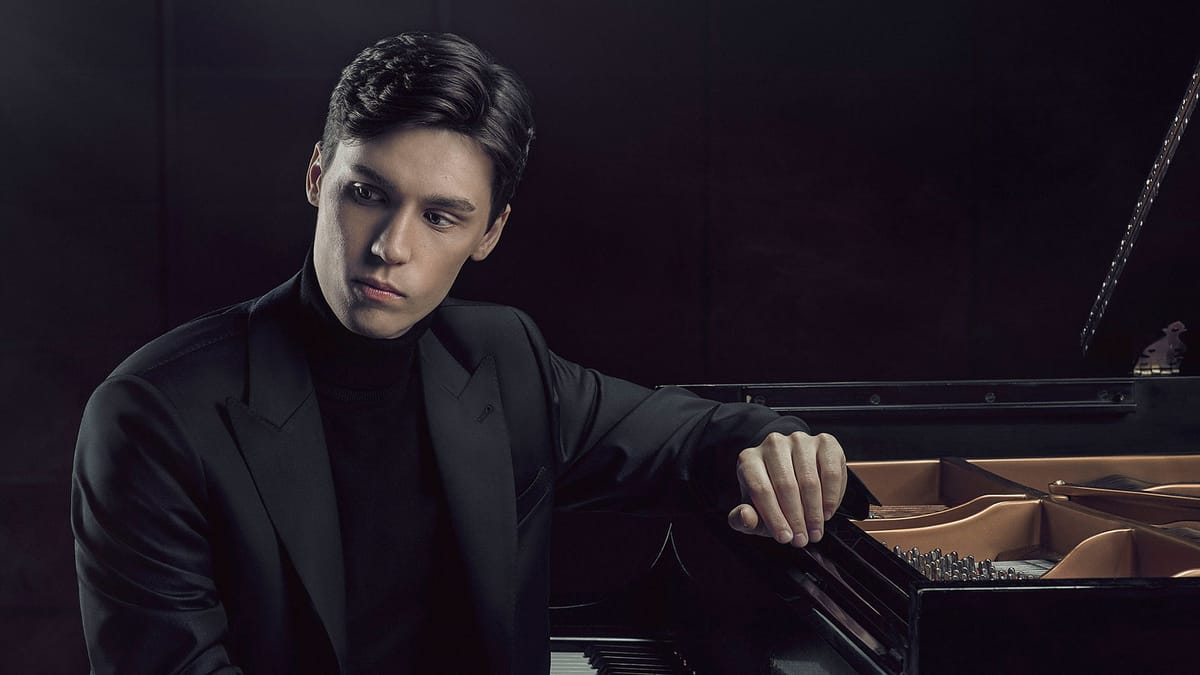
Jaeden Izik-Dzurko piano
Alexander Scriabin
Fantasy in B minor, Opus 28 (1900)
César Franck
Prelude, Chorale, and Fugue (1884)
Sergei Rachmaninoff
Ten Preludes, Opus 23 (1903)
No.1 in F-sharp minor
No.2 in B-flat major
No.3 in D minor
No.4 in D major
No.5 in G minor
No.6 in E-flat major
No.7 in C minor
No.8 in A-flat major
No.9 in E-flat minor
No.10 in G-flat major
This concert is performed without intermission.
Program Notes
Fantasy in B minor, Opus 28
Alexander Scriabin
Born: January 6, 1872, in Moscow
Died: April 27, 1915, in Moscow
Work Composed: 1900
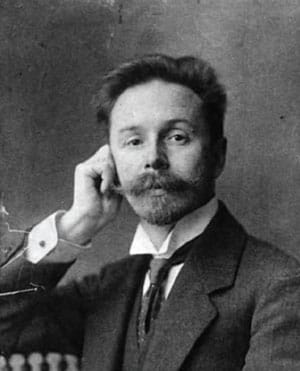
We all know the shopworn story about an innovative composer who slaves away in a garret, unappreciated, unknown, and unpaid. Then he dies. Posthumous recognition arises swiftly. Everybody who dissed or ignored him is sorry. Or embarrassed. Or both.
Alexander Scriabin, never one to tread the well-followed path, did it in reverse. During his lifetime he was something of a star. Biographies resembled hagiographies: “Scriabin’s work brought about an artistic revolution unequaled in the whole history of the arts,” proclaims one. “Scriabin’s output, having emerged from the condition of being the most discussed, is now the most performed music of the day,” states another.
Then he died, from blood poisoning, in 1915. Within 15 years, Dmitri Shostakovich had declared war on “our bitterest musical enemy,” while British composer Constant Lambert condemned Scriabin’s “opulent vulgarity.” By mid-century, the distinguished Russian composer Nicolas Nabokov had washed his hands of his once-famed predecessor: “Scriabin’s eroticism was good only for high-strung adolescents.”
But that all passed. Scriabin re-entered the mainstream repertory, finally understood as a rational artist in sync with his own place and time. Unique he most definitely was, uninhibited both musically and personally, grandiloquent and messianic and hedonistic. But he was neither lunatic nor vulgarian. His mind was global, protean, and shaped by the Silver Age of Russian thought to which he belonged, his musical language and philosophies evolving gradually and by logical steps. Scriabin was the unquestioned master of his own artistry, from his earliest Chopinesque piano pieces to his planned but never realized fusion of all things, Mysterium.
Scriabin wrote during a period of heightened pianism, of über-virtuoso composer-pianists who reveled in challenging the limits of two hands on one instrument. We shouldn’t be surprised, therefore, to find technical challenges in the Fantasy in B minor that border on the impossible.
But the piece itself is quite traditional, despite its heightened emotions and supercharged piano writing. Cast in a straightforward sonata form, it places an angular primary theme—typically stated in octaves in both hands—against a meltingly beautiful secondary theme in the relative major key, followed by a proper closing theme derived from the primary. A goodly development section leads to a stormy recapitulation and an extended coda that reserves the most blazing fireworks for the very end.
It has been reported that Scriabin may have actually forgotten about the very existence of the Fantasy. That might be sensationalist hyperbole on the part of an early biographer. Nevertheless, there is no evidence of Scriabin having ever played the piece in public.
Prelude, Chorale, and Fugue
César Franck
Born: December 10, 1822, in Liège
Died: November 8, 1890, in Paris
Work Composed: 1884
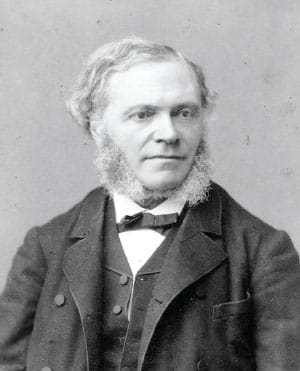
It was only in later life that César Franck cast off his habitual underdog persona. A respectably bourgeois organist and church musician, it had been his karma to be slung about by domineering family members, first an overbearing father, then a softly-persistent wife who required her pliant husband to sustain his churchy stuffiness and bring home a steady income. To that end he wrote solidly crafted but distressingly lifeless liturgical pieces that made excellent use of his spectacular organ technique but were otherwise baldly utilitarian.
Elevation to a professorship at the Paris Conservatory changed all that. Franck acquired a circle of brilliant, daring, and forward-thinking students, including such future stars as Vincent d’Indy, Ernest Chausson, and Henri Duparc. They lit him up, and he responded with a lavish banquet of rapturous, highly-colored and splendidly structured works, including a symphony, a violin sonata, several orchestral tone poems, and a piano quartet, all bedrock repertory. They are Franck’s legacy, and we are all the richer for them.
The Prelude, Chorale, and Fugue is one of the earlier products of Franck’s efflorescence. Unified around two ideas—a two-note falling appoggiatura figure and a sturdy progression in descending fourths, both inspired by materials in Bach’s works—this landmark of the late-Romantic French piano repertory seasons technical rectitude with pianistic and harmonic opulence. An opening Prelude channels Bach’s Well-Tempered Clavier while also paying clear homage to his irreplaceable organ works, while the Chorale creates a luminous sonic aura more reminiscent of a mighty pipe organ in a resonant cathedral than a mere piano on a recital stage. The concluding Fugue is built from the falling two-note figure, sometimes inverted to its rising counterpart, ultimately combined with the chorale melody in a brilliant apotheosis, the whole concluding with a radiant sunburst of major chords.
Ten Preludes, Opus 23
Sergei Rachmaninoff
Born: April 1, 1873, in Semyonovo, Staraya Russa, Russia
Died: March 28, 1943, in Beverly Hills, California
Work Composed: 1901–03
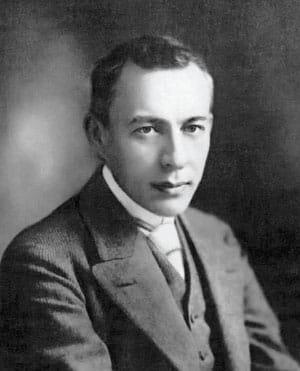
History imposes a sharp limitation when it comes to many of our greatest pianists. Because most of them died before the advent of recording, we have only circumstantial evidence of their achievements. Mozart, Beethoven, Chopin, Liszt, and Anton Rubinstein have all receded into the silence of the past, known only via the reminiscences of those who heard them play live, their memories understandably (if regrettably) clouded by time and distance. Furthermore, biases and agendas foul the mix and leave it to later generations to sort through, and hopefully make sense of, a mass of sometimes conflicting reports.
But no such limitation exists regarding composer-pianist-conductor Sergei Rachmaninoff, who bequeathed his patrician art to us via numerous recordings from the 1920s onwards. Although he didn’t particularly like recording, he understood its necessity and enjoyed the profits reaped from his best-selling discs until the Great Depression put an end to all that largesse. A fussbudget in the recording studio, Rachmaninoff insisted on multiple takes until he got what he wanted, then demanded the destruction of those shellac matrices that hadn’t passed muster. (In those days all you had to do was throw the brittle things against the wall, and that was that).
Rachmaninoff’s extensive discography gives us a rare insight into his own works, even in his recordings of other composers’ works, such as Schumann’s Carnaval or Chopin’s Piano Sonata No. 2. If there is one adjective that can be applied to his playing equally across the board, it must be that overused but descriptive word “elegant.” That might come as a surprise to those who associate Rachmaninoff with an imposing angular presence, a perpetual scowl, baseball-mitt hands, and forbiddingly difficult keyboard writing that seems to oblige pianists to channel their inner linebacker. But Rachmaninoff himself was not that kind of pianist: his textures were clear, his passagework was immaculate, his tone was invariably gorgeous, and his interpretations were intelligent and imaginative. To hear Rachmaninoff sing out the Chopin E-flat major Nocturne with the ease and freedom of a master singer, always guided by the notation but never enslaved by it, is to hear piano playing of such expressive nobility as to transcend all criticism. And to hear him play his own piano works, such as those eight of his Preludes that he committed to disc, can be revelatory.
About those Preludes: there are 24 in all divided into two sets, both dating from the first decade of the 20th century, covering all the major and minor keys à la Chopin. The ubiquitous C-sharp–minor Prelude—which Rachmaninoff grew to despise—is the sole outlier, dating from 1892. While Chopin’s Preludes are variably sized, some substantial and some distilled down to a half page or less, Rachmaninoff’s are all full-length pieces, usually in the three-part form common to Romantic compositions such as Chopin’s Nocturnes or Brahms’s Intermezzos. Many require stratospheric keyboard technique to render successfully; all require penetrating musicianship.
No.1 in F-sharp minor: Russian melancholy pervades throughout, with a long-lined melody passed between the piano’s middle and upper ranges accompanied with undulating figurations in the left hand. After a gradual rise to a climax, the prelude subsides then ends in seven somber statements of an F-sharp minor chord.
No.2 in B-flat major: Not for the pianistic faint of heart. Glittering and propulsive left-hand arpeggios sweep the keyboard while the right-hand carves out scintillating cascades of octaves and chords, the whole culminating in a spectacular spray of octaves in both hands.
No.3 in D minor: Tempo di minuetto, it says, but what a delectably sinister minuet it is, left-hand staccato figurations hinting at furtive skullduggery, short-lived lyrical passages soon giving way to intrigue and more than a whiff of danger. Not surprisingly, it ends in an elusive whisper.
No.4 in D major: Rachmaninoff, spinner of incomparably beautiful melodies, conjures up keyboard bewitchery in the warm key of D major. Unlike many a lyrical piano piece before and after, this prelude tucks the melody into the midst of the accompaniment, thereby creating a “three-hand” effect also employed successfully by Mendelssohn, Liszt, and Scriabin.
No.5 in G minor: This might well be the most familiar of the Opus 23 Preludes, its rat-a-tat martial rhythms flanking a soaring middle section that floats two melodies over a surging accompaniment. Nota bene: Rachmaninoff left us two recordings of this Prelude; both are crisp, authoritative, and unsentimental, neither hinting at the slightest pianistic difficulty.
No.6 in E-flat major: This exquisite Andante echoes certain of Chopin’s preludes with its wandering, quasi-melodic left-hand accompaniment underpinning an aria-like melody. Its structure is serenely Classical, in which four-bar phrases ending in clearly-delineated cadences are balanced by longer and less tidy transitional passages, its melodic lines all derived from a simple rising three-note figure.
No.7 in C minor: Impressionistic washes make up an interesting, if not often acknowledged, part of Rachmaninoff’s stylistic vocabulary. A nonstop whir of 16th notes is punctuated by melodic fragments, the whole darkly mesmerizing and surprisingly understated, despite all the passion surging just beneath the surface.
No.8 in A-flat major: Pianists are inclined to refer to a piece as particularly “pianistic,” a description that might not make much sense to those outside the discipline, but that speaks volumes to other pianists. That’s indubitably the case with this richly colored abstract in which one can feel Rachmaninoff’s hands, almost from the inside-out as it were, as they roam over the keyboard with that ineffable grace of his.
No.9 in E-flat minor: There’s something distinctly etude-like about this quicksilver prelude, which channels Chopin’s insanely demanding etude in sixths in the course of conjuring up a distinctly Gothic atmosphere, dark and stormy, its underlying sense of menace palpable, chilling, and fabulous.
No.10 in G-flat major: Rachmaninoff could have ended Opus 23 with a gut-buster, but instead chose to close with this contemplative and intimate morceau, serving as a heartfelt soliloquy to conclude this towering landmark of late Romantic piano literature.
—Scott Foglesong
About the Artists

Jaeden Izik-Dzurko
Jaeden Izik-Dzurko is the 2024 Gold Medal winner of the Leeds International Piano Competition and a current recipient of the Borletti-Buitoni Trust Fellowship. The same year he took gold in Leeds, he made history as the first Canadian to receive the Grand Prize at the Concours Musical International de Montréal.
This season, Izik-Dzurko debuts at London’s Wigmore Hall, the Leipzig Gewandhaus (Mendelssohn-Saal), and Hamburg’s Elbphilharmonie. He also makes solo debuts with both the Montreal Symphony and the National Symphony Orchestra of Ireland, and returns to the Edmonton Symphony and National Arts Centre Orchestra. He makes his debut at the San Francisco Symphony with this recital.
Izik-Dzurko has performed solo recitals at Carnegie Hall’s Weill Recital Hall, Salle Cortot in Paris, and the Auditorio Nacional de Música in Madrid. Other notable engagements include performances with the Vancouver Recital Society, Münchner Künstlerhaus, and Sociedad Filarmónica de Bilbao. His orchestral highlights include appearances with the Bilbao Orchestra and RTVE Symphony. He has earned top prizes at the Hilton Head, Maria Canals, and Paloma O’Shea Santander international piano competitions.
Born in British Columbia with Hungarian-Ukrainian heritage, Izik-Dzurko studied with Corey Hamm at the University of British Columbia before studying at the Juilliard School. He currently trains with Jacob Leuschner at the Hochschule für Musik Detmold and Benedetto Lupo at the Accademia Nazionale di Santa Cecilia.
From the Pianist
This program features three piano works written in the late Romantic era. Scriabin’s Fantasy is a grandiose single-movement piece from quite early in his life. The music alternates between exalted and rhapsodic climaxes, and moments of incredible intimacy and tenderness. In my opinion, the work contains one of his most exquisite melodies.
Franck’s Prelude, Chorale, and Fugue possesses a more reserved emotional character, maintaining a reverential, almost austere tone and a rigorous musical structure that takes inspiration from the Baroque era. The work’s memorable climax features an ingenious combination of themes from the three titular musical sections.
Finally, Rachmaninoff’s Preludes are a series of ten vignettes that together take the listener on a varied and eventful musical journey. Alongside more extroverted preludes like Nos. 2, 5, and 7, Rachmaninoff includes some of his most intimate and personal creations like Nos. 4, 6, and 10. The Preludes are a moving illustration of his versatile musical style, as well as his prodigious skill as a pianist and a composer for the keyboard.
—Jaeden Izik-Dzurko