In This Program
The Concert
Sunday, March 1, 2026, at 7:30pm
Academy of St Martin in the Fields
Joshua Bell music director and violin
Charles Ives
(arr. Iain Farrington)
Variations on “America” (1892)
Johannes Brahms
Violin Concerto in D major, Opus 77 (1878)
Allegro non troppo
Adagio
Allegro giocoso, ma non troppo vivace
Cadenzas by Joshua Bell
Joshua Bell
Intermission
Robert Schumann
Symphony No. 1 in B-flat major, Opus 38, Spring (1841)
Andante un poco maestoso–Allegro molto vivace
Larghetto
Scherzo: Molto vivace
Allegro animato e grazioso
The Music for Families Series is supported by

Program Notes
Variations on “America”
Charles Ives
(arr. Iain Farrington)
Born: October 20, 1874, in Danbury, Connecticut
Died: May 19, 1954, in New York
Work Composed: 1891–92
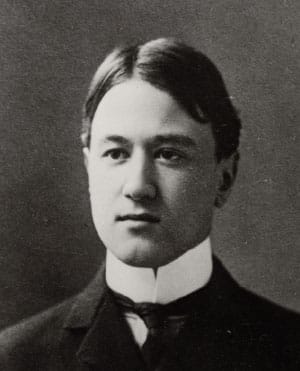
Born and reared in rural Connecticut, Charles Ives was the son of George Ives, an eccentric Union Army bandleader who liked to send a pair of marching bands to opposite ends of the village square so that he could listen to them playing different songs in different keys as they marched to and fro. George began giving Charles music lessons at age five, passing on not only his technical expertise but also his democratic values, his belief that music belongs to everyone, including the self-trained amateurs. Until his late teens, when Ives left his native Danbury—first to attend a year of prep school in New Haven, then to Yale for his undergraduate degree—his father was his primary influence.
Ives was only 17 years old when he wrote his Variations on “America.” For the previous three years, he had been serving as the main organist at a Methodist church in nearby Brewster, New York, which is where he debuted the work, in 1892, as part of an Independence Day celebration. His open-minded father, the acoustical experimenter, was taken aback by the brashness of the composition, its full-throated commitment to dissonance. At one point, he even told his son to stop playing the variations in church because they “upset the elderly ladies and make the little boys laugh and get noisy!” Ives continued to tinker with the variations as he performed them in area churches, sometimes heeding his father’s counsel but mostly improvising to amuse himself. Although he later called the effort “but a boy’s work, partly serious and partly in fun,” this statement comes from a composer who always prioritized fun. He described the experience of performing the athletic pedal part in the final variation as “almost as much fun as playing baseball.”
The organ work has been arranged for orchestra several times, including this version for the Academy of St Martin in the Fields by Iain Farrington.
Violin Concerto in D major, Opus 77
Johannes Brahms
Born: May 7, 1833, in Hamburg
Died: April 3, 1897, in Vienna
Work Composed: 1878
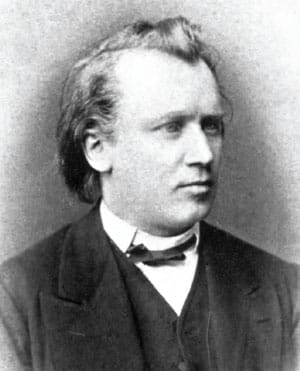
For most of his life and about a half-century after his death, Johannes Brahms was considered a superb craftsman but something of a fusty relic. Now that we don’t adhere to the strict binaries that polarized music fans during the so-called War of the Romantics—a mostly bloodless, decades-long ideological battle that required concertgoers to declare their loyalty to either radical Team Wagner or conservative Team Brahms—we can see Brahms in all of his complexity.
Brahms was at once an antiquarian and an experimentalist, a conservative classicist and a singular Romantic. One of his more surprising champions, the composer Arnold Schoenberg, delivered a lecture in 1933, 100 years after Brahms’s birth, titled “Brahms the Progressive.” In this appreciation, which Schoenberg revised and expanded in 1947, the cutting-edge serialist reclaims “Brahms, the classicist, the academician,” calling him “a great innovator in the realm of musical language.”
Brahms was a brilliant pianist, but unlike Beethoven, Mendels-sohn, and Mozart, he couldn’t play the violin. Fortunately, he was close friends with Joseph Joachim, the Hungarian-born violinist, composer, and conductor who ranks among the most influential musicians of the 19th century. Although Joachim was only two years older than Brahms, he was already an established performer when he befriended the young Hamburg native in 1853. A child prodigy, Joachim was mentored by Felix Mendelssohn; it was his 1844 performance of Beethoven’s violin concerto, under Mendelssohn’s baton, that cemented the work as a staple of the repertoire. Through Joachim, Brahms met Robert and Clara Schumann, who promoted him tirelessly.
In summer 1878, when Brahms began working on his violin concerto, he was 45 years old, with two formidable symphonies and one piano concerto under his belt. Despite his lack of proficiency on violin, he wasn’t especially anxious about the project. His models were the same two violin concertos that inspired and intimidated most of his serious contemporaries: Beethoven’s urgently expressive contribution to the genre, championed by both Joachim and Felix Mendelssohn, and Mendelssohn’s lustrously lyrical one. Joachim, whose own Hungarian Concerto remained popular, was generous with his time and talent. For the rest of that year, the two men composed by correspondence, with Joachim offering technical advice, rewriting tricky passages, and even composing the only cadenza, in the first movement (Bell performs his own cadenza for this performance).
Brahms was a relentless perfectionist and he irritated Joachim by soliciting feedback only to ignore it. More annoying still, Brahms announced that he was deleting the two middle movements, which Joachim had been diligently practicing for weeks. “I’m writing a wretched adagio instead,” the composer explained with his usual irony.
He finished the concerto by the deadline, but just barely. The four-movement work that he and Joachim had originally envisioned now comprised a more conventional three movements, but it was far from conventional in most other respects. His loyal ally Joachim pronounced it a masterpiece, but few of their peers seemed to agree. Most people were put off by its daring, destabilizing rhythms and its oddly egalitarian orchestration. The wider public was simply not ready for a symphonic concerto in which the soloist and orchestra are equal partners, not star and supporting players, or rivals.
The 1879 premiere was disappointing. The Leipzig audience was politely underwhelmed. In fact, for decades after the composer’s death, the violin concerto was widely dismissed as a failed experiment: dry, severe, pointlessly difficult. The conductor Josef Hellmesberger famously dubbed it “a concerto not for, but against, the violin.” Brahms was so dismayed by its reception that he destroyed his second violin concerto before allowing anyone to hear it, and he never composed another.
The Music
The opening Allegro non troppo builds slowly to its lyrical climax, with numerous Romani-style excursions in honor of its dedicatee’s Hungarian roots, where such folk music was common. This unusually long movement begins in its home key—pretty, pastoral D major—but the solo violin, accompanied by timpani in an obvious nod to Beethoven, enters in a deliberately jarring D minor.
The central Adagio, with its blissful oboe melody suspended over gossamer wind harmonies, is dreamy, delicate, and anything but “wretched.” The oboe tune elicits the solo violin’s variation, and the new idea inspires a stormy middle section (in minor) before circling back to serenity.
Brahms marked the finale “Allegro giocoso, ma non troppo vivace,” (jocularly cheerful, but not too lively). This lusty quasi-rondo is a technical terror, peppered with tricky double-stops, harrowing rhythmic tension, and Hungarian fireworks. Even Joachim had to perform it several times before he felt comfortable with the breakneck passagework. “One enjoys getting hot fingers playing it,” he later declared, “because it’s worth it.”
Symphony No. 1 in B-flat major, Opus 38, Spring
Robert Schumann
Born: June 8, 1810, in Zwickau, Saxony
Died: July 29, 1856, Endenich, near Bonn
Work Composed: 1841
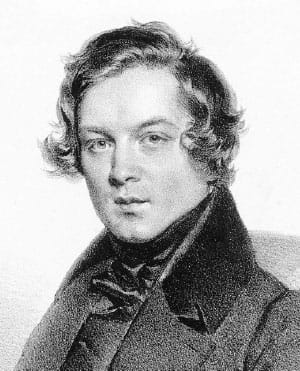
Despite the title he assigned to his first symphony, Spring, Robert Schumann wrote his Symphony No. 1 in B-flat major in the dead of winter. It was a creative, prolific, and wildly happy period for the 30-year-old composer, calendar be damned. On September 12, 1840, the day before her 21st birthday, he had married his longtime love, the famed pianist Clara Wieck, after the couple successfully sued her father—Schumann’s former piano teacher and landlord—who vehemently opposed the union. The year of their marriage, during his “year of song” or Liederjahr, he wrote well over 100 songs, including his Dichterliebe and Liederkreis cycles, which rank among the greatest achievements of German Romanticism.
Urged on by his bride, Schumann turned his attention to orchestral works in 1841. Up to that point, he had written only part of a symphony, two movements that he found unsatisfactory and scrapped before finishing. Despite being relatively inexperienced as a symphonist, he completed the Spring Symphony in a flurry of productivity. He sketched out the music in a mind-boggling four days, from January 23–26, and finished the orchestration by February 20. The symphony debuted in Leipzig, where the couple had recently set up house, on March 31, with Felix Mendelssohn conducting. The premiere went even better than Schumann had hoped. As he crowed somewhat hyperbolically in his diary, “It was received with such enthusiasm as I don’t think has been accorded any symphony since Beethoven.” Even so, he revised the symphony several times before he finally allowed it to be published, more than a decade after the first performance.
In a letter to his friend and fellow composer Louis Spohr, Schumann explained, “I wrote the symphony in that rush of spring which carries a man away even in his old age, and comes over him anew every year.”
It was not so much spring that inspired him, however, but the anticipation of spring. About a year later, he advised the conductor Wilhelm Taubert on the symphony’s ideal interpretation: “If only you could breathe into your orchestra, when it plays, that longing for spring! It was my main source of inspiration when I wrote the work in February 1841. I should like the very first trumpet call to sound as though proceeding from on high and like a summons to awaken. In the following section of the introduction, let me say, it might be possible to feel the world turning green.”
The Music
In addition to the symphony’s title, Schumann originally assigned titles to each of the four movements: “The Beginning of Spring,” “Evening,” “Merry Playmates,” and “Spring in Full Bloom” (or “Farewell to Spring,” depending on the source). Although he deleted these titles before publication, perhaps believing them to be needlessly prescriptive, they aptly summarize the mood of each section.
The symphony opens with a fanfare, which forms the kernel of the first theme, initially sung by trumpets and horns. The motif, essentially a sped-up version of the fanfare, recurs throughout the movement in various forms. Its rhythm syncs up precisely to the final line of “Frühlingsgedicht” (Spring Poem) by Adolf Böttger: “Im Tale blüht der Frühling auf” (For spring is blooming in the vale). After a leisurely introduction, the anticipation builds as the majestic Andante morphs into the spirited Allegro. The movement is in standard sonata form (exposition, development, recapitulation), but the coda is somewhat unusual, consisting of an entirely new motif.
The gorgeous minor-key Larghetto is the only movement that Schumann left nearly untouched during his long revision process. It gracefully shifts from the home key to E-flat major and ends with a soft, dark, and weirdly chromatic coda, carried by the trombones and bassoons; this melody foreshadows the theme of the subsequent Scherzo in G minor, which comprises a pair of boisterous, off-kilter trios, the first in duple meter.
The exuberant finale returns to B-flat major with a dramatic brass fanfare leavened by skipping strings. A gentle passage scored for solo oboe, flute, and horns leads to the recapitulation. Although it is difficult to imagine a more euphoric conclusion to the symphony, Schumann urged Taubert not to overlook its underlying seriousness: “I want to tell you that I would like to describe a farewell to spring, and therefore do not want it to be taken too frivolously.”
—René Spencer Saller
About the Artists
Joshua Bell
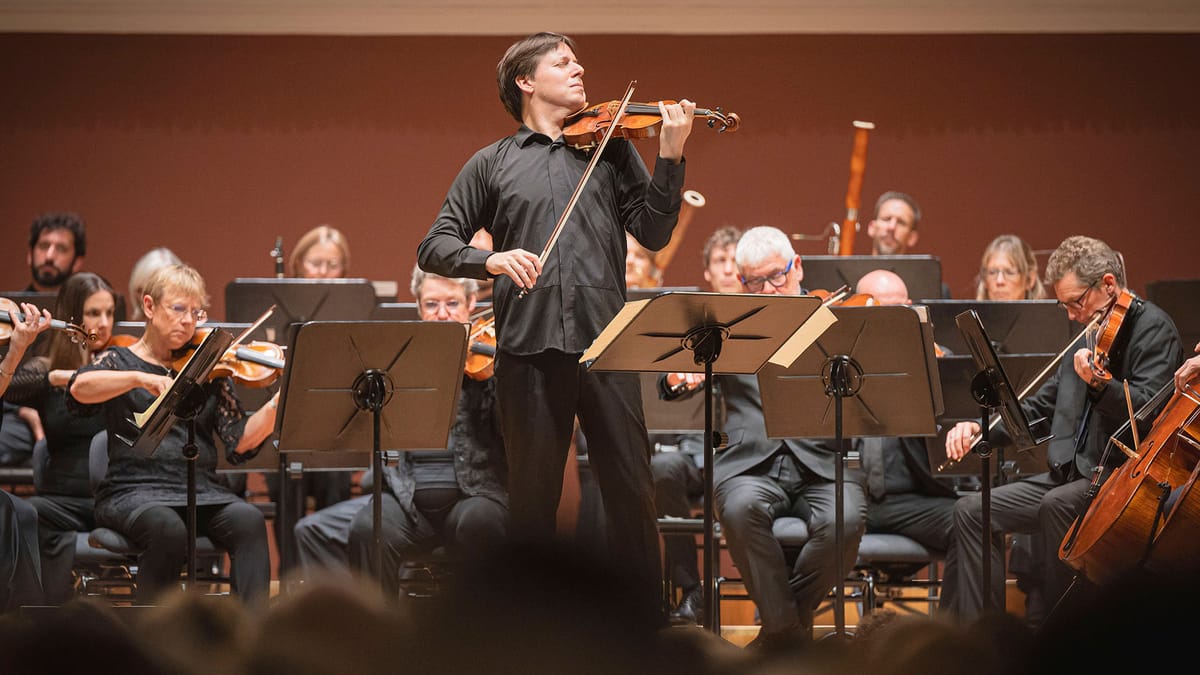
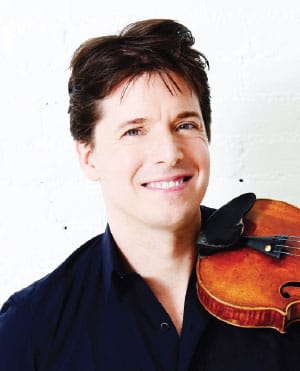
With a career spanning almost four decades, Grammy Award–winning violinist Joshua Bell has performed with virtually every major orchestra in the world, and regularly appears as a soloist, recitalist, chamber musician, conductor, and as music director of London’s Academy of St Martin in the Fields. In 2025, he was awarded an honorary commander of the Most Excellent Order of the British Empire. He made his San Francisco Symphony debut in 1991 as a Shenson Young Artist.
This season, following his world-premiere recording of Thomas de Hartmann’s violin concerto, Bell performs the work at the BBC Proms, New York Philharmonic, and during his season- long tenure as a Toronto Symphony Spotlight Artist. He also leads extensive US and European tours with the Academy of St Martin in the Fields; makes his first appearances as the New Jersey Symphony’s inaugural principal guest conductor; tours Asia with the NDR Elbphilharmonie Orchestra; and joins Steven Isserlis and Evgeny Kissin for trio programs in New York, Paris, Vienna, and Prague.
Bell has been nominated for six Grammy Awards, named “Instrumentalist of the Year” by Musical America, selected as a “Young Global Leader” by the World Economic Forum, recognized with the Avery Fisher Prize, and honored as an “Indiana Living Legend.” His many collaborators include Emanuel Ax, Chris Botti, Chick Corea, Renée Fleming, Josh Groban, Lang Lang, Dave Matthews, Anoushka Shankar, Regina Spektor, Sting, and Daniil Trifonov. Bell has performed for three American presidents and the justices of the Supreme Court of the United States. After participating in Barack Obama’s Committee on the Arts and Humanities’ first cultural mission to Cuba, he headlined the subsequent Emmy-nominated PBS Live from Lincoln Center special. Bell performs on the 1713 Huberman Stradivarius violin.
Joshua Bell appears by arrangement with Park Avenue Artists and the Academy of St Martin in the Fields. He records exclusively for Sony Classical—a Masterworks label. The position of the music director of the Academy of St Martin in the Fields is generously supported by the Berry Charitable Foundation.
Academy of St Martin in the Fields
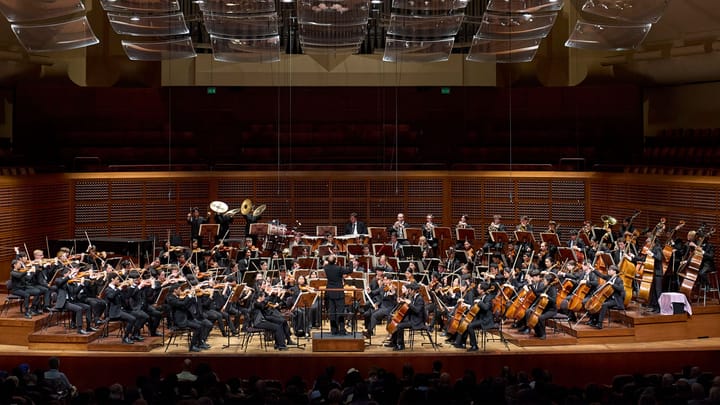
Founded in 1958 by Sir Neville Marriner, the Academy of St Martin in the Fields has evolved into a musical powerhouse, an orchestra renowned across the world for its commitment to the musical freedom of its players and the sharing of joyful, inspiring performances. Today, with Music Director Joshua Bell, ASMF’s player-led approach empowers every member of the orchestra. This creates a direct line and electrifying connection between the orchestra and our audiences, resulting in ambitious and collaborative performances that transcend the more traditional conductor-led model.
ASMF presents its most ambitious season of the last decade in 2025–26, continuing to collaborate with the world’s great soloists and directors, including Joshua Bell, Jan Lisiecki, Steven Isserlis, Arthur and Lucas Jussen, Elena Urioste, and Khatia Buniatishvili. The orchestra also embarks on its most significant international season of the last decade, including ASMF’s return after 20 years to Carnegie Hall, and four separate tours across Europe.
Beyond the concert hall, ASMF’s commitment to a social purpose manifests in impactful projects that harness the power of music to empower. The Academy has a longstanding history of work which connects with people experiencing homelessness, and education projects that develop autonomy and creativity among emerging musicians worldwide. Building on its rich legacy, ASMF remains one of the world’s most-recorded orchestras, igniting a love for classical music in people around the world.
The Academy’s work in the United States is supported by Maria Cardamone and Paul Matthews together with the American Friends of the Academy of St Martin in the Fields. Exclusive Management for the Academy of St Martin in the Fields: Opus 3 Artists.
The Academy of St Martin in the Fields
Hannah Bache, Head of Concerts and Tours
Charlotte Cosgrove, Head of Audiences and Community
Tim Davy, Executive Director, Performance & Planning
Anna Galloway, Concerts and Tours Manager
Callum Given, Head of Social Purpose
Georgina Hamilton, Development Manager (American Friends)
Helen Harris, Librarian
Philip Knight, Finance Manager
William Lloyd, Senior Development & Marketing Coordinator
Annie Lydford, Chief Executive Officer
Chris Martin, Director of Development and External Affairs
Amy Scott, Head of UK Development
Esme Sullivan, Performance & Projects Assistant
Charlotte Templeman, Orchestra Personnel Manager
Alex Tighe, Project Manager
For Opus 3 Artists
Robert Berretta, Managing Director
Benjamin Maimin, Chief Operating Officer
Jemma Lehner, Associate Manager
Miles Bentley, Administrative Assistant
For the Academy of St Martin in the Fields Tour
Leonard Stein, Consulting Producer
Peter Katz, Manager, Touring Logistics
Sarah Vardigans, Company Manager
Academy of St Martin in the Fields
FIRST VIOLINS
Joshua Bell, Music Director
Harvey de Souza
Amanda Smith
Gabrielle Painter
Miranda Playfair
Matthew Ward
Martin Gwilym-Jones
Sijie Chen
Dorina Markoff
SECOND VIOLINS
Martin Burgess
Fiona Brett
Clare Hayes
Richard Milone
Antonia Kesel
Miranda Dale
Cecily Ward
VIOLAS
Robert Smissen
Fiona Bonds
Ian Rathbone
Nicholas Barr
Matthew Maguire
CELLOS
Richard Harwood
Will Schofield
Judith Herbert
Reinoud Ford
Sarah Suckling
BASSES
Lynda Houghton
David Stark
Alice Kent
FLUTES
Harry Winstanley
Sarah Newbold
OBOES
James Hulme
Rachel Ingleton
CLARINETS
Fiona Cross
Thomas Lessels
BASSOONS
Julie Price
Lorna West
HORNS
Stephen Stirling
Joanna Hensel
Peter Francomb
Jamie Shield
TRUMPETS
Mark David
William O’Sullivan
TROMBONES
Rebecca Smith
Andrew Cole
Daniel West
TIMPANI
Louise Lewis Goodwin
PERCUSSION
Laura Bradford