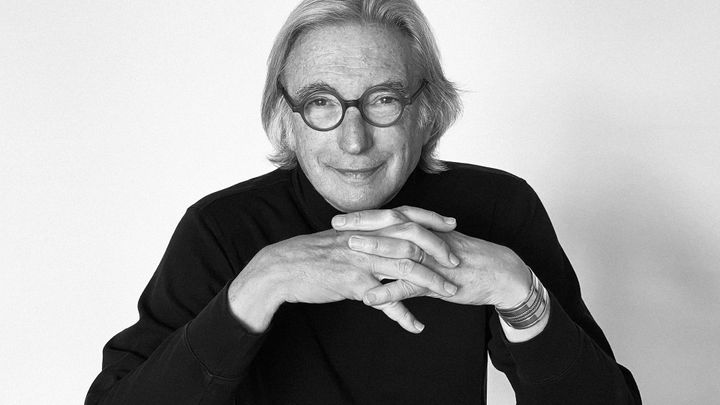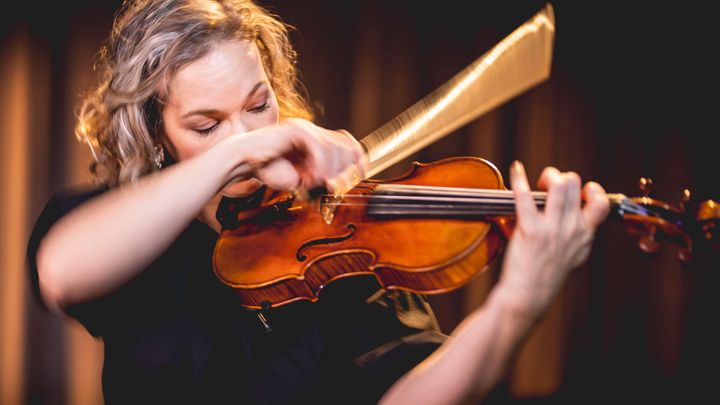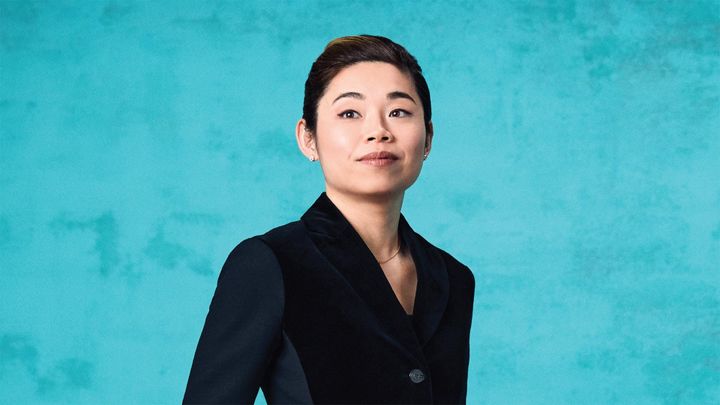
In This Program
The Concert
Wednesday, July 1, 2026, at 7:30pm
Chloé Van Soeterstède conducting
Elfrida Andrée
Concert Overture in D major (1873)
First San Francisco Symphony Performance
Max Bruch
Violin Concerto No. 1 in G minor, Opus 26 (1867)
Prelude: Allegro moderato
Adagio
Finale: Allegro energico
Paul Huang
Intermission
Felix Mendelssohn
Symphony No. 5 in D major, Opus 107, Reformation (1829)
Andante; Allegro con fuoco
Allegro vivace
Andante
Andante con moto; Allegro vivace
Program Notes
At a Glance
Elfrida Andrée’s Overture in D major reveals a pioneering Swedish musical voice, while Max Bruch’s First Violin Concerto intersperses Hungarian-spiced licks with crowd-pleasing passagework. The program concludes with Felix Mendelssohn’s Reformation Symphony, filled with echoes of J.S. Bach and Lutheran chorale melodies.
Concert Overture in D major
Elfrida Andrée
Born: February 19, 1841, in Visby, Sweden
Died: January 11, 1929, in Göteborg, Sweden
Work Composed: 1873
First SF Symphony Performance
Instrumentation: 2 flutes, 2 oboes, 2 clarinets, 2 bassoons, 2 horns, 2 trumpets, 3 trombones, timpani, and strings
Duration: About 12 minutes
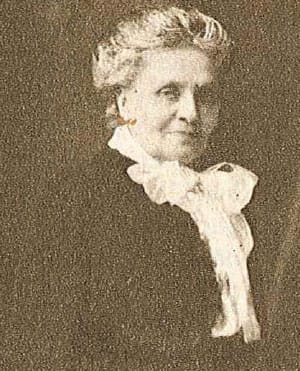
Elfrida Andrée’s musical life centered around the organ. Raised in Visby, the major town on the Swedish island of Gotland in the Baltic Sea, she moved to Stockholm as a teenager. At age 16, she became the first girl to pass the organ exam at the Stockholm Conservatory, and then pursued composition studies. Swedish law at the time forbade women from holding fulltime positions as church organists, so Andrée and her liberal father lobbied parliament until the law was repealed. In 1861 she was appointed organist at the Finnish Church in Stockholm, and in 1866 moved to the prestigious Gothenburg Cathedral, becoming the first female cathedral organist in Scandinavia, and perhaps in all of Europe. Parallel to her musical career, Andrée was interested in electrical telegraphy, and also convinced the Swedish government to allow women to become telegraph operators. (Not coincidentally, early telegraph machines resembled organ keyboards.)
Andrée wrote five orchestral works, including two symphonies in 1869 and 1893, two suites on Icelandic sagas, and the D-major Overture on this program. She became a conductor (again, the first Swedish woman to do so) in order to lead her own works, and in 1897 became the director of the Swedish Labour Concerts, a socialist-minded effort to present classical music for the working class.
The Concert Overture shows a real melodic and harmonic sensibility, unfolding in a moody, post-Beethoven Romantic vein. It was performed at least once during her life, in Berlin in 1888, probably conducted by Andrée herself.
—Benjamin Pesetsky
San Francisco Symphony.
Violin Concerto No. 1 in G minor, Opus 26
Max Bruch
Born: January 6, 1838, in Cologne
Died: October 2, 1920, in Berlin
Work Composed: 1865–67
SF Symphony Performances: First—January 1913. Henry Hadley conducted with Maude Powell as soloist. Most recent—January 2026. Edward Gardner conducted with Randall Goosby as soloist.
Instrumentation: solo violin, 2 flutes, 2 oboes, 2 clarinets, 2 bassoons, 4 horns, 2 trumpets, timpani, and strings
Duration: About 24 minutes
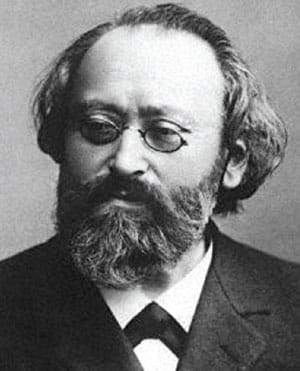
Max Bruch was born during an era of seismic changes in the dominant idioms of German art music. A staunch champion of the sound defined by Felix Mendelssohn and Robert Schumann, “he stayed behind to defend the bastion of mid-nineteenth-century Romanticism,” writes biographer Christopher Fifield, “[and] thus became an increasingly isolated figure and an equally embittered one.”
Despite a six-decade career as a composer, Bruch’s conservatism put him out of sync with the period’s innovations. As musicologist Georg Predota puts it, “He emerged on the German music scene dominated by Mendelssohn, lived under the shadow of Wagner and Brahms, and died within a decade of the first performance of Schoenberg’s Pierrot lunaire.”
Born in Cologne to a musical family (his mother was a singer), Bruch began composing at a young age, studying in both his hometown and nearby Bonn. After early-career stints in Mannheim, Paris, and Brussels, Bruch began to balance his compositional output with conducting appointments—he wrote the Violin Concerto No. 1 during a stint as music director of the court of Koblenz.
A brief term as music director of the Liverpool Philharmonic Society was marred by contentious relationships with its governing committee and a lack of time to devote towards composition (though both his Scottish Fantasy and Kol Nidrei were completed and premiered during this time). After escaping to a new post in Breslau, Bruch eventually arrived in Berlin, where he devoted himself to his new family (he married soprano Clara Tuczek in 1881 during his time in Liverpool), his teaching at the Berlin Hochschule für Musik (students included a young Ottorino Respighi), and continued composition until his death in 1920.
The Music
“The Germans have four violin concertos … the richest, the most seductive was written by Max Bruch,” said Joseph Joachim, arguably the most important violinist of the 19th century. Despite the other three concerto-writers’ greater contemporary renown (Beethoven, Brahms, and Mendelssohn), Bruch’s First Violin Concerto stands (along with his Scottish Fantasy, another work for solo violin and orchestra) as one of his most enduring works and a standard of the violin’s concerto repertoire. Joachim helped Bruch revise the concerto, and premiered the final version in 1867.
In the first movement—an allegro in sonata form—the violin answers two quiet, chorale-like interrogatives from the winds with brief, wandering fantasias. A third, louder statement of the chorale launches the solo violin into the movement’s first theme, full of bravura and sorrow in equal measure.
The second theme—lyrical and thick with sentiment—sees the violin alternately in the rich depths of its range and in its upper limits. A brief return of the first theme’s material in the dominant major quickly devolves into a pyrotechnic development, one which leads into a thundering tutti (a full orchestra passage).
The chorale figure from the opening emerges declaratively—snarling and diminished in the thundering brass—before receding towards the recapitulation. The violin’s fantasy intensifies towards a final orchestral interlude, which starts strongly before falling, attacca (without pause), into the second movement’s opening melody (a sweet, lullaby-like tune).
Out of simple building blocks—the initial melody and an additional dotted motif—Bruch builds titanic ebbs and flows. They bloom with pastoral beauty, glow quietly, and thunder forward in tutti—all connected by the violin’s alternating lyricism and filigree. The soloist’s final, tender statement of the theme swells—then falls again.
The third movement’s suppressed strings quickly roar to life and set up the violin’s entrance with the finale’s swashbuckling theme, one which is then echoed by the orchestra. A run of winding triplets leads the ensemble towards a triumphant statement of the second, more sustained theme.
After offering a calmer, more assured restatement in the solo line, the toggling between the two thematic groups continues, all linked by virtuosic stretches in the solo line. The violin’s final transformations of the first theme give way to a galloping presto which ends the concerto.
—Lev Mamuya
Symphony No. 5 in D major, Opus 107, Reformation
Felix Mendelssohn
Born: February 3, 1809, in Hamburg
Died: November 4, 1847, in Leipzig
Work Composed: 1829
SF Symphony Performances: First—December 1949. Pierre Monteux conducted. Most recent—January 1996. Christoph Eschenbach conducted.
Instrumentation: 2 flutes, 2 oboes, 2 clarinets, 2 bassoons, contrabassoon, 2 horns, 2 trumpets, 3 trombones, timpani, and strings
Duration: About 35 minutes
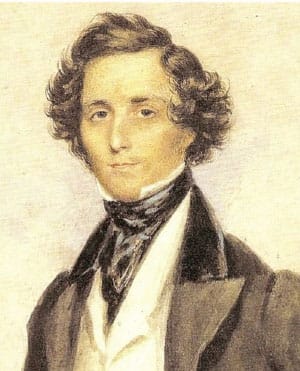
In June 1530, the Imperial Diet of Augsburg, an assembly of representatives from across the Holy Roman Empire, was convened by Emperor Charles V to deliberate over important political, military, and religious matters. One of their central objectives was reconciliation between the Roman Catholic Church and Protestant reformers, who had broken away 12 years earlier when Martin Luther posted his Ninety-five Theses. Although Luther himself could not attend the Diet under imperial banishment, he nevertheless contributed to the writing of the Augsburg Confession, a pivotal set of 21 articles that was presented to the emperor and established the foundational tenets of the Lutheran Church. While the conference was in session, Luther may have also written “Ein’ feste Burg ist unser Gott” (A Mighty Fortress Is Our God), a hymn that paraphrases Psalm 46 and was soon adopted as a rallying cry of the Protestant Reformation.
Almost three centuries later, in autumn of 1829, 20-year-old Felix Mendelssohn began work on a new symphony to commemorate the 300th anniversary of the Augsburg Confession, which was to be celebrated the following summer in Berlin. The symphony would provide a programmatic narrative of the triumph of Protestantism over Catholicism in Germany by quoting Luther’s famous hymn. Although Frederick William III, the king of Prussia, had not yet announced that any festivities would take place, Mendelssohn assumed he would soon be tasked with providing new music. However, he never received any formal commission, and a popular competitor, Eduard Grell, was called upon instead. Perhaps a large-scale symphonic work, compared to Grell’s more conservative choral music, was thought inappropriate for the event. Mendelssohn may have also been discriminated against due to his Jewish heritage, even though he had been a devout Lutheran since the age of seven.
Mendelssohn soon resumed touring around Europe, offering his Reformation Symphony to be premiered in Paris in 1832, where it was rejected after just one rehearsal, this time as “much too learned, [with] too much fugato [and] too little melody.” It may have also been too Protestant for Catholic France. After some revisions, the symphony finally received its premiere on November 15, 1832, at the Singakademie in Berlin, where it received only mixed reviews. Mendelssohn later dismissed the piece as “juvenilia,” and even suggested it should be burned. It was not performed again until 1868, more than 20 years after the composer’s death, and was then published as his Fifth Symphony, even though it was the second to be written chronologically. Such a fate was unusual for a work by Mendelssohn, who enjoyed almost unrivaled musical popularity both during and after his lifetime.
The Music
The opening Andante does not burst forth with a stately, ceremonial proclamation, as one might expect for a work commemorating such an important historical event, but rather begins with a sort of spiritual awakening. Low strings introduce a psalm-like theme of D–E–G–F-sharp (a transposition of the main motif of the finale to Mozart’s Jupiter Symphony), to which a wind choir nobly responds. This imitative counterpoint resembles Catholic polyphony, simulating stile antico (old style), the conservative church music style of the late Renaissance. The ethereal first entrance of the violins, a simple rising scale, quotes the “Dresden Amen,” another motivic symbol of the Protestant Church (later used by Richard Wagner as the Grail motif in Parsifal). In the subsequent Allegro con fuoco section, an energetic, militant fanfare, perhaps symbolizing religious strife, is periodically interrupted by a quieter, more lyrical secondary theme. The exultant Dresden Amen motif returns unexpectedly at the end of the development section before building back up to an invigorating recapitulation and coda.
The playful second movement, Allegro vivace, counteracts the rigors of the first, with a lilting, rustic dance in B-flat major and a tuneful trio in G major. The following Andante, a gentle, brief “song without words” for first violins, is accompanied only by strings, flutes, and bassoons until the last few measures. Clarinets, trumpets, horns, and timpani reinforce a short reference to the secondary theme of the first Allegro. Over the closing note, a single flute (an instrument Martin Luther himself played) intones the first phrase of “Ein’ feste Burg,” moving directly into the fourth and final movement.
After the hymn is played as an introductory chorale, the orchestra launches into a fantasia in which “Ein’ feste Burg” is heard first in fragmentary forms, then with increasing clarity and confidence. Turbulent contrapuntal sections revisit the idea of spiritual division, from which the music soon becomes triumphant again, reflecting the Lutheran belief in the power of collective congregational worship. Suddenly pianissimo at the coda, the orchestral forces grow in both speed and might until the entire ensemble rejoices in a final, jubilant chorale.
—Richard F. O’Donnell
About the Artists

Chloé Van Soeterstède
Chloé Van Soeterstède became principal guest conductor of the Bournemouth Symphony in 2024. Her recent highlights include engagements with the Norwegian Radio Symphony, Gävle Symphony, London Philharmonic, Hallé Orchestra, Royal Northern Sinfonia, Orchestre National de Montpellier, Orchestre National de Lille, Orquesta Sinfónica de Castilla y León, Real Filharmonia de Galicia, and RTVE Symphony Orchestra in Madrid. In 2023 she debuted with the Melbourne Symphony, Adelaide Symphony, and Auckland Philharmonia, and in 2024 debuted with the Vancouver Symphony.
This season, Van Soeterstède returned to the BBC Scottish Symphony for a concert at Glasgow’s City Halls. She closed the season with the Orchestra of the Opéra National de Lorraine in Nancy, and returned to the Norrköping Symphony and Ulster Orchestra as part of last summer’s BBC Proms. She makes her San Francisco Symphony debut with this performance.
Van Soeterstède was born in France and in 2012 founded the Arch Sinfonia, a chamber orchestra based in London. She was made a Taki Alsop Fellow for 2019–21 by Marin Alsop, was a Dudamel Fellow with the Los Angeles Philharmonic in the 2021–22 season, and in 2023 became an associate member of the Royal Northern College of Music. She regularly programs works by contemporary composers and was awarded the Bärenreiter Prize for the best interpretation of a contemporary work at the German Conducting Award in Cologne, where she also won third prize overall.
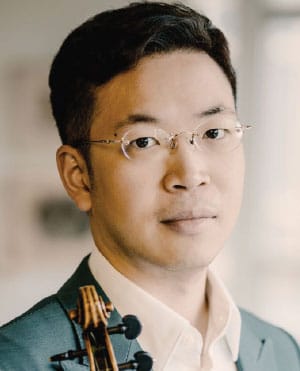
Paul Huang
Paul Huang debuts next season at Carnegie Hall with Orpheus Chamber Orchestra, and will make subscription debuts with the Cleveland Orchestra, George Enescu Philharmonic, Singapore Symphony, China Philharmonic, Guangzhou Symphony, and Pasadena Symphony. He returns to the Rotterdam Philharmonic, Detroit Symphony, Residentie Orchestra, Buffalo Philharmonic, and National Symphony Orchestra of Taiwan. His recent highlights include Bravo!Vail Music Festival, Rotterdam Philharmonic, BBC Symphony Orchestra, Detroit Symphony, Houston Symphony, NHK Symphony, Dallas Symphony, Mariinsky Orchestra, Baltimore Symphony, and Seoul Philharmonic. In 2021, he became the first classical violinist to perform his own arrangement of the national anthem for an opening game of the NFL.
Huang is the recipient of an Avery Fisher Career Grant and Lincoln Center Award for Emerging Artists. As winner of the 2011 Young Concert Artists International Auditions, Huang debuted at Lincoln Center and Kennedy Center. His other honors include first prize at the Tibor Varga International Violin Competition Sion-Valais in Switzerland, the Chi-Mei Cultural Foundation Arts Award for Taiwan’s Most Promising Young Artists, the 2013 Salon de Virtuosi Career Grant, and 2014 Classical Recording Foundation Young Artist Award.
Born in Taiwan, Huang was a recipient of the inaugural Kovner Fellowship at the Juilliard School, where he earned bachelor’s and master’s degrees. He plays on the 1742 “ex-Wieniawski” Guarneri del Gesù on extended loan through the Stradivari Society of Chicago. He made his San Francisco Symphony debut in February 2024.