In This Program
The Concert
Friday, March 20, 2026, at 7:30pm
Saturday, March 21, 2026, at 7:30pm
Sunday, March 22, 2026, at 2:00pm
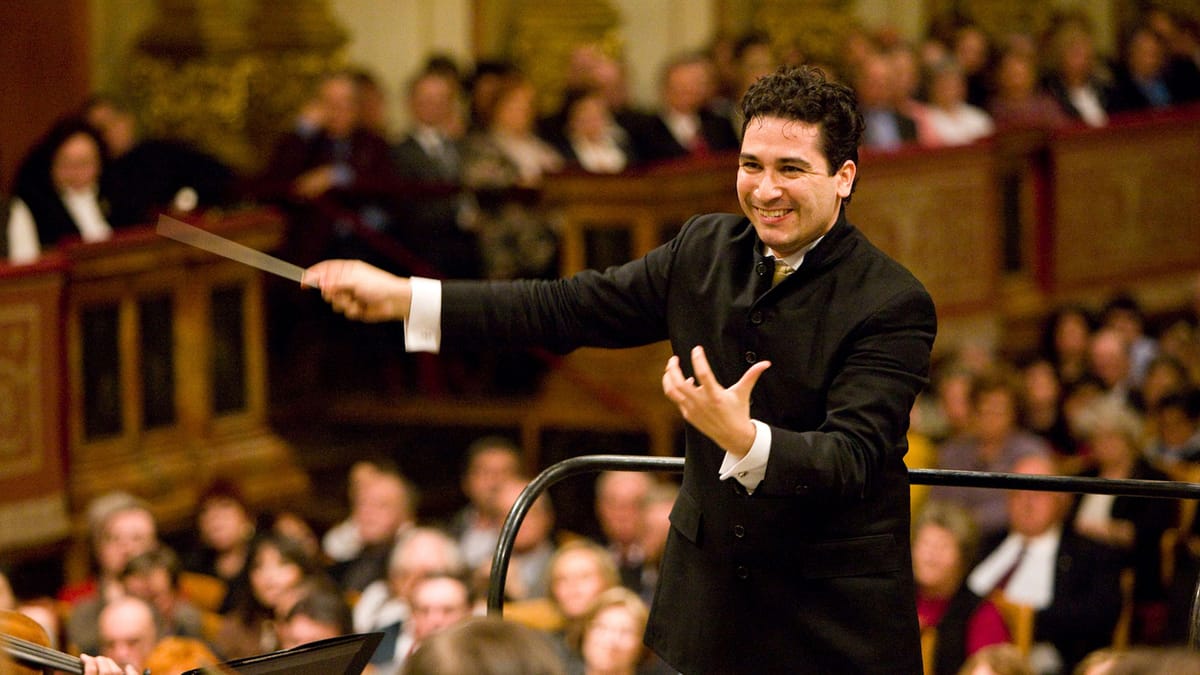
Andrés Orozco-Estrada conducting
Carl Maria von Weber
Overture to Euryanthe, Opus 81 (1823)
Wolfgang Amadeus Mozart
Piano Concerto No. 9 in E-flat major, K.271 (1777)
Allegro
Andantino
Rondo: Presto
Jan Lisiecki
Intermission
Antonín Dvořák
Symphony No. 7 in D minor, Opus 70 (1885)
Allegro maestoso
Poco adagio
Scherzo: Vivace
Finale: Allegro
Lead support for this concert series is provided by The Phyllis C. Wattis Fund for Guest Artists.
Program Notes
At A Glance
Antonín Dvořák’s Symphony No. 7 was inspired by Johannes Brahms, premiered for a London audience, and is perhaps the least typically Czech-sounding of Dvořák’s mature works. Nonetheless, it is a uniquely grand, gloomy, and dramatic entry among his symphonies.
Overture to Euryanthe, Opus 81
Carl Maria von Weber
Born: November 19?, 1786, in Eutin, Prince-Bishopric of Lübeck (Germany)
Died: June 5, 1826, in London
Work Composed: 1823
SF Symphony Performances: First—January 1913. Henry Hadley conducted. Most recent—May 1993. Herbert Blomstedt conducted.
Instrumentation: 2 flutes, 2 oboes, 2 clarinets, 2 bassoons, 4 horns, 2 trumpets, 3 trombones, timpani, and strings
Duration: About 9 minutes
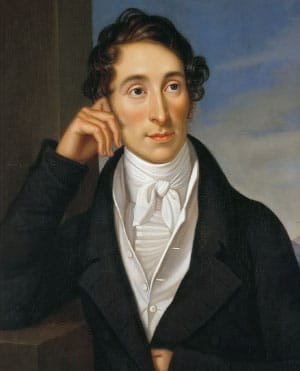
In Carl Maria von Weber’s Autobiographical Sketches, written in 1818, he related that, since his father was an excellent cellist, it was natural that he should have been encouraged in the arts. “My family’s withdrawn manner of life,” he explained, “the regular society of cultivated adults, and the scrupulous care with which I was kept from the rough company of my contemporaries early taught me to live predominantly in the world of my own imagination and to seek in it my interests and my happiness.” Following early training in piano and composition, including a stint of instruction from Michael Haydn in Salzburg, he discovered that “a preference for the dramatic began to become unmistakable in my musical individuality.”
He served as music director at a succession of civic and court theaters and opera houses: at Breslau (1804–06), at Duke Eugen Friedrich of Württemberg’s castle at Carlsruhe (1806–07), in Prague (where he headed the German Opera Company from 1813–16), and in Dresden (where, at the King of Saxony’s behest, he oversaw the German Opera Theater from 1817–21). But it was as a composer, rather than a conductor, that he made his enduring mark. He worked on 10 operas in his too-brief life. Not all of them were completed, and not everything he completed of them seems to have survived. But four of them—Abu Hassan, Der Freischütz, Euryanthe, and Oberon—remain at least somewhat before the public ear today (at least via their overtures), and Der Freischütz is honored as a true classic.
They are not his only works to remain alive. Pianists still play his Concert-Stück occasionally; clarinetists and bassoonists delight in the concertos he composed to spotlight their instruments; and chamber groups present his clarinet quintet and flute trio now and again. His two symphonies have unfortunately fallen off the radar (and could be profitably revived), but orchestra and ballet audiences do still hear his Aufforderung zum Tanze (Invitation to the Dance) as arranged by Hector Berlioz, though it is almost never programmed in its original piano version. Nonetheless, it was Weber’s work in opera that earned him the historical position he enjoys as a pillar of German Romanticism, as a defining figure in a fantasy-rich movement that managed to link such ethereal illusions as fairies with such real ones as German nationalism.
In the wake of the success of Der Freischütz in 1821, the Vienna Kärntnertor-Theater approached Weber about writing a similar opera to capitalize on that triumph. Weber assented, but moved ahead in a different direction. Rather than produce another work with spoken dialogue (like Der Freischütz and nearly all other German operas of the time), he decided to create a fully sung grand opera, more along the lines of contemporary Italian and French practice. For his libretto he turned to Helmine von Chézy, a cosmopolitan society lady who moved between Vienna and Paris. She protested that she lacked the experience to write a libretto, but Weber failed to take her at her word and convinced her to accept the project. Her libretto for Euryanthe earned her a spot in the annals of musical kitsch, and the resulting opera—a mystifying hash of a pseudo-medieval plot replete with battles, poisons, and ghosts—ran for only 20 performances.
Considered apart from the libretto (to the extent that is possible) Weber’s music for Euryanthe includes some of his most inspired pages. Robert Schumann described the score as “a chain of sparkling jewels from beginning to end, all brilliant and flawless.” The overture, which was the last piece of the opera Weber composed, has always been a popular concert item. It draws on themes from the opera, principally the aria “O Seligkeit, dich fass’ ich kaum” from Act Two, and in its central development section it makes especially effective use of the Act One music in which a ghost is represented by eight muted solo violins playing in highly chromatic counterpoint.
Piano Concerto No. 9 in E-flat major, K.271
Wolfgang Amadeus Mozart
Born: January 27, 1756, in Salzburg
Died: December 5, 1791, in Vienna
Work Composed: 1777
SF Symphony Performances: First—March 1924. Alfred Hertz conducted with Germaine Schnitzer as soloist. Most recent—April 2015. Pablo Heras-Casado conducted with Igor Levit as soloist.
Instrumentation: solo piano, 2 oboes, 2 horns, and strings
Duration: About 30 minutes
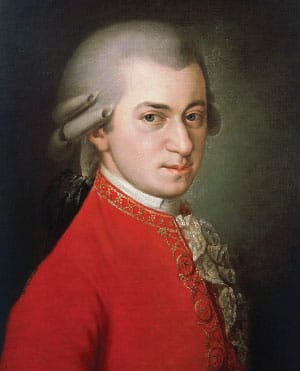
When Wolfgang Amadeus Mozart wrote this concerto, in January 1777, he was just turning 21. He had attracted international attention as a performer and had written his first 10 operas, oodles of symphonies and string quartets, and a handful of concertos. Still, against this background, the E-flat major Piano Concerto, K.271, stands as nothing less than a miracle. One might argue that it is the composer’s first indisputable masterpiece, at least among his instrumental works. Few listeners today have often heard the eight piano concertos that preceded it; and most who have would be hard pressed to remember much about them except that several involve Mozart’s arrangements of pre-existent movements by other composers. But this concerto is memorable, as much for the immediate appeal of its writing, which includes a challenging solo part and imaginative wind writing, as for the way it successfully melds bold experimentation with accepted practice.
The concerto opens with a surprise. In Mozart’s time, concertos invariably began with a stretch of material (usually including at least a couple of discrete themes) presented by the orchestra before the soloist took a turn in the spotlight. Here, however, the piano shares in the opening phrase of the work, providing a response to the orchestra’s introductory fanfare. The composer has put the listener on notice that in this concerto the soloist and the orchestra will interweave with some complexity. The slow movement is also a breakthrough. This melancholy Andantino is an exercise in the hyper-expressive Sturm und Drang aesthetic so popular at that time. Accordingly, it is the first middle movement of a concerto that Mozart pens in the minor mode (C minor, in this case). The opening theme incorporates a falling figure that seems at least a sigh—and perhaps a sob when the strings give it voice. The piano sometimes declaims its sorrow in recitative-like passages, and the strings underscore the emotional effect by installing mutes except for an anguished four-measure outburst near the movement’s end. In the finale, Mozart again experiments with structure; in the midst of a highly energized rondo, he interpolates a minuet—leisurely, long, and unusually expressive—with four elegantly turned variations.
This may have been the first of Mozart’s piano concertos to be published, if it was the concerto advertised in an early catalogue of the Parisian publishing house of François-Joseph Heina (though no copies of that announced publication exist). Fortunately, Mozart provided two separate sets of written-out cadenzas for this concerto: two alternative versions for the first movement, two for the second. For the third movement he also provided three alternative versions each of two brief Eingänge (“lead-ins”), short improvisatory flourishes to introduce musical sections—far shorter than full-fledged cadenzas yet substantial enough to display creativity from soloists who choose to create them extemporaneously.
Mozart wrote a letter to his father in which he referred to a woman surnamed “Jenomy” in connection with this concerto, and his father referred to the same as “Madame genomai.” (Spelling was an approximate discipline in the 18th century.) The water became muddied when, in 1912, the French scholars Théodore de Wyzewa and Georges de Saint-Foix posited the existence of a Mademoiselle Jeunehomme; with some nationalistic bias, they imagined her to be a French pianist (“one of the most celebrated virtuosos of her time,” no less) who visited Salzburg in the winter of 1776-77 and commissioned Mozart to write this concerto—pure balderdash. Documents in the City Archive of Vienna identify the person to whom Mozart and his father referred as Louise Victoire Jenamy (1749–1812), a daughter of the dancer and ballet-master Jean-Georges Noverre, who was a friend of the Mozarts. (Mozart and Noverre would collaborate on the ballet Les petits riens in 1778 in Paris.) She was an excellent pianist—surely the musician to whom Wolfgang and his father referred and the one who commissioned this piece.
Symphony No. 7 in D minor, Opus 70
Antonín Dvořák
Born: September 8, 1841, in Nelahozeves, Bohemia
Died: May 1, 1904, in Prague
Work Composed: 1884–85
SF Symphony Performances: First—August 1930. Antonia Brico conducted. Most recent—October 2016. Pablo Heras-Casado conducted.
Instrumentation: 2 flutes (2nd doubling piccolo), 2 oboes, 2 clarinets, 2 bassoons, 4 horns, 2 trumpets, 3 trombones, timpani, and strings
Duration: About 38 minutes
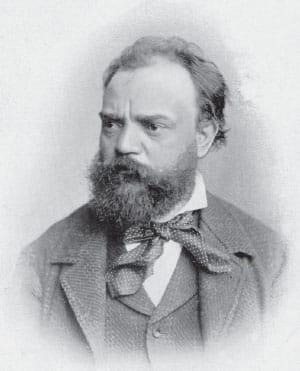
The spirit of Brahms hovers over many pages of Dvořák’s Seventh Symphony, which is the darkest and potentially the most intimidating of his nine. His Symphony No. 6 in D major, composed four years earlier, had also seemed to be a reaction to Brahms, its pastoral mood emulating to some extent Brahms’s recent Second Symphony (1877), in the same key. Since then, Brahms had released a further symphony—his confident, sinewy Third, which Hans Richter (who conducted its premiere in December 1883) dubbed “Brahms’s Eroica.” A month later, in January 1884, Dvořák traveled to Berlin to hear it performed and was appropriately impressed, and by the end of that year he began to write his Seventh Symphony, which echoes some of the storminess and monumental power of Brahms’s Third. In February 1885, Dvořák wrote to his publisher, “I have been engaged on a new symphony for a long, long time; after all it must be something really worthwhile, for I don’t want Brahms’s words to me, ‘I imagine your symphony quite different from this one [i.e. Dvořák’s Sixth],’ to remain unfulfilled.” As it happens, this new symphony would engender a certain edginess in Dvořák’s relationship with his publisher, who adamantly refused to offer more than 3,000 marks for the rights to the piece. In a letter, Dvořák made an elegant case for more: “I think that even though such large works do not produce the desired financial effect straight away, the time may come when everything will be amply made up for.”
As his reputation grew in the early 1880s, Dvořák gained a staunch following in England, and in 1883 the rapturous reception of his Stabat Mater in London made him a celebrity there. On the heels of that triumph, the Royal Philharmonic invited him to conduct some concerts in 1884, in the course of which his Sixth Symphony made such an impression that the orchestra immediately extended a commission for him to write another specifically for them, which he was to introduce the following season. The Seventh scored another English success when he conducted the premiere in London’s St. James Hall on April 22, 1885. Just after its premiere he wrote to a friend in Mirovice, Bohemia: “Before this letter reaches Mirovice you will perhaps know how things turned out here. Splendidly, really splendidly. This time, too, the English again welcomed me as heartily and as demonstratively as always heretofore. The symphony was immensely successful and at the next performance will be a still greater success.”
The Music
A deeply religious man who believed that his compositions were ordained from on high, Dvořák typically wrote at top speed to keep pace with the divine dictation. The D-minor symphony, however, gestated through a pile of sketches before reaching the precise expression that makes its dense, oppressive mood so instantly recognizable. The first movement displays an ominous quality. A passionate observer of railway trains, Dvořák reported that its opening came to him in the Prague railroad terminal as a train arrived delivering hundreds of Hungarian anti-monarchists to a theater festival. Well-meaning colleagues (including Brahms) had been encouraging him to adhere to a style that would not perturb mainstream German and Austrian audiences, who needed to be courted if a composer hoped to achieve commercial success. But seeing the Hungarian patriots helped Dvořák validate his authentic Czech voice rather than try to bury it beneath any foreign veneer—hence, one suspects, the harmonic and emotional ambiguity of the opening pages.
The slow movement travels a broad landscape of the soul, embracing both introspection and outburst. Following the premiere, Dvořák cut about 40 of its measures, and he communicated the emendation to Simrock with the assurance, “Now I am convinced that there is not a single superfluous note in the work.” The third movement, a scherzo, extends the work’s blustery mien, notwithstanding its overlay of folk rhythms; and the finale works its way through extensive thematic development before concluding with a major-key intimation that there may be the slightest room for hope after all.
—James M. Keller
About the Artists
Andrés Orozco-Estrada
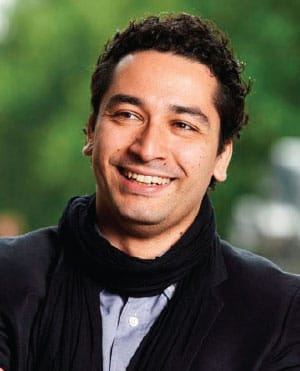
Andrés Orozco-Estrada has been appointed music director of the Swedish Radio Symphony beginning with the 2026–27 season. Since fall 2025, he has been general music director of the city of Cologne and Gürzenich Kapellmeister, and since 2023 has been principal conductor of the Orchestra Sinfonica Nationale della RAI in Turin. He was previously music director of the Houston Symphony, principal conductor of the Hesse Radio Symphony, and principal conductor of the Vienna Symphony.
Recent and upcoming guest appearances include the Zurich Tonhalle Orchestra, Leipzig Gewandhaus, Royal Concertgebouw Orchestra, Orchestre de Paris, and Los Angeles Philharmonic. He also conducted the New Year’s Eve concert of the Dresden Staatskapelle, broadcast live on German television. Last summer he made his Tanglewood debut and returned to the Lucerne Festival. He has also appeared with the Berlin Philharmonic, Vienna Philharmonic, London Philharmonic, New York Philharmonic, Boston Symphony, NHK Symphony, Hong Kong Philharmonic, Vienna State Opera, Berlin State Opera, Dresden State Opera, and La Scala. He made his San Francisco Symphony debut in April 2017.
Orozco-Estrada was born in Medellín, Colombia, and began studying the violin in his early youth, switching to conducting at age 15. In 1997 he began a course of study at Vienna’s University of Music and Performing Arts, where he has been professor of orchestral conducting since 2022.
Jan Lisiecki
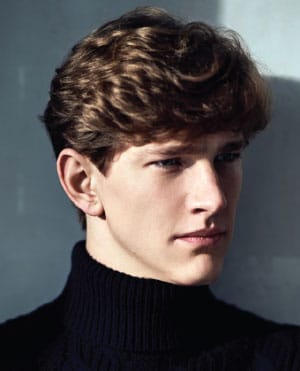
Jan Lisiecki’s 2025–26 season sees him return to Rotterdam Philharmonic, Vienna Symphony, Finnish Radio Symphony, Warsaw Philharmonic, Gulbenkian Orchestra, Berlin Radio Symphony, and Houston Symphony, among other orchestras. Last summer he was featured at the Seoul International Music Festival and a further 30 recitals have taken him across Europe and North America, including to the Berlin Philharmonie and Vienna Konzerthaus. Continuing his collaboration with the Academy of St Martin in the Fields, which he led from the piano in a tour of several Beethoven cycles last season, he performs another Beethoven cycle at the Enescu and Merano festivals.
Other recent appearances include the New York Philharmonic, Cleveland Orchestra, Chicago Symphony, Orchestre de Paris, Tonhalle-Orchester Zurich, Berlin Philharmonic, and Dresden Staatskapelle. Lisiecki is a fixture at major summer festivals, including the Salzburg Festival and BBC Proms. He made his San Francisco Symphony debut in June 2016.
Lisiecki was offered an exclusive recording contract with Deutsche Grammophon at the age of 15. Since then, he has recorded nine albums which have been awarded with the Juno Award, Echo Klassik, Gramophone Critics’ Choice, Diapason d’Or, and Edison Klassiek. At age 18, he received both the Leonard Bernstein Award and Gramophone’s Young Artist Award, becoming the youngest ever recipient of the latter. Lisiecki was named UNICEF ambassador to his native Canada in 2012.