In This Program
The Concert
Sunday, March 15, 2026, at 7:30pm
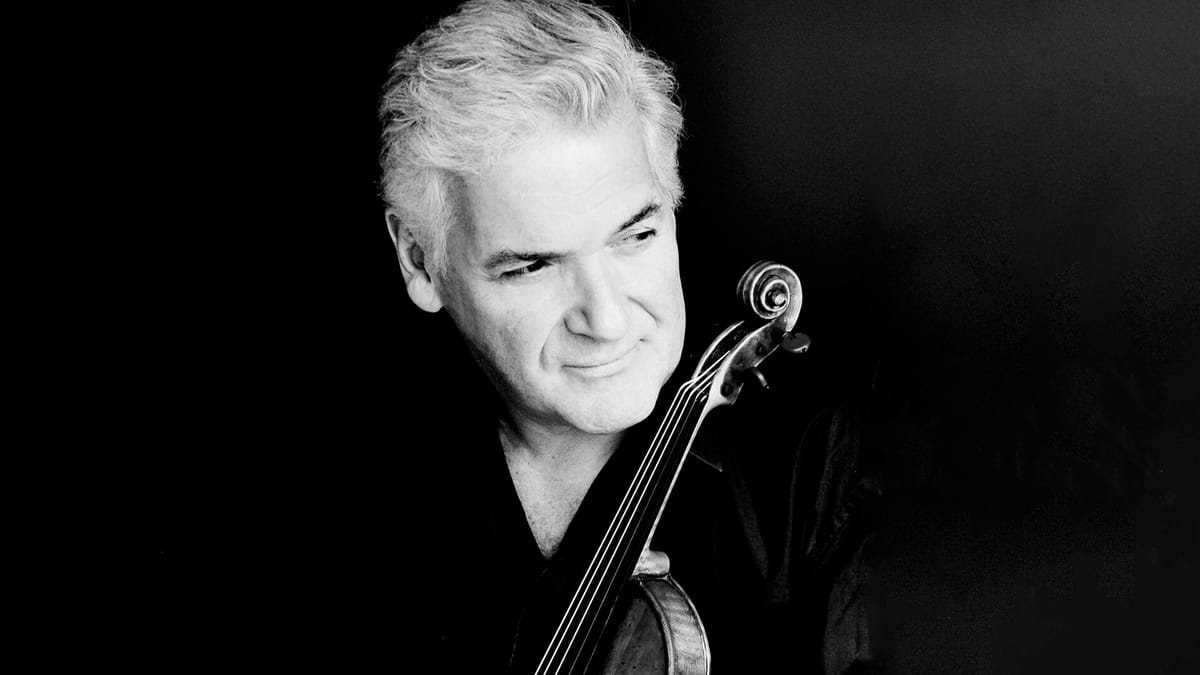
Pinchas Zukerman violin
Shai Wosner piano
Johannes Brahms
Complete Works for Violin and Piano
Scherzo in C minor, WoO 2, from F-A-E Sonata (1853)
Violin Sonata No. 1 in G major, Opus 78 (1879)
Vivace ma non troppo
Adagio
Allegro molto moderato
Intermission
Violin Sonata No. 2 in A major, Opus 100 (1886)
Allegro amabile
Andante tranquillo
Allegretto grazioso quasi andante
Violin Sonata No. 3 in D minor, Opus 108 (1888)
Allegro
Adagio
Un poco presto e con sentimento
Presto agitato
Presenting Sponsor of the Great Performers Series

Program Notes
Complete Works for Violin and Piano
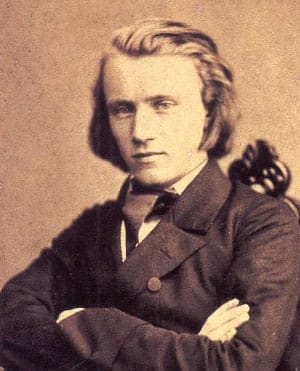
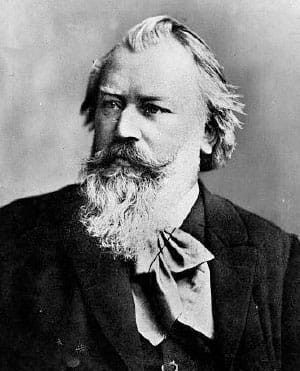
Johannes Brahms
Born: May 7, 1833, in Hamburg
Died: April 3, 1897, in Vienna
Works composed: Scherzo in C minor—1853. Violin Sonata No. 1—1879. Violin Sonata No. 2—1886. Violin Sonata No. 3—1888.
Nobody had to worry much about maintaining a suitable balance between violin and piano in the 18th century. The era’s wooden-framed forte- pianos were lightly strung and gave off an enticingly pungent but not particularly loud sound. Those fortepianos blended effortlessly with the violin, so much so that composers such as Joseph Haydn often cast the violin in a second-class role, assigning it the task of helping the fortepiano sustain a legato line. Consider an early Mozart cover page that announces “sonatas for the pianoforte, that can be played with violin accompaniment”—a statement that’s likely to leave modern violinists sputtering with indignation.
That all changed in the 19th century. The piano’s increasing popularity, enhanced by barnstorming recitalists of the Franz Liszt stripe, led to pianos becoming increasingly heavy, resonant, and above all, loud. By 1850 the once equal partnership between violin and piano had acquired a distinct David vs. Goliath vibe, the massive and sonorous piano all too capable of obliterating the violin from the soundscape, as many a careless modern pianist has discovered when taken severely to task by a thoroughly ticked-off and drowned-out violinist.
Johannes Brahms was well aware of the inherent imbalance between the two instruments, having not only spent part of his salad days touring with violinist Eduard Reményi but also thanks to his lifelong association with the distinguished violinist Joseph Joachim, whose advice and counsel threads through Brahms’s output as an idée fixe. Brahms was not temperamentally inclined to write glitzy showpiece sonatas that relegated the piano to mere support for violin pyrotechnics. For Brahms, a sonata for violin and piano was a dialog between equals, no matter what the sonic inequity between the two instruments, and he adamantly refused to release any attempt at the genre that failed to meet his exacting standards. We hear that as many as five such sonatas were composed, weighed in the balance, found wanting, and consigned to the living-room fireplace. Only an early scherzo movement often known as the Sonatensatz (sonata movement) has survived from those early years.
A complete and fully realized violin-and-piano sonata was still well off. Brahms was 46 years old before he finally deemed that he had got it right, by way of a newly transparent piano style first developed in the Opus 76 Klavierstücke, and also via scrupulous attention to each instrument’s sonic territory. He was sufficiently pleased with the Violin Sonata No. 1 in G major to have it published as Opus 78. But he waited another eight years before writing another violin-piano sonata, and then he produced two—No. 2 in A major and No. 3 in D minor—in rapid succession. Together the three sonatas form a noble triptych that encapsulates the best of Brahms’s middle and late styles: the first sonata expansive and luxuriant, the second Schubertian and lyrical, the third passionate and occasionally fiery. In these three sonatas, as biographer Peter Latham tells us, Brahms “never seeks grandeur, and woos rather than compels.”
Scherzo in C minor, WoO 2, from F-A-E Sonata
Even the greatest of masters have to start somewhere. For the 17-year-old Johannes Brahms that meant touring with violinist Eduard Reményi, through whom Brahms met Joseph Joachim, the magisterial violinist-composer who would prove to be a lifelong support, influence, and muse—a relationship that took some damage when Brahms sided with Joachim’s wife during their 1883 divorce. “Never in the course of my artist’s life have I been more completely overwhelmed,” Joachim remembered about his first encounter with the young Brahms.
The first fruit of their friendship was a Scherzo movement that Brahms contributed to a violin sonata co-composed for Joachim by the team of himself, Albert Dietrich, and Robert Schumann. The title F-A-E refers to Joachim’s motto “Frei aber einsam,” free but lonely.
Even at age 20, Brahms was most definitely Brahms, as this muscular and superbly constructed Sonatensatz (sonata movement) demonstrates. There’s even a nobly lyrical trio section at the halfway point, very much in keeping with Brahms’s practices throughout his career.
Violin Sonata No. 1 in G major, Opus 78
Here’s a little secret about Brahms: if he states a musical figure clearly, even baldly, at the beginning of a composition, that figure is almost certain to be a musical seed that Brahms will grow and develop throughout the rest of the work. Brahms’s Fourth Symphony provides an excellent case in point, as the falling third at the opening turns out to be the source of an extraordinary amount of the material to come.
So consider the brief dotted-note rhythm (dum-da-DUM) with which the violin commences the G-major sonata. That rhythm turns out to permeate the entire piece, from the first movement’s primary theme, through its contrasting secondary theme (now displaced by one beat in the measure), even to its closing theme. The dotted rhythm reaches its apotheosis in the sonata’s finale, revealed as the defining upbeat rhythm of Brahms’s “Regenlied” (Rain Song), the art song that serves as the main melody of the last movement.
That dotted rhythm serves to unify a gloriously long-lined and long-limbed sonata that glows with springtime joy and well-being. The first-place Vivace ma non troppo can be a revelation to those who associate Brahms with thick, blocky textures; gossamer and airy, both piano and violin parts flow with a lithe grace more commonly associated with Mendelssohn or Fauré. Tragedy is by and large kept firmly at bay, even in the middle slow movement, a tripartite affair in which two contemplative passages flank a somewhat faster central interlude characterized by—yes, dotted rhythms.
The finale not only quotes “Regenlied” but also does something unusual for Brahms, which is to indulge in a bit of tone painting by way of a raindrop-like pitter-patter of 16th notes in the piano. The movement is cast in rondo form, which interleaves a central reprise with contrasting sections, some of which refer back to the previous two movements. The “rain” sonata ends peacefully, the natural and proper conclusion to such a contented piece.
Violin Sonata No. 2 in A major, Opus 100
Brahms’s music can seem severe sometimes. So could Brahms himself. Notoriously grumpy and distressingly clumsy in his personal relationships, he was one of those unfortunate souls who can’t seem to refrain from inflicting problems on themselves, this deeply introverted man who was often blindly careless with other peoples’ feelings. But he was actually a cream puff—crusty on the outside, soft and sweet inside.
The music mirrors the man. Brahmsian rectitude can give way to Schubertian allure at the drop of a hat, sometimes for a passage, sometimes for a movement, and even sometimes for an entire work. The second violin sonata is indubitably and gloriously one of those pieces, an exquisite creation that is utterly heartfelt but never mawkish, shot through with an inner dignity that protects its sincere sentiment from any hint of sentimentality.
A charming young lady had something to do with that. She was a good friend, her name was Hermine Spies, and she was a singer. So we shouldn’t be surprised to learn that a particularly rhapsodic Brahms song, “Wie Melodien zieht es mir” is the source of the secondary theme of the first movement, or that several other lieder including “Komm bald” and “Immer leiser wird mein Schlummer” can be discerned as well. The A-major violin sonata is all about song and singing.
Melodies that descend lightly then arc gently upwards populate the first movement, which bears the illuminating tempo marking of Allegro amabile—that second word implying “loveable” as much as “amiable” or “genial.” That’s not to say it doesn’t have its more etched or dramatic moments; it does, but they are obliged to do their thing within the movement’s prevailing overall lyricism.
The second movement is a portmanteau affair that combines slow movement and scherzo into one. The Andante tranquillo with which the movement opens could be one of Brahms’s late intermezzos, with its canonic follow-the-leader style and unruffled serenity. However, in keeping with this sonata’s tender overall demeanor, the scherzo-like passages are also “amabile,” lilting and elastic, never bumptious or jocular. It ends, however, in a downright virtuoso display from both instruments.
The finale is among Brahms’s most beguiling concoctions, bearing the revealing marking of Allegretto grazioso (quasi Andante)—a bit slower than Allegro, gracious, somewhat Andante (i.e., walking tempo). Brahms was among the most scrupulous of composers when it comes to tempo and character indications, so it’s worth mulling that one over a bit. Perhaps we could sum it up as “move along, but watch your step.” The finale’s smoothly contoured melodies are occasionally enlivened by delicately shimmering arpeggios in the piano under sustained syncopations in the violin, creating a sustained essay in gentleness that moved Brahms’s friend Elisabeth von Herzogenberg to declare that “the whole Sonata is one caress.”
Violin Sonata No. 3 in D minor, Opus 108
With the D-minor sonata we leave the Elysian Fields and journey to harsher climes. The sole minor-mode piece in the triptych, and the only one with four separate movements, the sonata combines urgency with an overall gestalt of turbulence and passion. The opening movement throws down the gauntlet from the beginning with a syncopated piano part underlying a primary melody that is characterized by an ascending fourth, a relatively rapid falling figure, then a long held note. Even the secondary theme is restless, filled with offbeat accents and a reluctance ever to land on a resolving harmony.
By contrast, the songful and major-mode Adagio second movement offers warm consolation, opening with double melodies—the violin has one, and the piano the other. (That second melody is characterized by a falling fourth, i.e., the inversion of the rising fourth that informs so much of the first movement.) At the midway point the roles switch, with the violin taking the piano’s former melody and vice-versa. The mood is mostly tranquil, untroubled, and serene, but from time to time passion rises into momentary outbursts in the violin before settling back into soft lyricism.
Brahms was not always inclined to write a traditional scherzo movement; in a number of his later works he preferred a gentle intermezzo, such as here with a slightly toe-tappy affair given the marking Un poco presto e con sentimento. Unusually for Brahms, the scherzo places the piano in the lead for the most part, while the violin provides what almost comes across as a running commentary. Even if the movement riles itself up ever so slightly during its central section, it remains understated overall.
But there’s nothing whatsoever understated about the finale, a blazing Presto agitato that puts the performers through their paces (and then some) while perching listeners on the edge of their seats. Something of a high-voltage tarantella, its sonata- rondo form allows for intervening episodes that provide respite, but those tend to be brief. For the most part, feathers fly, sweat pours, and perhaps a few bow hairs come undone. It’s all wonderfully effective, if exhausting, and a reminder that even in his late years, Johannes Brahms could still brawl with the best of them.
—Scott Foglesong
About the Artists
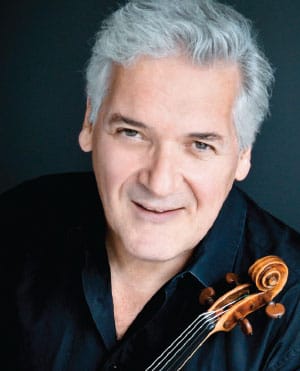
Pinchas Zukerman
With a celebrated career spanning more than six decades, Pinchas Zukerman is a violin and viola soloist, conductor, and chamber musician. His discography of more than 100 albums has gained two Grammy Awards and 21 nominations. He made his San Francisco Symphony debut in January 1969 at the War Memorial Opera House and made his Davies Symphony Hall debut in February 1981.
This season, Zukerman performs with orchestras including the Colorado Symphony, Vienna Philharmonic, and Israel Philharmonic at Carnegie Hall. A tour of Japan features concerts with the ARK Philharmonic, and he solos with the Belgrade Philharmonic and tours with Sinfonia Varsovia. The season also includes engagements in Korea with the KG Philharmonic in Seoul and the KNN Broadcasting Orchestra in Busan, as well as in China with the Hangzhou Philharmonic. Recent highlights include performances with the Vienna Philharmonic, Gulbenkian Orchestra, Zurich Chamber Orchestra, Basque National Orchestra (Euskadiko Orkestra), and a Japanese tour with the Danish Philharmonic.
A devoted teacher and champion of young musicians, Zukerman has served as chair of the Pinchas Zukerman Performance Program at the Manhattan School of Music for more than 30 years, and has been the Dallas Symphony’s artistic and principal education partner since 2021, collaborating with Southern Methodist University’s Meadows School of the Arts to provide intensive coaching and tutoring for its music students. Zukerman has received honorary doctorates from Brown University, Queen’s University in Canada, and the University of Calgary, as well as the National Medal of Arts from President Ronald Reagan. He is a recipient of the Isaac Stern Award for Artistic Excellence in Classical Music.
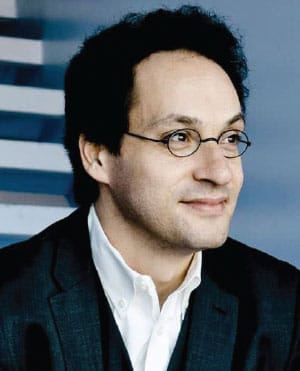
Shai Wosner
Shai Wosner’s recent and upcoming highlights include recitals and chamber music in Japan, a return to the Utah Symphony, and performances of piano concertos by Mason Bates and Vijay Iyer. He performed with the Jack Quartet at the newly reopened Frick Collection and tours separately with Pinchas Zukerman and Joshua Bell (with whom he returns to the Great Performers Series for a recital on April 19).
Wosner has appeared with the Vienna Philharmonic, Berlin Staatskapelle, London Symphony, the BBC orchestras, Philadelphia Orchestra, Pittsburgh Symphony, Cleveland Orchestra, Atlanta Symphony, Indianapolis Symphony, Chicago Symphony, Dallas Symphony, and Los Angeles Philharmonic, among many other ensembles. He made his solo debut with the San Francisco Symphony in February 2005.
In recent years, Wosner’s arrangements have gained widespread recognition. His chamber versions of Beethoven symphonies have been premiered and toured by Emanuel Ax, Leonidas Kavakos, and Yo-Yo Ma, and are available in Grammy Award–nominated recordings on Sony Classical. His own acclaimed recordings for Onyx Classics range from Schubert sonatas, to chamber works by Bartók and Kurtág, to concertos by Haydn and Ligeti.
Born in Israel, Wosner studied piano with Opher Brayer and Emanuel Krasovsky, as well as composition, theory, and improvisation with André Hajdu. He later studied with Emanuel Ax at the Juilliard School, where he is now on the piano faculty. Wosner is a recipient of Lincoln Center’s Martin E. Segal Award, an Avery Fisher Career Grant, and a Borletti-Buitoni Trust Award.