In This Program
The Concert
Thursday, March 26, 2026, at 2:00pm
Friday, March 27, 2026, at 7:30pm
Saturday, March 28, 2026, at 7:30pm
Inside Music Talk with Sarah Cahill
Thursday: on stage immediately after the performance
Friday and Saturday: on stage at 6:30pm before each performance
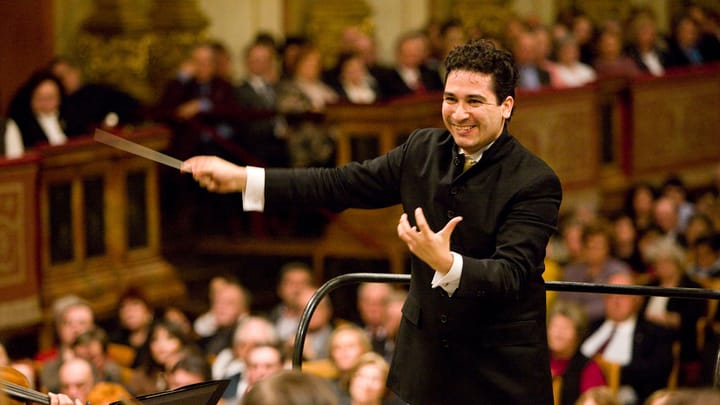
Philippe Jordan conducting
Claude Debussy
Prelude à L’Après-midi d’un faune (1894)
Camille Saint-Saëns
Piano Concerto No. 5 in F major, Opus 103, Egyptian (1896)
Allegro animato
Andante
Molto allegro
Jean-Yves Thibaudet
Intermission
Hector Berlioz
Symphonie fantastique, Opus 14 (1830)
Reveries, Passions
A Ball
Scene in the Fields
March to the Scaffold
Dream of a Witches’ Sabbath
Thursday matinee concerts are endowed by a gift in memory of Rhoda Goldman.
Inside Music Talks are supported in memory of Horacio Rodriguez.
Program Notes
At A Glance
Yet the other two works on this week’s program embody sharply different ideas of what orchestral music can be. Camille Saint-Saëns embraces color, travel, and spectacle in his Egyptian Piano Concerto, while remaining rooted in Classical balance and clarity. Berlioz’s Symphonie fantastique, though the earliest work on the concert, erupts as a piece of obsessive narrative and orchestral excess, shattering inherited forms rather than refining them.
Prélude à L’Après-midi d’un faune
Claude Debussy
Born: August 22, 1862, in Saint-Germain-en-Laye, France
Died: March 25, 1918, in Paris
Work Composed: 1892–94
SF Symphony Performances: First—February 1912. Henry Hadley conducted. Most recent—January 2025. Mark Elder conducted.
Instrumentation: 3 flutes, 2 oboes, English horn, 2 clarinets, 2 bassoons, 4 horns, 2 harps, antique cymbals, and strings
Duration: About 10 minutes
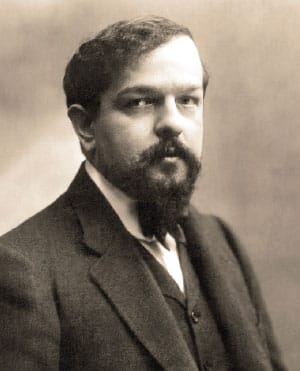
Prelude to the Afternoon of a Faun, Claude Debussy’s first important work for orchestra, is often cited as the point of origin of the French composer’s thinking as a radical innovator. Just as often, the piece evokes associations with so-called impressionism. Debussy disliked that analogy with the visual arts, however, preferring to point to the literary source behind the piece: Stéphane Mallarmé’s poem “L’Après-midi d’un faune” (The Afternoon of a Faun), which dates back to 1865 and was published in 1876.
The poem is a dramatic monologue whose ancient pastoral setting alludes to the Eclogues of Virgil. The setting serves as the backdrop for the erotic fantasies entertained by a faun—a mythic rural deity who is half-man, half-goat—as he recalls his attempts to seduce beautiful nymphs. The faun evokes the seductive spell of music by playing his reed pipes. Debussy initially envisioned an orchestral triptych based on the poem but completed only the first part (which is why he gave it the qualifier “Prelude”).
With Faun, Debussy leaves behind the Romantic world of emotional subjectivity and enters a nebulous, twilit sphere that resounds with harmonic and rhythmic ambiguities. He abandons the principle of conventional thematic development as well, but he does use thematic and harmonic recall throughout the piece for his own expressive ends. Faun thus veers away from the narrative structure of Romantic tone poems, offering a self-contained meditation on Mallarmé’s ode to sex and art.
Debussy replaces such thematic and narrative approaches with a musical process that is closer to the hazy logic of dreams. The score’s breath-like gestures and exquisite instrumental coloring hint at the borderline state between dreaming and consciousness. Debussy’s precision and nuance of gesture convey the ebb and flow of lust and longing—and opened the door to a new century of musical experimentation.
This music, as well as the source poem by Mallarmé, held great allure for the dancer and choreographer Vaslav Nijinsky, a star of the expat company the Ballets Russes established in 1909 in Paris by the impresario Sergei Diaghilev. Eager to expand his work as a dancer to include choreography, in 1912 Nijinsky turned to Debussy’s score to create a pioneering early modern ballet.
The Music
In the opening bars, a chromatic flute solo conjures the image of the piping faun. The flute’s line oscillates between a C-sharp in the middle of the staff and a G below—a harmonically unstable interval known as the tritone. This harmonic outline subverts conventional patterns of major and minor and thus casts a tantalizingly ambiguous spell on ears accustomed to clearly defined harmonies.
The precision and nuance of Debussy’s scoring convey the ebb and flow of lust and longing. Shifts in weight and balance among the instrumental textures become musical events. Notice, for example, the perfectly timed touch of the “ancient cymbals” that, toward the end, suddenly cast an entirely new light of wistful reflection on music we have heard.
Piano Concerto No. 5 in F major, Opus 103, Egyptian
Camille Saint-Saëns
Born: October 9, 1835, in Paris
Died: December 16, 1921, in Algiers
Work Composed: 1896
SF Symphony Performances: First—January 1969. Seiji Ozawa conducted with Jeanne-Marie Darre as soloist. Most recent—January 2016. Edwin Outwater conducted with Stephen Hough as soloist.
Instrumentation: solo piano, 2 flutes, piccolo 2 oboes, 2 clarinets, bass clarinet, 2 bassoons, 4 horns, 2 trumpets, 3 trombones, timpani, tam-tam, and strings
Duration: About 30 minutes
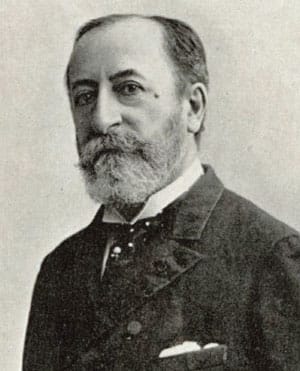
Astonishingly prolific, Camille Saint-Saëns lived so long—and across so many stylistic eras—that he experienced the rare fate of becoming, in old age, an opponent of the very musical progress he had once championed. In his prime, he had been a bold advocate for radical figures such as Liszt and Wagner; later, he attacked the innovations of Debussy and Stravinsky. Yet throughout these shifting tides of taste, Saint-Saëns remained supremely at ease in just about every musical genre he could imagine—he even lived long enough to become a pioneer of the film score—with the solo concerto proving an especially congenial form.
A virtuoso pianist himself, Saint-Saëns had helped introduce all five Beethoven piano concertos to skeptical Parisian audiences and composed a cycle of five concertos of his own, performing them with formidable authority. A child prodigy, he made his public debut at the age of 10 playing concertos by Mozart and Beethoven, and quickly established a reputation for effortless command at the keyboard. Composition came just as naturally: Saint-Saëns liked to compare his productivity to an apple tree bearing fruit, and across an exceptionally long career he remained a conspicuous presence in musical life, giving his final public performance only months before his death at age 86.
Saint-Saëns was an inveterate traveler, repeatedly seeking refuge from Parisian winters in North Africa. The Piano Concerto No. 5 was written during one such stay in Luxor, the ancient pharaonic capital on the Nile, known to the Greeks as Thebes. It was premiered in the spring of 1896, at a gala concert marking the 50th anniversary of Saint-Saëns’ debut recital—which was even held in the same Parisian venue where he had appeared so long ago, the Salle Pleyel. Introducing the work, the composer wryly remarked that he had once been “too young for the part he had to play,” and now, at 60, felt himself too old—but hoped his audience might help “blow a few dying cinders to life.”
The Music
Soft, sustained chords in the woodwinds and a few bars of plucked strings at the outset give way to the piano’s gracefully lilting first theme, and the soloist also introduces the second theme, a slower, lugubrious idea in the minor. The movement continues to reconsider the relative merits of these contrasting themes, ending with a deliciously dreamy coda.
The most unusual music appears in the Andante, which begins with a sense of excitement not typical of a songful slow movement. Saint-Saëns introduces unusual scale variants and elaborate arabesques. While the right hand offers flowing accompaniment, a haunting melody emerges from the left. Here, as the composer later recalled, he smuggled in “a Nubian love-song that I heard sung by the boatmen on the Nile when I was going downstream in a dahabiah.” He likened another passage set in the keyboard’s highest register to the sound of frogs croaking along the Nile at twilight. Jean-Yves Thibaudet points to a moment early in the movement when the piano “suddenly sounds like a completely different instrument—almost as if it were prepared.”
The finale brings this musical journey to its culmination with dazzling figurations and excited themes that suggest a madly ecstatic dance unfolding. Saint-Saëns creates a sense of rush towards a destination—indeed, he described the concerto as a whole “as a kind of voyage in the East.”
Symphonie fantastique, Opus 14
Hector Berlioz
Born: December 11, 1803, in La Côte-Saint-André, France
Died: March 8, 1869, in Paris
Work Composed: 1830
SF Symphony Performances: First—January 1920. Alfred Hertz conducted. Most recent—October 2022. Esa-Pekka Salonen conducted
Instrumentation: 2 flutes (2nd doubling piccolo), 2 oboes (2nd doubling English horn), 2 clarinets (2nd doubling E-flat clarinet), 4 bassoons, 4 horns, 4 trumpets, 3 trombones, 2 tubas, timpani (2 players), percussion (cymbals, snare drum, field drum, bass drum, and bells), 2 harps, and strings
Duration: About 50 minutes
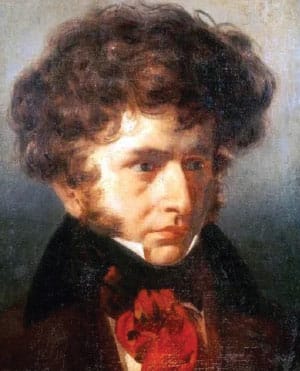
A lifelong sense of curiosity was cultivated in the young Hector Berlioz by his father, a liberal-minded, agnostic physician who experimented with hydrotherapy and acupuncture. Growing up in southeastern France, with the distant backdrop of the Alps, young Hector learned from his father a love of literature, especially Latin (Virgil) and French, and a taste for travel books that stimulated his desire to visit distant lands. The elder Berlioz even offered some basic instruction on a small wind instrument to his son, who would later become adept on the flute and guitar (though never the piano).
But a life in music was not on the agenda: Berlioz’s father wanted him to follow in his footsteps and prepare for a career in medicine. Despite a couple of years of attempting to appease his parents by pursuing medical studies in Paris, Berlioz could not resist his attraction to all things musical. The inquiring spirit encouraged by his parent led him to devote long evenings to new discoveries at the opera and to seek out classes at the conservatory. He was still only 21 when he determined, according to a colleague, to be “no doctor nor apothecary but a great composer.”
Only five years later, Berlioz was at work on one of the most provocative symphonic debuts in music history with his Symphonie fantastique, into which he poured all of the intellectual and emotional experiences that were formative for this insatiably curious young artist. A key impetus occurred in the fall of 1827, when a London theater company took Paris by storm during its residency at the Théâtre de l’Odéon on the Left Bank. It presented a handful of Shakespeare plays—performed in English—that caught the attention of the young Berlioz, who had by then decisively rejected the medical path in order to follow his bliss.
Not a small part of that impact centered on the Irish actress Harriet Smithson, who played Ophelia and Juliet. Berlioz’s infatuation with Smithson became nothing short of an obsession—but ultimately faded: once impossibly distant, she eventually married the composer, but the couple grew alienated and later separated. What endured, however, was the encounter’s artistic legacy. Berlioz’s passion for Shakespeare remained central to his imagination for the rest of his life and inspired several major works. A little later, he experienced a similar epiphany when the symphonies of Beethoven were introduced to Paris. Berlioz found a model for the Symphonie’s five-movement design in Beethoven’s Pastoral Symphony.
All of these threads are combined in the Symphonie fantastique, which premiered in December 1830, only three years after Beethoven’s death. Among those in the audience for the 1830 premiere was the younger Franz Liszt, who became a powerful ally. Liszt’s piano transcription of the Symphonie fantastique helped spread the word about Berlioz’s unique genius.
In Berlioz’s original concept, the Symphonie fantastique centers around an unnamed artist’s obsession with a woman who represents his ideal of love. The composer published an elaborate program detailing a narrative about the artist’s conflicting emotions as he moves from “the tumult of a festive party” to “the peaceful contemplation of the beautiful sights of nature … everywhere, whether in town or in the countryside, the Beloved’s image keeps haunting him.” An anxiety that his beloved has betrayed him gnaws at the artist. In despair, he hopes to commit suicide by taking a large dose of opium but instead succumbs to hallucinations that he has murdered the beloved and is in fact witnessing his own execution. The final movement continues this nightmare with an excursion into hell, where the artist participates in a witches’ sabbath celebrating his funeral. Even the beloved takes part in their revels.
The Music
A slow, melancholy introduction to the first movement (Reveries, Passions) evokes the artist in his solitude, incomplete without this love. When the Allegro starts several minutes in, Berlioz presents a theme representing the beloved (flutes and violins), whom he sees for the first time in real life after dreaming of her. He calls this theme the idée fixe—a “fixed idea” because it not only represents the artist’s obsessive image of the beloved but plays a key part in the musical pattern and recurs at crucial moments, each time in a varied context. The melody’s yearning quality suggests how much the idée fixe is actually a projection of the artist’s own desire.
The dance-centered second movement (A Ball), with its scintillating harp textures, foregrounds the classical side of Berlioz, who also numbered Mozart and Gluck among his idols. The third movement (Scene in the Fields) is the longest and most enigmatic—the impulses from Beethoven’s Pastoral are most obvious here. The oboe and English horn evoke duetting shepherds overheard by the self-conscious artist. The natural setting translates his subjective angst into menacing weather.
If the first two movements focus on the idealism of the artist’s love, the last two trace his descent into hell. “March to the Scaffold” includes a chilling image of the barbaric crowd whose bloodthirst has been aroused by the prospect of a death sentence. “Dream of a Witches’ Sabbath” incorporates some of Berlioz’s most striking orchestral special effects. The idée fixe morphs into a mocking, high-pitched taunt on the clarinet, launching the witches’ orgy, while the ancient Dies irae (Day of wrath) melody from the Catholic Requiem, the musical emblem of the Last Judgment, is similarly parodied in a frenetic—and viscerally exciting—passage in which Berlioz combines it with the witches’ dance.
Violins and violas striking their instruments with the wood of the bow, graveyard bells mixed with bellowing tuba: Berlioz’s unrelenting curiosity pressed him to explore sonic extremes that redefined assumptions about what music itself could express. The Symphonie fantastique not only provided the composer with a means of catharsis for his own turbulent experience of personal relationships but signaled a revolutionary new approach to music as a medium for autobiographical, subjective expression.
—Thomas May
Sarah Cahill is a pianist who has worked closely with numerous contemporary composers. She hosts Revolutions Per Minute every Sunday from 6:00pm–8:00pm on KALW 91.7 and is a regular speaker at the Los Angeles Philharmonic and San Francisco Symphony. She serves on the Music History and Literature faculty of San Francisco Conservatory of Music.
About the Artists
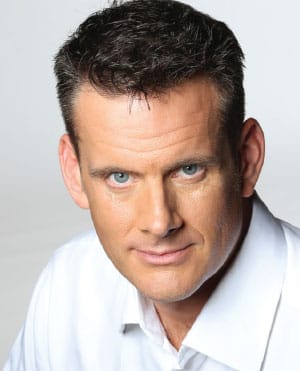
Philippe Jordan
Philippe Jordan has been named music director of Orchestre National de France beginning with the 2027–28 season. He previously served as music director of the Vienna State Opera, music director of Opéra National de Paris, chief conductor of the Vienna Symphony, and principal guest conductor at the Berlin State Opera, among other positions.
Jordan appears this season with the Vienna State Opera on tour to Japan, as well as with Opéra de Paris, La Scala, Dresden Staatskapelle, Zurich Tonhalle Orchestra, Bamberg Symphony, Vienna Symphony, Chicago Symphony, Seoul Philharmonic, Hong Kong Philharmonic, and NHK Symphony. Born to an artistic Swiss family, Jordan has collaborated with the Berlin Philharmonic, Vienna Philharmonic, Royal Concertgebouw Orchestra, London Symphony, Philharmonia Orchestra, Boston Symphony, Chicago Symphony, Cleveland Orchestra, Philadelphia Orchestra, and Los Angeles Philharmonic. He made his San Francisco Symphony debut in October 2007.
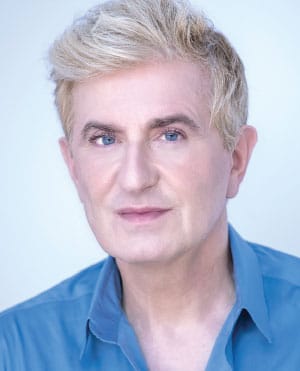
Jean-Yves Thibaudet
Jean-Yves Thibaudet has earned a reputation as one of the world’s finest pianists and is especially known for his diverse interests beyond the classical world, including numerous collaborations in film, fashion, and visual arts. He is the first-ever artist in residence at the Colburn School, which awards several scholarships in his name. He made his San Francisco Symphony debut in October 1994.
A prolific recording artist, Thibaudet has appeared on more than 70 albums and six film scores. His extensive catalog has received two Grammy nominations, two Echo Awards, the German Record Critics’ Award, the Diapason d’Or, the Choc du Monde de la Musique, the Edison Prize, and Gramophone Awards. Thibaudet is the soloist on Dario Marianelli’s reissued score for Pride & Prejudice, which was certified Gold by the RIAA in 2025. His playing can also be heard on Atonement, The French Dispatch, Extremely Loud & Incredibly Close, and Wakefield. His concert wardrobe was designed by Vivienne Westwood.