In This Program
The Concert
Thursday, June 25, 2026, at 2:00pm
Friday, June 26, 2026, at 7:30pm
Saturday, June 27, 2026, at 7:30pm
Inside Music Talk with Sarah Cahill
Thursday: on stage immediately after the performance
Friday and Saturday: on stage at 6:30pm before each performance
Stéphane Denève conducting
Guillaume Connesson
Flammenschrift (2012)
First San Francisco Symphony Performances
Francis Poulenc
Organ Concerto in G minor (1938)
Andante–Allegro giocoso–Subito andante moderato–
Tempo allegro, molto agitato–Très calme. Lent–
Tempo de l’allegro initial–Tempo introduction. Largo
Olivier Latry
Intermission
Camille Saint-Saëns
Symphony No. 3 in C minor, Opus 78, Organ (1886)
Adagio–Allegro moderato–Poco adagio
Allegro moderato–Presto–Maestoso
Olivier Latry
These concerts are generously sponsored by the Wattis Special Performance Fund.
Thursday matinee concerts are endowed by a gift in memory of Rhoda Goldman.
Inside Music Talks are supported in memory of Horacio Rodriguez.
Program Notes
At a Glance
Guillaume Connesson’s Flammenschrift draws its instrumentation and key motif from Beethoven’s Fifth Symphony, and the contemporary French composer has been a frequent collaborator with Denève. Francis Poulenc’s Organ Concerto “is not the happy-go-lucky Poulenc,” the composer himself said, but rather “a Poulenc en route to the cloister—a 15th-century Poulenc.”
Finally, Camille Saint-Saëns’s Organ Symphony has been a hit with audiences since 1886, when the composer led the Royal Philharmonic Society in its world premiere. His writing for the organ—quietly shaded at first, commanding later—is the perfect showcase for Davies Symphony Hall’s Ruffatti organ.
Flammenschrift
Guillaume Connesson
Born: May 5, 1970, in Boulogne-Billancourt, France
Work Composed: 2012
First SF Symphony Performances
Instrumentation: 2 flutes, piccolo, 2 oboes, 2 clarinets, 2 bassoons, contrabassoon, 2 horns, 2 trumpets, 3 trombones, timpani, and strings
Duration: About 10 minutes
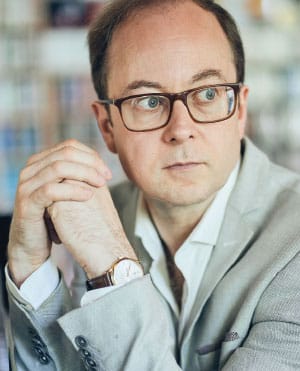
In an interview for the French-language publication Tutti, Guillaume Connesson described his experience of music as a visceral force, something felt in the body, not generated by the brain:
“Very often I write pieces that have a relationship with dance,” he explained. “But with me the dance must be so spontaneous that nothing about it is premeditated. I like dance, but I think above all that I’m attracted to the place that exists between the body and rhythm.... When jazz bassists express a rhythm, they feel it and don’t read it off the page. It’s this rhythm that can’t be written down that I’m seeking. For me, the score is there only to represent a bridge of memory between rhythm and the body.”
Born and raised in a suburb of Paris, Connesson is the recipient of many international awards and honors and has produced an eclectic catalogue that spans all the major genres, from études to operas. Stylistically, he draws from what he calls “the complex mosaic of the contemporary world,” which might mean Ludwig van Beethoven, James Brown, John Adams, Maurice Ravel, or Bernard Herrmann, depending on the situation. He completed Flammenschrift in 2012, fulfilling a commission for a Beethoven-related work from the conductor Daniele Gatti and the National Orchestra of France. Conceptually, the piece focuses on Beethoven’s iconic Fifth Symphony, but Connesson radically expands the Beethovenian sound world, pushing it beyond Brahms into new harmonic terrain.
Connesson later turned Flammenschrift into a symphonic triptych by combining it with two similar orchestral works, Maslenitsa and E chiaro nella valle il fiume appare, which pay tribute to the Russian and Italian musical traditions, respectively. Stéphane Denève and the Brussels Philharmonic Orchestra recorded all three pieces, along with a flute concerto by Connesson, for the 2016 Deutsche Grammophon release Pour sortir au jour.
The Music
In his own program notes, Connesson connects Flammenschrift not only to Beethoven, the immediate source of inspiration, but also to Beethoven’s late Romantic successors:
Flammenschrift, or “fire-letter,” is a word that Goethe used in his poem “Marienbad Elegy.” I wished to compose a “Furies’ tune” that draws a psychological portrait of Beethoven and, more generally, pays homage to the music of Germany. For Beethoven I portray an angry, seething, impetuous man, whose interior violence shows through in numerous pages of his music. In his works, Beethoven constantly celebrated the fraternity of man, but he was often harsh with his loved ones and domestic servants. My desired musical portrait originates in this paradox. This misanthropic Beethoven—seen walking down the street looking disheveled, with his misshapen hat, this loner cursed by destiny but sanctified by genius—has always fascinated me: he constructed a very significant image of the artist in the 19th-century imagination that endures to the present day.
To pay tribute to him, I use the same instrumentation as in his Fifth Symphony, but also some oppositions of characteristic units (the winds against the strings), and above all a rhythmic language that frequently alludes to his work. But in a larger sense, it was to the whole of Germanic music that I wanted to give homage, with glimpses of compositions by Brahms and Richard Strauss toward the end of the piece.
Flammenschrift is cast in a kind of double-sonata form, without the opening recapitulation. Two themes of a fierce character are revealed first; a third, initially more relaxed one (carried by the clarinets and bassoons) will experience a great number of transformations. Finally, a fourth, more lyrical theme completes the substance of the introduction. After a lengthy development, the four themes are transmuted, in the memory of the major-key eruption from the Fifth’s finale: the drama followed by a dance of joy.
Organ Concerto in G minor
Francis Poulenc
Born: January 7, 1899, in Paris
Died: January 30, 1963, in Paris
Work Composed: 1936–38
SF Symphony Performances: First—July 1973. Arthur Fiedler conducted with Ludwig Altman as soloist. Most recent—April 2009. Yan Pascal Tortelier conducted with Paul Jacobs as soloist.
Instrumentation: solo organ, timpani, and strings
Duration: About 20 minutes
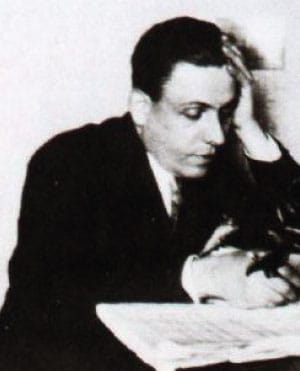
In 1936, not long after Francis Poulenc began his Organ Concerto, his best friend, the composer and critic Pierre-Octave Ferroud, died in a car accident. The tragedy transformed Poulenc, who found comfort and meaning in his Christian faith. The old Poulenc, the so-called “apostle of the Parisian café concert,” was irreverent and urbane, a bad boy who hobnobbed with Erik Satie and Georges Auric. The new Poulenc aspired to the devoutness of “a simple country parson,” in his words. As a young man he scored an exuberant modernist ballet for Diaghilev; by his mid-30s he was making pilgrimages to Catholic shrines and composing sacred music.
A few years before his spiritual conversion, Poulenc fell passionately in love with a man. Although their physical relationship ran its course, the pair remained lifelong friends. Poulenc’s sexual orientation didn’t keep him from proposing to a close female friend, who gently rebuffed him and then died unexpectedly, breaking his heart. For Poulenc, religion offered solace, not judgment or reprieve. His devotional music carries the same tender urgency as the secular love songs that he never stopped writing.
“You will find sobriety and sadness in French music just as in German or Russian,” Poulenc observed. “But the French have a keener sense of proportion. We realize that somberness and good humor are not mutually exclusive. Our composers also write profound music, but when they do, it is leavened with that lightness of spirit without which life would be unendurable.”
Poulenc received the commission for the organ concerto in 1934, two years before his spiritual epiphany and four years before he finally completed the assignment. The commission came from an American sewing-machine heiress turned French royal, Princess Edmond de Polignac (née Winnaretta Singer), who wanted a piece with chamber orchestra accompaniment and a relatively easy organ part that she might play herself, on her magnificent Cavaillé-Coll instrument.
Poulenc completed the concerto in 1938, after years of struggle. The organ part—inspired by the intricate keyboard fantasies of Buxtehude, Bach, and other Baroque heavies—was no longer even close to easy by this point. “This is not the happy-go-lucky Poulenc who wrote the Concerto for Two Pianos,” he confessed in a letter to a colleague, “but a Poulenc en route to the cloister—a 15th-century Poulenc, if you like.”
The first performance took place on December 16, 1938, at the Polignac mansion in Paris, with Maurice Duruflé on organ and Nadia Boulanger conducting. Years later, while exiled in England during World War II, the princess sent a brief but heartfelt note to Poulenc about the work she had commissioned: “Its profound beauty haunts me.”
The Music
Because this was Poulenc’s first attempt at a work for organ, he relied on Duruflé for technical advice on registration and voicing. It is scored for solo organ, timpani, and string orchestra because the princess wanted to perform it in her own salon.
Although concise, at approximately 20 minutes, the concerto comprises seven continuous sections. It isn’t divided into three distinct movements, in the style of a typical concerto, but it retains something of the conventional fast-slow-fast structure.
Poulenc described it as “grave and austere,” a great step in a new direction. “Properly speaking,” he explained, “it is not a concerto da chiesa (church concerto), but in limiting the orchestra to strings and timpani, I made performance in church possible.”
Symphony No. 3 in C minor, Opus 78, Organ
Camille Saint-Saëns
Born: October 9, 1835, in Paris
Died: December 16, 1921, in Algiers, Algeria
Work Composed: 1886
SF Symphony Performances: First—August 1931. Pierre Monteux conducted. Most recent—February 2020. Fabien Gabel conducted with Jonathan Dimmock as organist.
Instrumentation: 3 flutes (3rd doubling piccolo), 2 oboes, English horn, 2 clarinets, bass clarinet, 2 bassoons, contrabassoon, 4 horns, 3 trumpets, 3 trombones, tuba, timpani, percussion (triangle, cymbals, and bass drum), piano (4 hands), organ, and strings
Duration: About 35 minutes
We call the pipe organ the “king of instruments” because it reigns supreme, surpassing its orchestral brethren by nearly every measure: size, weight, decibel level, and timbral range.
It’s a pity that the adjective “awesome” is so overused because a pipe organ augmented by an orchestra—or an orchestra augmented by a pipe organ, if you prefer—induces actual awe, the state of speechless reverence. Volume has little to do with it. By deploying certain frequencies below the human range of hearing, Saint-Saëns’s Symphony No. 3 creates an effect more powerful than mere loudness. These subliminal bass tones demonstrate, through the listener’s own body, that taking in sound is primarily a physical experience.
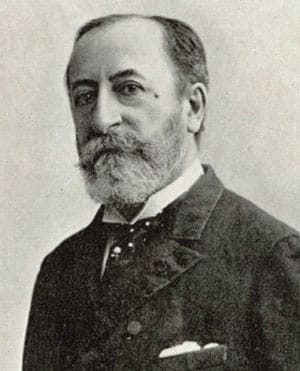
Saint-Saëns exerted a huge influence over the cultural life of France during the second half of the 19th century. As a child prodigy with a photographic memory, he wowed crowds by playing Mozart and Beethoven piano concertos by heart. At age 12 he entered the Paris Conservatory; three years later, he won first prize in organ. At 21 he was named organist at the church of La Madeleine, a post he held for 20 years. A true polymath, he studied astronomy, science, mathematics, and anthropology when he wasn’t composing works in nearly every musical genre that existed.
Saint-Saëns was 50 and in the full bloom of his fame when he finished Symphony No. 3. Although he was a brilliant organist, his Organ Symphony is not an organ concerto manqué. Instead, he made the organ an essential complement to the orchestra, a partner rather than a rival king. It’s not even the only keyboard instrument in the score; a piano, sometimes played with four hands, contributes a glittering carillon to the finale. The work’s ingenious structure reflects his interest in Lisztian thematic transformation, whereby a modified motif, or motivic kernel, spawns all the musical ideas of subsequent movements. “I gave everything to it I was able to give,” he wrote. “What I have here accomplished, I will never achieve again.” Although he lived another 36 years, he never composed another symphony.
The Music
The Organ Symphony has been a hit with audiences since its premiere at London’s St. James Hall, on May 19, 1886, when Saint-Saëns led the Royal Philharmonic Society in the work that it had commissioned.
Although Saint-Saëns lived long enough to be viewed as musically conservative, his Symphony No. 3 boasts many innovations. As he acknowledged in the program notes distributed at the premiere, no previous symphony had called for both an organ and a piano: “The composer felt that the time had come for the symphony to benefit from the progress made in modern instrumentation.” It’s also cast in two movements, although, as he noted, “the traditional four-movement structure is maintained.”
The Organ Symphony was among the earliest symphonies in France to adopt the concept of cyclical themes: artfully developed variants from a primary motivic source that unifies all the sections of the work. Listen for the ascending four-note figure introduced in the slow C-minor opening; it’s first sung by the oboe over plangent string harmonies. This motif resurfaces as a tender consolation in the Adagio and as a radiant chorale in the finale. In a strongly Beethovenian gesture, the symphony begins in C minor and ends up in C major, inscribing a dramatic struggle-to-triumph trajectory.
As for the organ part, its range descends to the lowest pedal notes in both the Poco adagio and the Maestoso, a deep, barely audible rumble that bypasses the brain to inhabit the body. Divine possession? Communion with the Holy Spirit? To quote an old Jamaican proverb by way of Bob Marley: “who feels it, knows it.”
—René Spencer Saller
The Ruffatti Organ
The San Francisco Symphony’s Ruffatti Organ is designed as “many organs within an organ” rather than merely as one extremely large instrument. The great array of stops offers organists choices of tone colors typical of organs from the 16th, 17th, 18th, 19th, and 20th centuries, and from Germany, France, England, Italy, Spain, the Netherlands, and the United States.
There are stops of lengths other than these normal lengths that sound not an octave or two higher or lower than the normal pitch, but some intermediate pitch, or harmonic, in between (i.e., the fifth above the octave). These stops are drawn together with stops of normal pitch to reinforce a note’s natural harmonics. It is these stops that make the organ unique: This is the only instrument where the player can actually control the harmonics that occur naturally when a note is played, thereby adding brightness and vitality to the sound and increasing the tonal variety of the instrument.
There are also “mixture” stops, which comprise several pipes grouped together and operated as though they were one pipe, simultaneously speaking different harmonics of a note. Like the stops described above, these are also drawn together with stops of normal pitch to vary the tone color and create feelings of richness and grandeur.
The names of stops have evolved over the centuries and developed from many traditions and circumstances. Some, like the Flûte, Trompette, and Cornet, are self-explanatory. Others take their names for no apparent reason: the Erzähler is an American stop meaning “storyteller”; the Flûte Magique is named after Mozart’s Magic Flute. Still others refer to attachments that have nothing to do with the pipes at all, i.e., the Étoile de Matin, an embellishment of bells that added a festive splendor to Baroque organs and can be seen spinning on a gold-leafed star near the top of the façade, center-stage. Regardless of how peculiar the names of stops may appear—Aliquot, Larigot, Contre Montre—they conjure specific musical sounds to organists, much as the jargon of a new cookbook might conjure tastes and aromas to an experienced cook.
—Adapted from notes by Fred Tulan
About the Artists
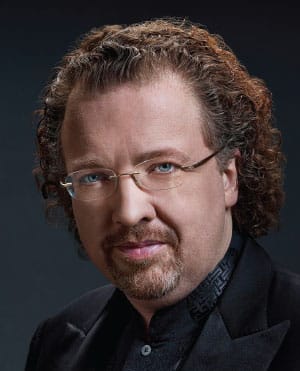
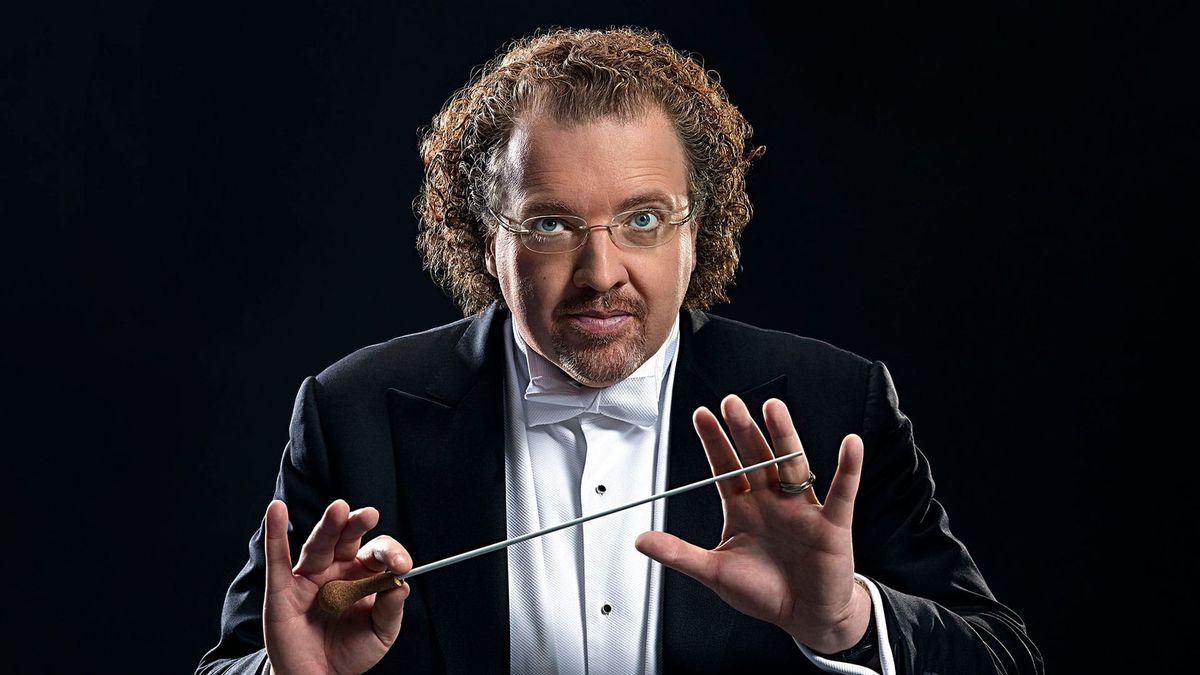
Stéphane Denève
Stéphane Denève is music director of the St. Louis Symphony, artistic director of the New World Symphony, and principal guest conductor of the Netherlands Radio Philharmonic. He previously served as principal guest conductor of the Philadelphia Orchestra, music director of the Brussels Philharmonic, chief conductor of the Stuttgart Radio Symphony, and music director of the Royal Scottish National Orchestra.
In North America, he has performed with the New York Philharmonic, Cleveland Orchestra, Chicago Symphony, Los Angeles Philharmonic, and Boston Symphony. Recent European appearances include the Berlin Philharmonic, Royal Concertgebouw Orchestra, Bavarian Radio Symphony, Vienna Symphony, Czech Philharmonic, BBC Proms, Orchestre National de France, and Royal Stockholm Philharmonic, with whom he conducted the 2020 Nobel Prize Concert. In Asia and Oceania, Denève has appeared with the NHK Symphony, Sydney Symphony, New Zealand Symphony, Hong Kong Philharmonic, and Saito Kinen Orchestra, with whom he conducted Deutsche Grammophon’s 125th anniversary gala. He made his San Francisco Symphony debut in April 2009.
A graduate and prize winner of the Paris Conservatory, Denève worked closely in his early career with Georg Solti, Georges Prêtre, and Seiji Ozawa. As an educator, he leads the New World Symphony and has also worked with students at the Colburn School, Tanglewood Music Center, European Union Youth Orchestra, Aspen Music Festival, Curtis Institute of Music, and Music Academy of the West.
Denève’s discography includes award-winning recordings of Poulenc, Debussy, Ravel, Roussel, and Connesson. Recent releases feature works by Kevin Puts and John Williams with the St. Louis Symphony, and his complete Ravel recordings with the Stuttgart Radio Symphony were released by Hänssler Classic in 2022.
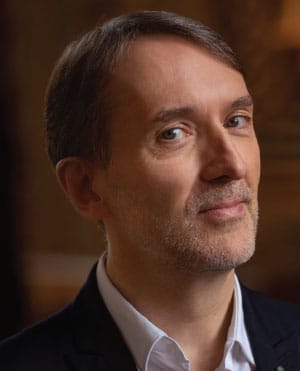
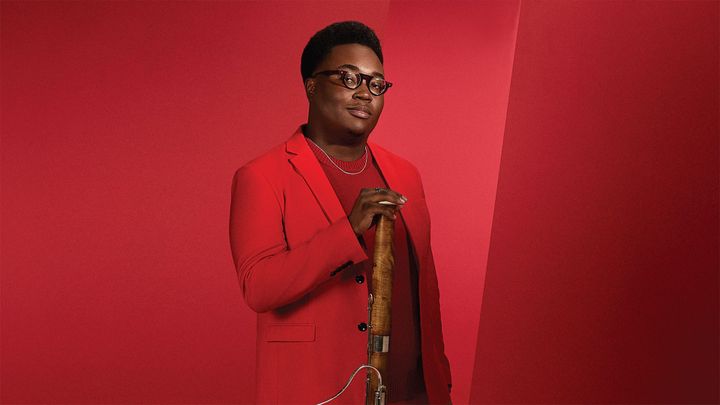
Olivier Latry
Olivier Latry was appointed a titular organist at Notre-Dame in Paris at age 23, and has been organist emeritus at Orchestre National de Montréal since 2012. He regularly appears at the Berlin Philharmonie, Philharmonie de Paris, Disney Hall, Concertgebouw, Elbphilharmonie, Leipzig Gewandhaus, Musikverein, Royal Albert Hall, and Suntory Hall, among many other venues. He has appeared as a soloist with the Berlin Philharmonic, Philadelphia Orchestra, Los Angeles Philharmonic, Boston Symphony, NHK Symphony, Tokyo Metropolitan Symphony, Orchestre de Paris, Orchestre National de France, Orchestre Philharmonique de Radio France, Munich Philharmonic, Philharmonia Orchestra, Sydney Symphony, Hong Kong Philharmonic, and Toronto Symphony. He made his San Francisco Symphony debut in November 2010.
In 2023 Latry premiered Esa-Pekka Salonen’s Sinfonia concertante for organ and orchestra with the Berlin Philharmonic, conducted by Salonen. Other premieres have included Pascal Dusapin’s Waves, Kaija Saariaho’s Maan Varjot, and Michael Gandolfi’s Ascending Light. In 2019, he played the German premiere of Thierry Escaich’s Third Organ Concerto with the Dresden Philharmonic and Stéphane Denève.
Latry’s strong attachment to French organ repertoire led him to record Messiaen’s complete works for organ for Deutsche Grammophon, which he also performed in recitals in Paris, London, and New York. Among several other recordings, Latry also recorded Saint-Saëns’s Symphony No. 3 with the Philadelphia Orchestra for Ondine Records. His latest album is Liszt: Inspirations, recorded on the organ of Philharmonie de Paris.
Latry has taught at the Paris Conservatory and is a recipient of numerous international distinctions and awards. He was named International Performer of the Year by the American Guild of Organists in April 2009 and has received an honorary doctor of music degree from McGill University.
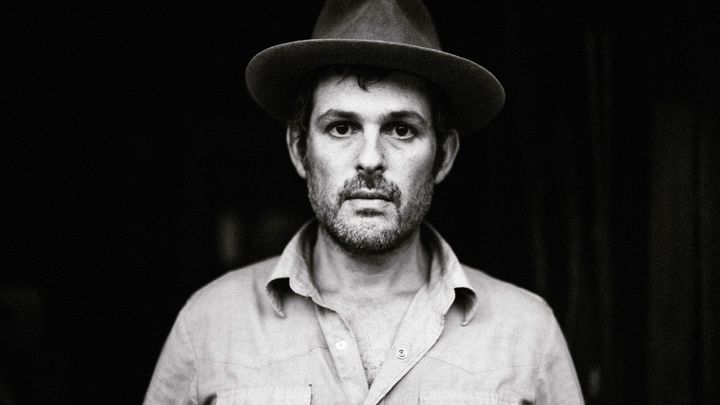
Sarah Cahill is a pianist who has worked closely with numerous contemporary composers. She hosts Revolutions Per Minute every Sunday from 6:00pm–8:00pm on KALW 91.7 and is a regular speaker at the Los Angeles Philharmonic and San Francisco Symphony. She serves on the Music History and Literature faculty of the San Francisco Conservatory of Music.