In This Program
The Concert
Sunday, April 19, 2026, at 7:30pm
Joshua Bell violin
Shai Wosner piano
Franz Schubert
Violin Sonata in A major, D.574 (1817)
Allegro moderato
Scherzo. Presto
Andantino
Allegro vivace
Edvard Grieg
Violin Sonata No. 3 in C minor, Opus 45 (1887)
Allegro molto ed appassionato
Allegretto espressivo alla Romanza
Allegro animato
Intermission
Sergei Prokofiev
Violin Sonata No. 2 in D major, Opus 94a (1943)
Moderato
Scherzo (Presto)
Andante
Allegro con brio
Maurice Ravel
Violin Sonata No. 2 in G major (1927)
Allegretto
Blues: Moderato
Perpetuum mobile: Allegro
Presenting Sponsor of the Great Performers Series

Program Notes
Violin Sonata in A major, D.574
Franz Schubert
Born: January 31, 1797, in Vienna
Died: November 19, 1828, in Vienna
Work Composed: 1817
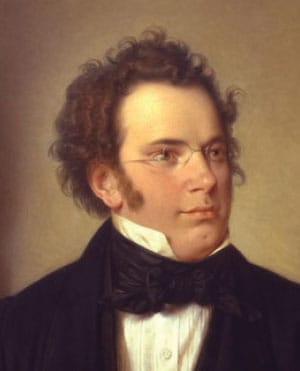
When Schubert wrote this A-major violin sonata—sometimes called the “Grand Duo”—in 1817, it hadn’t been all that long since violin and piano works were marketed as “piano sonatas with optional violin accompaniment.” As dismissive as it might seem, treating the violin as a hanger-on made sense in the context of the mid-18th century, when pianos were relatively flyweight and couldn’t sustain tones very well. An optional violin part that mostly reduplicated the pianist’s right hand was meant to spackle over the piano’s shortcomings in the legato department.
Pianos got better fast, and composers from Mozart onwards began seeking bona fide duos in which violin and piano were treated as separate but equal. By the early 19th century, the process was complete—consider Beethoven’s spectacular Kreutzer Sonata, almost a symphony for violin and piano, and a major workout for both instruments. Later in the century, the piano’s increasing heft and sonority would start causing some serious balance problems. Determined to solve the sonic inequity between the two instruments, Brahms didn’t release a violin sonata until mid-career, and later composers such as Ravel and Stravinsky took assiduous pains to avoid piano parts that inadvertently overwhelmed violinists.
But as of 1817, the two instruments were quite well matched, the piano still being in the early stages of what would soon become a volcanic growth spurt. As it turns out, violin and piano were Schubert’s two instruments; he wasn’t a virtuoso on either, but he could get around well enough on both, so his six some-odd works for the combination come from insider knowledge playing both sides. That’s not to say that they balance themselves; pianists still needed to keep careful watch over their volume levels. But a near-ideal balance between the two instruments is eminently possible in Schubert’s violin-piano duos, even considering the modern piano’s sonic heft.
As of 1817 Schubert hadn’t yet adopted the longer-means-better attitude that can challenge listeners of his later works. The A-major sonata is as notable for its trim efficiency as it is for its lyrical abundance and high spirits. Its nature as a true duo is manifest at the very opening, with a steady walking-bass theme in the piano’s left hand complemented by a more traditional melody in the violin, intriguingly left undeveloped and returning only at the start of the recapitulation. The piano’s left-hand rhythms, however, put in frequent appearances during the brief development section.
An elfin, lighter-than-air scherzo soars on an updraft of ascending arpeggios and bouncy rhythms, its contrasting trio section as suave as the scherzo is frisky. The third-place Andantino can be described as peak Schubert, an engaging valentine of a piece that makes some fascinating harmonic excursions away from its comfortable C-major home base, while the finale goes decidedly rowdy with cross-rhythms, nervous energy, and a healthy assortment of unexpected twists and turns.
Violin Sonata No. 3 in C minor, Opus 45
Edvard Grieg
Born: June 15, 1843, in Bergen, Norway
Died: September 4, 1907, in Bergen
Work Composed: 1887
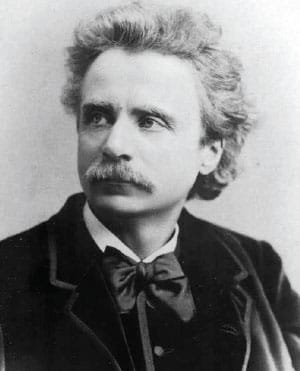
Edvard Grieg wasn’t much for multi-movement symphonic or chamber works; he ran more toward piano miniatures, theatrical and choral music, and art songs. He did produce a youthful symphony, one completed string quartet, one cello sonata, and one piano concerto. But that was about it, except for the one chamber genre for which he had a marked penchant: the violin sonata. Grieg composed three.
There’s a reason for that. A patron saint of sorts hovers over Grieg’s three violin sonatas: Norwegian violinist-composer Ole Bull (1810–80), a founding father of nationalistic Norwegian music and a critical influence on Grieg’s education and career. It was Bull who was responsible for shipping the young Edvard off to the Leipzig Conservatory—he hated the place—and who guided and shepherded Grieg’s early professional steps. A Bull specialty was the hardingfele, or hardanger fiddle, a folk violin with added understrings for extra resonance and a flattened bridge that made playing simultaneous multiple strings easier than on a traditional violin.
Thus we find the genesis not only of Grieg’s atypical bevy of violin sonatas, but also in the effective and idiomatic string writing found in those works—all the more impressive considering that Grieg’s instrument was the piano, not the violin. Not surprisingly, Grieg considered the sonatas to be among his very best works, describing them in a letter: “the first naïve, rich in ideas, the second national, and the third with a wider horizon.”
The Third Violin Sonata is his last chamber composition, written mostly in late 1886. Whereas the first two sonatas have had only a fitful presence on recital stages, the C-minor is a repertory staple, played by violinists worldwide. Exponentially more dramatic and less explicitly nationalistic than its predecessors, it combines its emotional turbulence with structural sophistication, wringing the maximum effect from its material while maintaining a strict economy of means. That’s not to say that the sonata comes across as calculated or overly planned—quite the opposite, in fact. Claude Debussy might have quipped that Grieg wrote “bonbons wrapped in snow,” but the overall feeling of the C-minor sonata is of blazing heat, not chill. An anonymous comment on the manuscript—it might be by Grieg himself—sums it up beautifully: “Bold and exuberant, the way I like it.”
Turbulence is the name of the game in the first movement, among the few violin sonatas to reach a shattering climax as soon as its second page. There’s even some heat in the engaging secondary theme thanks to syncopations in the accompaniment, but Grieg also offers passages of exquisite delicacy and near-
impressionistic washes of color. The second movement is filled with folk melodies, between its lyrical primary theme and its contrasting rustic dance episodes. To conclude, a knockout virtuoso display piece for both instruments sets a blazing primary idea against a heartfelt cantabile secondary theme that eventually provides the movement’s climax.
Violin Sonata No. 2 in D major, Opus 94a
Sergei Prokofiev
Born: April 23, 1891, in Sontsovka, Ukraine
Died: March 5, 1953, in Moscow
Work Composed: 1942/43
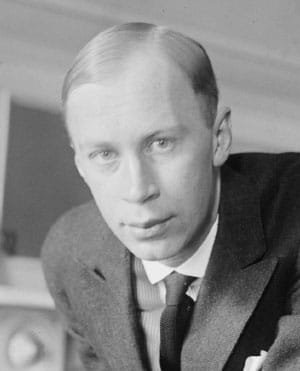
The twin hammer blows of the Second World War and Joseph Stalin’s murderous regime served as powerful stimulants to Sergei Prokofiev’s creative force. Having been induced to return to the Soviet Union in 1936 with promises of creative freedom, Prokofiev arrived barely less than a year before the commencement of the Great Terror in which millions of Soviet citizens were arrested and, in many cases, executed. Then came Operation Barbarossa, the German invasion of the Soviet Union: nothing could have prepared the Russian people for the nightmare about to unfold. The war ended with almost 27 million Soviet citizens dead, and in its wake the authorities began enforcing a stern attitude toward approved ideology. It wasn’t until Stalin’s death in 1953 that the repression began to lift, but Prokofiev was never able to benefit from the ensuing thaw, for he died on the same day as the fearsome Soviet dictator.
Prokofiev’s two violin sonatas are both products of those troubled years, along with such recognized masterworks as the Fifth Symphony and the score to Sergei Eisenstein’s film Ivan the Terrible. The first sonata in F minor suffered a troubled gestation, so much so that dedicatee David Oistrakh encouraged Prokofiev to create a violin transcription of his Flute Sonata in D major, Opus 94: a classically-oriented, relatively gentle work that Prokofiev had written in 1942 with the French flutist Georges Barrère in mind. The original had not been particularly well received, but the new transcription—published as Opus 94a and rechristened as a violin sonata—had quite a successful premiere with Oistrakh and pianist Lev Oborin on June 17, 1944, at the Moscow Conservatory.
Prokofiev’s description of it as a “sonata in a gentle, flowing classical style” is on the whole apt, but it does rather overlook the sinewy vigor coursing through the work. There is something almost Mendelssohnian in the rapt lyricism of the opening Moderato, cast in scrupulous sonata-allegro form. It is followed by a quicksilver Scherzo in which the piano plays the part of an insistent protagonist during what comes across as an overheated, overstimulated waltz; a contemplative middle section provides a welcome rest from all that whirling about.
Ever since the earliest days of Prokofiev’s career there had been a lyrical soul lurking within a sometimes vicious exterior. The rich vein of Romanticism is fully on display in the third-place Andante, a stately dialog between violin and piano marked by distinctly shadowed passages and moments of unease. Then comes the Allegro con brio finale, one of Prokofiev’s most athletic and joyous creations.
—Scott Foglesong
Violin Sonata No. 2 in G major
Maurice Ravel
Born: March 7, 1875, in Ciboure, France
Died: December 28, 1937, in Paris
Work Composed: 1927
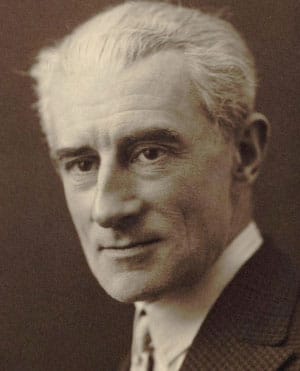
Maurice Ravel’s Violin Sonata No. 2 was a long time in the making, with the first ideas put down as early as 1922 and the premiere in 1927—all for about 17 minutes of music. In the intervening years, the middle-aged composer struggled with depression and his musical output slowed to a trickle. Deadlines flew by. The sonata was intended for the violinist Hélène Jourdan-Morhange, and in April 1922 he was already delinquent, writing to inform her of the delay, saying, “You won’t kill me on this account?” The following year he began to make progress on the sonata, and the premiere was announced for January 1924 in London. Yet it was still not completed, and another piece replaced it on that program.
Three years later, Ravel finally finished the sonata in a creative bloom that also brought the opera L’Enfant et les sortilèges and the song cycle Chansons madécasses to completion. By then, however, Jourdan-Morhange had developed arthritis and retired from her violin career, so the premiere went to George Enescu (the Romanian composer and violinist), joined by Ravel on piano.
The sonata’s centerpiece is “Blues,” which channels the music of America, a country Ravel would not visit until the following year. But jazz, which could be heard in Parisian cafés by the early 1920s, offered Ravel a way to express his own blues, perhaps helping him to overcome his creative block. The sonata’s outer movements include a rolling Allegretto on one side and a scurrying Perpetuum mobile on the other.
—Benjamin Pesetsky
About the Artists
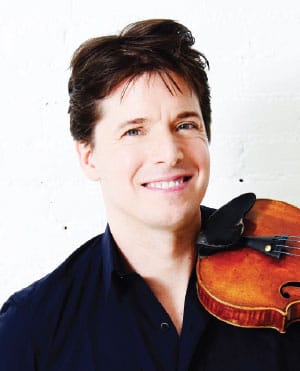
Joshua Bell
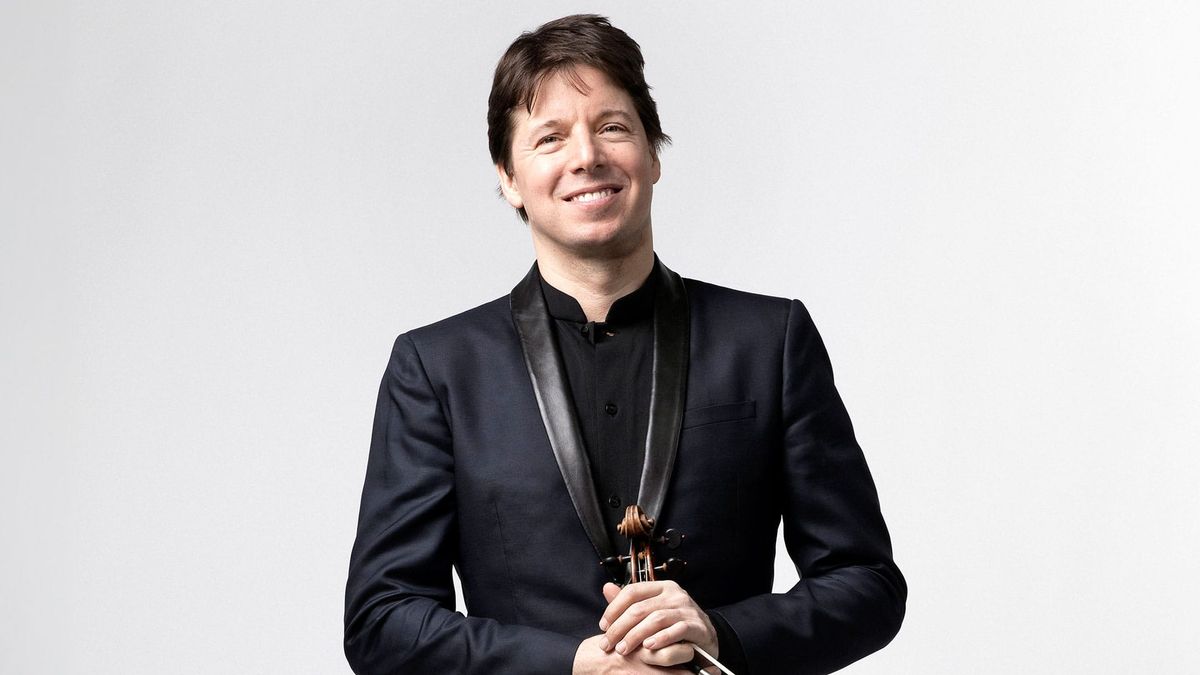
With a career spanning almost four decades, Grammy Award–winning violinist Joshua Bell has performed with virtually every major orchestra in the world, and regularly appears as a soloist, recitalist, chamber musician, conductor, and as music director of London’s Academy of St Martin in the Fields. In 2025, he was awarded an honorary commander of the Most Excellent Order of the British Empire. He made his San Francisco Symphony debut in 1991 as a Shenson Young Artist.
This season, following his world-premiere recording of Thomas de Hartmann’s violin concerto, Bell performs the work at the BBC Proms, New York Philharmonic, and during his season- long tenure as a Toronto Symphony Spotlight Artist. He also leads extensive US and European tours with the Academy of St Martin in the Fields; makes his first appearances as the New Jersey Symphony’s inaugural principal guest conductor; tours Asia with the NDR Elbphilharmonie Orchestra; and joins Steven Isserlis and Evgeny Kissin for trio programs in New York, Paris, Vienna, and Prague.
Bell has been nominated for six Grammy Awards, named “Instrumentalist of the Year” by Musical America, selected as a “Young Global Leader” by the World Economic Forum, recognized with the Avery Fisher Prize, and honored as an “Indiana Living Legend.” His many collaborators include Emanuel Ax, Chris Botti, Chick Corea, Renée Fleming, Josh Groban, Lang Lang, Dave Matthews, Anoushka Shankar, Regina Spektor, Sting, and Daniil Trifonov. Bell has performed for three American presidents and the justices of the Supreme Court of the United States. After participating in Barack Obama’s Committee on the Arts and Humanities’ first cultural mission to Cuba, he headlined the subsequent Emmy-nominated PBS Live from Lincoln Center special. Bell performs on the 1713 Huberman Stradivarius violin.
Management for Joshua Bell: Park Avenue Artists
Booking for Joshua Bell: Primo Artists
Joshua Bell records exclusively for Sony Classical—a Masterworks label.
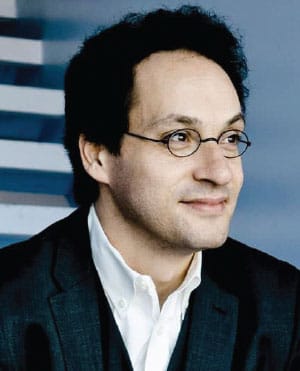
Shai Wosner
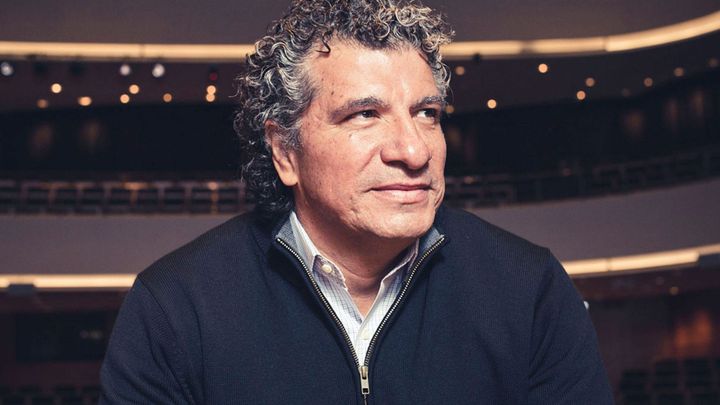
Shai Wosner’s recent and upcoming highlights include recitals and chamber music in Japan, a return to the Utah Symphony, and performances of piano concertos by Mason Bates and Vijay Iyer. He performed with the Jack Quartet at the newly reopened Frick Collection and tours separately with Joshua Bell and Pinchas Zukerman.
Wosner has appeared with the Vienna Philharmonic, Berlin Staatskapelle, London Symphony, the BBC orchestras, Philadelphia Orchestra, Pittsburgh Symphony, Cleveland Orchestra, Atlanta Symphony, Indianapolis Symphony, Chicago Symphony, Dallas Symphony, and Los Angeles Philharmonic, among many other ensembles. He made his solo debut with the San Francisco Symphony in February 2005.
In recent years, Wosner’s arrangements have gained widespread recognition. His chamber versions of Beethoven symphonies have been premiered and toured by Emanuel Ax, Leonidas Kavakos, and Yo-Yo Ma, and are available in Grammy Award–nominated recordings on Sony Classical. His own acclaimed recordings for Onyx Classics range from Schubert sonatas, to chamber works by Bartók and Kurtág, to concertos by Haydn and Ligeti.
Born in Israel, Wosner studied piano with Opher Brayer and Emanuel Krasovsky, as well as composition, theory, and improvisation with André Hajdu. He later studied with Emanuel Ax at the Juilliard School, where he is now on the piano faculty. Wosner is a recipient of Lincoln Center’s Martin E. Segal Award, an Avery Fisher Career Grant, and a Borletti-Buitoni Trust Award.