In This Program
The Concert
Sunday, April 26, 2026, at 7:30pm
Mahler Chamber Orchestra
Yuja Wang pianist and director
Matthew Truscott concertmaster and leader
Sergei Prokofiev
Symphony No. 1 in D major, Opus 25, Classical (1917)
Allegro
Larghetto
Gavotte: Non troppo allegro
Finale: Molto vivace
Alexander Tsfasman
Suite for Piano and Orchestra (Jazz Suite) (1945)
Snowflakes (Allegro vivace)
Lyrical Waltz
Polka
Career (Presto)
Intermission
Sergei Prokofiev
Piano Concerto No. 2 in G minor, Opus 16 (1913/23)
Andantino
Scherzo: Vivace
Intermezzo: Allegro moderato
Finale: Allegro tempestoso
Presenting Sponsor of the Great Performers Series

This concert is generously sponsored by Andy & Teri Goodman.
Program Notes
Symphony No. 1 in D major, Opus 25, Classical
Sergei Prokofiev
Born: April 23, 1891, in Sontsovka, Ukraine
Died: March 5, 1953, in Moscow
Work Composed: 1916–17
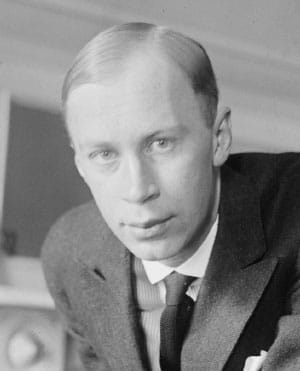
The young Sergei Prokofiev: prodigy, genius, phenomenon. Also: mouthy, brash, and impertinent, he left a trail of irritated professors in his wake while he produced a catalog of white-hot compositions that thrilled and repelled listeners in equal measure. It was as though he composed with a pen in one hand and a blowtorch in the other. His concert audiences weren’t sure whether he was playing the piano or trying to pulverize it.
As such he was very much a child of his times, for those times were cacophonous indeed. As of 1917, Russia’s disastrous entry into World War I had brought about the wholesale slaughter of the country’s young men on the battlefields. Tsar Nicholas II abdicated, eventually to be murdered along with his family. A Provisional Government and Russian Republic under Alexander Kerensky stumbled along shambolically before being wiped out by Lenin and the Bolsheviks. That led to civil war, violence, starvation, and social chaos.
None of that particularly bothered Prokofiev. The only child of a widow, he wasn’t likely to be called up for military service. He confessed in his diary that “I am neither a counter-revolutionary nor a revolutionary and I do not stand on one side or the other … I was amazed that during a time of war, revolution, civil war, and famine it was possible for a young man eligible for military service, and who was not wealthy, to live so well and so easily, without cares.” That sense of blithe insouciance in the midst of societal catastrophe fed into the creation of his first symphony, a witty update of the Viennese Classical style and just about the last thing anyone would have expected from someone with such a reputation for musical mayhem.
Prokofiev’s motives for writing the symphony weren’t altogether noble. He aimed to cock a snook at the conservative Saint Petersburg musical establishment. “When our classically inclined musicians and professors (who in my opinion are really nothing more than false-classics) hear this symphony,” he wrote in his diary, “they will start shouting about yet another impudent act committed by Prokofiev, and that he can’t even leave Mozart in peace in his grave, but had to disturb him with his dirty hands, sprinkling dirty Prokofievian dissonances among the pure classical pearls.”
What he wound up writing was a pearl in its own way, a direct counter to those behemoth symphonies of the late 19th century with their massive orchestral forces and endurance-contest lengths. Prokofiev’s Classical Symphony—that’s his own title, not a nickname, by the way—is trim, buff, lightly orchestrated, and short. That makes it an early instance of the “neo-classical” style that is commonly associated with Stravinsky, but Prokofiev actually beat him to the punch with this sparkling cocktail, a definitive score of the neoclassical movement and one of the best-loved symphonies of the 20th century.
The first movement hews to Classical precepts by juxtaposing two keys against each other, each with its own dedicated theme. There’s even a propulsive ascent at the beginning, typical of the mid-18th century composers who worked for the Mannheim court. That’s not to say it’s a mere copy; the themes are subtly askew, the recapitulation begins in the “wrong” key, and from time to time the rhythm takes a sudden zag where we might have been expecting a zig.
There was a lyrical soul lurking inside Prokofiev’s harsh exterior, and as he grew older he gave his inner songbird progressively greater latitude. The second movement offers a preview by way of lovely melodies suspended over a gently walking bass. For his third movement Prokofiev departs from Classical norms by offering a gavotte instead of the usual minuet, in a delectable galumph that was to make a future appearance in his ballet score Romeo and Juliet. To cap it all off, an exuberant finale positively zings with Haydn-esque athleticism and spring-loaded energy.
Suite for Piano and Orchestra (Jazz Suite)
Alexander Tsfasman
Born: December 14, 1906, in Alexandrovsk, Russia
(now Zaporizhzhia, Ukraine)
Died: February 20, 1971, in Moscow
Work Composed: 1945
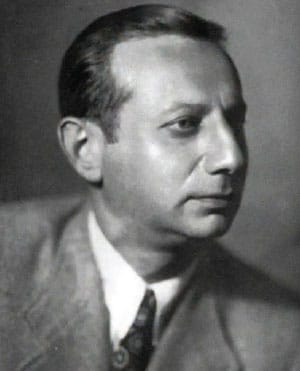
Anyone who thinks that American jazz musicians had a rough time of it should take a look at their counterparts in the Soviet Union. Those in the West could disapprove all they wanted, but as a whole they lacked the political power to turn their distaste into official legislation. The Soviet authorities had the power, and they used it; they closed jazz clubs, disbanded ensembles, blacklisted and even imprisoned or exiled musicians. Jazz did not meet Soviet standards of ideological purity, so composers and performers alike were faced with a stark choice: assimilate or perish.
Alexander Tsfasman had a marginally easier time of it than most, partially due to his sterling credentials as a piano student of Felix Blumenfeld at the Moscow Conservatory, also from his ability to fuse state-approved stuff—military marches, victory songs, etc.—with light jazz elements. Still, he faced professional ruin from the same 1946 Zhdanov Decree that took a sledgehammer to Shostakovich, Prokofiev, and other leading Soviet concert composers. Tsfasman’s fortunes improved after Stalin’s death in 1953, but he remained an isolated figure, his many recordings restricted to Soviet markets while he was denied permission to travel to such international venues as the Monterey Jazz Festival.
Fortunately, sizeable tranches of Tsfasman’s recordings are now available via streaming, including his pioneering 1928 band recording of Vincent Youmans’s “Hallelujah” on the A-side and Harry Warren’s “Seminole” for the B-side, the first domestic jazz record ever made in the USSR. The now-copious audio documentation reveals a pianist in the grand Romantic tradition, clear and refined, his tone never lapsing into harshness even in the most rhythmically energetic passages. We can also hear him playing the accordion, at which he was self-taught. His various bands over the years tended more toward dance music than improvisational jazz, all buffed to a high polish by his mostly Conservatory-sourced players.
Tsfasman’s 1945 Suite for Piano and Orchestra has been enjoying a renaissance of late, and with good reason. Tsfasman was as familiar with Western composers such as George Gershwin and Irving Berlin as was possible for a Soviet jazzman—and he put his superb training to use in this well-written, utterly enjoyable confection that combines sweet lyricism with superb keyboard writing and terrific orchestration.
“Snowflakes” opens the suite with Tsfasman’s sterling pianism on full display, in a three-part romp with a sparkling reprise reminiscent of Zez Confrey’s 1921 “Kitten on the Keys,” flanking an elegantly soulful interlude that channels such posh piano stylists as Eddie Duchin. Lyrical Waltz is just that, an irresistibly hummable sweetheart of a piece that can’t resist adding tinkling triangle to its toe-tapping oom-pah-pahs. A subtle Russian sensibility only adds to its charm and allure.
The third-place Polka is adorable and funny, with a certain circus-clown je ne sais quoi. One can easily imagine it accompanying a Charlie Chaplin or Buster Keaton movie, underpinning all those pratfalls and double-takes. To conclude, a Presto again summons up Zez Confrey, but this time via his 1923 hit “Dizzy Fingers,” that jet-propelled keyboard jamboree that was a surefire crowd-pleaser for American popular pianists and, as one can imagine, Alexander Tsfasman himself.
Piano Concerto No. 2 in G minor, Opus 16
Sergei Prokofiev
Work Composed: 1912–13 (Reconstructed 1923)
Prokofiev’s epic second piano concerto was almost done in by an omelet. In 1918 he had left the full orchestral manuscript in his Saint Petersburg apartment when he went on a tour of the United States. Upon his return, he discovered that, during his absence, the residents had burned the manuscript to cook the aforesaid omelet—cooking fuel being in severely short supply in those revolution-wracked years. Prokofiev reconstructed the entire concerto from memory, but with enough upgrades to qualify as an almost altogether new work. We’ll never know just how much version 2.0 differs from the original, but after Prokofiev played the 1924 premiere in Paris with Serge Koussevitzky conducting, it was established as the concerto we have today.
It was slow to enter the repertory. Part of that has to do with its gut-busting technical difficulty. But there’s also its overall affect as a dark carnival of a concerto, creepy and sarcastic, pensive and morbid, flamboyant and borderline hysterical. In 1912, the year of the original version, concertos were still dominated by the opulence of late Romanticism. Sergei Rachmaninoff’s third piano concerto was only three years old, Ferruccio Busoni’s gigantic C-major concerto with its choral finale was eight, and even Johannes Brahms’s mighty second piano concerto was only 30. Prokofiev’s first piano concerto (also from 1912) was shocking enough with its glittering propulsion and percussive treatment of the piano, but this new concerto was something else entirely—longer, louder, more dissonant, and even more blatantly virtuosic.
The original version’s 1913 premiere in Pavlovsk, a suburb of Saint Petersburg, was met mostly with loathing. Newspapers gleefully reported the scathing negativity. Listeners were “frozen in fright, hair standing on end,” according to one. “The audience is scandalized,” another wrote, “most of them hiss … the cats at home can make better music than this!” But Prokofiev also discerned a certain amount of applause amid all the booing and hissing, and on the general principle that there’s no such thing as bad publicity, he claimed to be “pleased that the concerto provoked such strong feelings.”
He rather cooled toward it later in life. Vladimir Horowitz said that Prokofiev had steered him away from the concerto because he just didn’t like it any more. There are also reports of a BBC broadcast with Ernest Ansermet conducting in which Prokofiev had let the piece slip out of his fingers and made quite a botch of it.
Be all that as it may, once the Prokofiev Second caught on, it went gangbusters. Jorge Bolet’s pioneering 1953 recording handily demonstrated the concerto’s caustic wit, high spirits, and sheer exhilaration, not to mention its passages of soulful lyricism. Since then, pianists of all stripes have come to realize that one need not bang the daylights out of the piano in order to deliver the piece to audiences, who in turn have come to revel in its kaleidoscopic sound canvas and widely varying moods.
The Music
The concerto opens in storytelling mode, as though it’s about to relate some ancient and nearly forgotten tragedy. A subdued, downright stark theme in the piano is followed by a more luxuriant rising melody that savors just a bit of the Romantic impulse; the two themes interact and develop, then lead into a development made of somewhat more energetic material. Instead of the usual recapitulation, the orchestra drops out, ushering in what is surely the longest and most ear-popping cadenza in the literature. At its blazing peak the orchestra re-enters in a climax of cataclysmic power; the temperature suddenly drops and the movement ends in the same hushed chill in which it began.
Listeners and performers alike are advised to fasten their seat belts for the second movement, a delirious toccata in which the piano is given the fascinating task of playing what seems for all the world like a nonstop, supercharged update of an étude. The third-place Intermezzo explores both the grotesque and lyrical in equal measure, followed by an Allegro tempestoso finale that shudders on the very edge of madness, interrupted for a bit by an ardent theme that could be a Russian or Ukrainian folk tune—except that it isn’t. The concerto ends with a searing outburst in both piano and orchestra that positively shrieks its way to an abrupt, guillotine-blade termination.
—Scott Foglesong
About the Artists
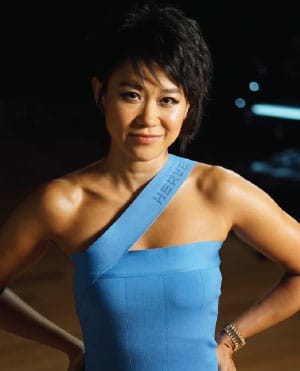
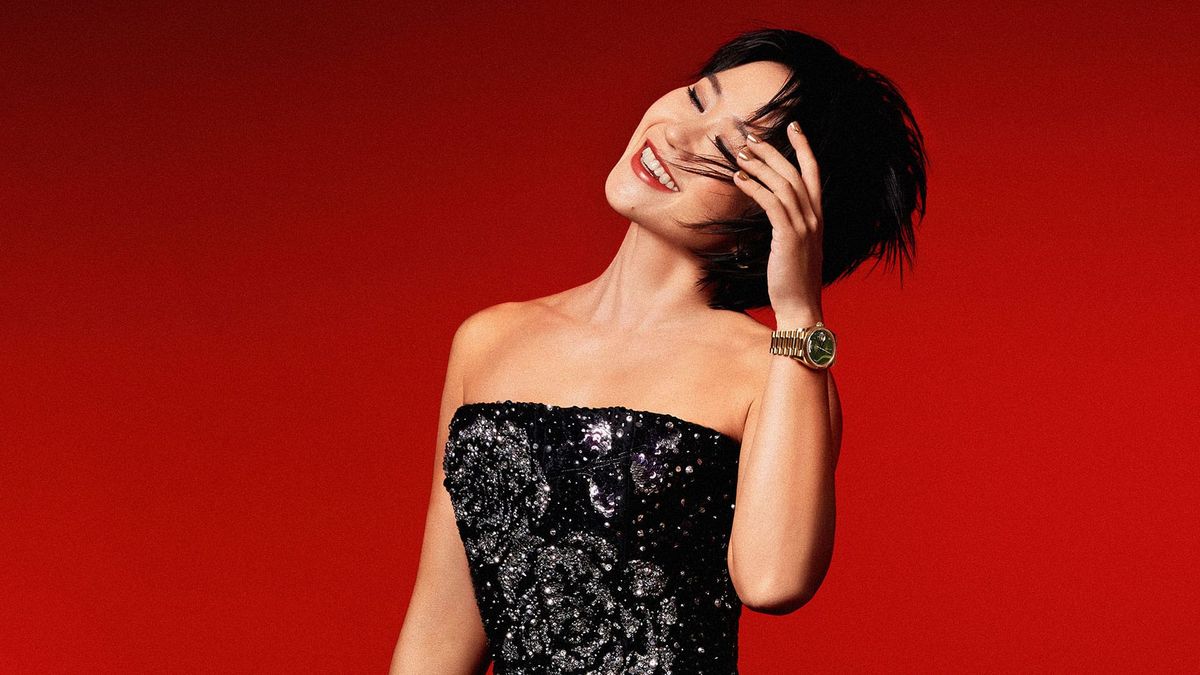
Yuja Wang
Yuja Wang is celebrated for her charismatic artistry, emotional honesty, and captivating stage presence. She has performed with the world’s most venerated conductors, musicians, and ensembles, and is renowned not only for her virtuosity, but her spontaneous and lively performances.
Recent highlights include a European and South American play-direct tour with the Mahler Chamber Orchestra, where she has been artist in residence, as well as her return to the United States, where she is in residence with the New York Philharmonic. Last September, she performed at the SF Symphony’s Opening Gala, and then opened Carnegie Hall’s season the following month.
Her skill and charisma were demonstrated in a marathon Rachmaninoff performance at Carnegie Hall with the Philadelphia Orchestra, including all four of his concertos plus the Rhapsody on a Theme of Paganini. In 2022, she gave the world premiere of Magnus Lindberg’s Piano Concerto No. 3 with the San Francisco Symphony.
Wang was born into a musical family and began studying the piano at the age of six. She received advanced training in Canada and at the Curtis Institute of Music with Gary Graffman. Her international breakthrough came in 2007, when she replaced Martha Argerich as soloist with the Boston Symphony. Two years later, she signed an exclusive contract with Deutsche Grammophon and has since established her place among the world’s leading artists, with a succession of critically acclaimed performances and albums. Her recordings have garnered multiple awards, including five Grammy nominations and her first Grammy win for Best Classical Instrumental Solo with her 2023 release The American Project. For this she also won an Opus Klassik award in the concerto category.
As a chamber musician, Wang has developed long-lasting partnerships with several leading artists. She recently embarked on an international duo recital tour with pianist Víkingur Ólafsson. Wang made her San Francisco Symphony debut in February 2006 and became a Shenson Young Artist later that year. She returns to the Great Performers Series for a recital next season (April 18, 2027).
Mahler Chamber Orchestra
Since its creation in 1997 by the musicians of the orchestra, the Mahler Chamber Orchestra has established itself as one of the world’s leading chamber orchestras. Working as a “global collective,” the MCO is led by its members in collaboration with its Berlin-based management office. The musicians, who come from around 25 different countries, unite for each tour or project. The chamber-music dialogue and unanimous act of listening shape the orchestra’s sound; it’s a philosophy inspired by the orchestra’s founding mentor and longtime partner Claudio Abbado that the MCO calls “the sound of listening.”
Last season, the MCO performed with conductors and soloists including Antonello Manacorda, Riccardo Chailly, Leif Ove Andsnes, and many others. The MCO is also known for its performances without a conductor—artistic partners Yuja Wang and Mitsuko Uchida, with whom the orchestra has gone on several tours, often lead the MCO from the piano. In the 2025–26 season, the MCO joins the stage with Maxim Emelyanychev, Gianandrea Noseda, Augustin Hadelich, Kian Soltani, Adam Fischer, Igor Levit, Yuja Wang, Joana Mallwitz, Piotr Beczala, Hélène Grimaud, Vikingur Olafsson, Thomas Adès, Daniel Harding, Daniil Trifonov, and many others. The orchestra maintains residencies in Berlin and Lucerne. From March 2026 to 2028, it will succeed the Berlin Philharmonic at the Baden-Baden Easter Festival. In 2024, the MCO assumed the role of artistic director of Musikwoche Hitzacker.
The MCO continually explores new musical and social initiatives. Its program Feel the Music introduces music to deaf and hard-of-hearing individuals, while the MCO Academy allows orchestra members to share their expertise with the next generation of musicians. Additionally, the MCO’s school concerts foster introspection through the power of music. The MCO has also co-developed a series of virtual reality concert formats. Since July 2024, some of the chamber music pieces produced in virtual reality have been available in the Mahler Chamber Orchestra app for Apple Vision Pro. The MCO debuts at the SF Symphony with this performance.
Matthew Truscott
Matthew Truscott is a versatile violinist who shares his time between period instrument and modern performance. He is concertmaster of the Mahler Chamber Orchestra and a leader of the Orchestra of the Age of Enlightenment. As a guest leader, engagements have included English National Opera, Dutch National Opera, Netherlands Chamber Orchestra, Budapest Festival Orchestra, the English Concert, Le Concert d’Astrée, the King’s Consort, and Arcangelo. He is also leader of Classical Opera, St James’s Baroque, and the Magdalena Consort, and teaches Baroque violin at the Royal Academy of Music.
Mahler Chamber Orchestra
FIRST VIOLINS
Matthew Truscott (UK), concertmaster
May Kunstovny (Austria)
Hildegard Niebuhr-Candan (Germany)
Alexandra Preucil (USA)
Tim Summers (USA)
Clara Scholtes (Germany)
Elena Rindler (Germany)
Elvira van Groningen (Netherlands)
Hwa-Won Rimmer Pyun (Germany)
Mona Burger (Germany)
SECOND VIOLINS
Johannes Lörstad (Sweden), section leader
Michiel Commandeur (Netherlands)
Fjodor Selzer (Germany)
Christian Heubes (Germany)
David Moosmann (Germany)
Beatrice Colombis (Italy)
Hayley Wolfe (USA)
Jana Lebrova (Czech Republic)
VIOLAS
Beatrice Muthelet (France), section leader
Yannick Dondelinger (UK)
Frida Siegrist Oliver (Norway)
Sofie Van der Schalie (Netherlands)
Aline Saniter (Germany)
Justin Caulley (USA)
CELLOS
Frank-Michael Guthmann (Germany), section leader
Stefan Faludi (Germany)
Philipp von Steinaecker (Germany)
Clara Grünwald (Germany)
Katharina Kühl (Germany)
BASSES
Sebastian Breidenstein (Germany), section leader
Johane Gonzalez Seijas (Spain)
FLUTES
Chiara Tonelli (Italy)
Julia Gallego Ronda (Spain)
OBOES
João Da Silva (Portugal)
Iria Folgado (Spain)
CLARINETS
Vicente Alberola Ferrando (Spain)
Jaan Bossier (Belgium)
BASSOONS
Mathis Stier (Germany)
Chiara Santi (Italy)
HORNS
Juan Manuel Gomez Gonzalez (Spain)
Gerard Sanchez Safont (Spain)
Aurora Kuo (Taiwan)
Lily Kern (USA)
TRUMPETS
Per Ivarsson (Sweden)
Florian Kirner (Germany)
TROMBONES
Carlos Jimenez Fernandez (Spain)
William Stenhouse (United Kingdom)
Jürgen Oswald (Austria)
TUBA
Jose Martínez Anton (Spain)
TIMPANI & PERCUSSION
Rodolphe Théry (France)
Rizumu Sugishita (Japan)
Christian Miglioranza (Italy)