Behind the Aisle
Inside the world of theatre ushers | By Todd Matthews

Pinging and glowing smartphones. Aisles crowded by feet and bags. Noisy mid-show audience chatter. Of all the issues for which Seattle Rep volunteer usher Kelly Kemmerling could have prepared, a broken drinking-water fountain was not on her bingo card.
But as ticketholders passed through Seattle Rep’s carpeted hallways toward the Leo K. Theater for a Saturday matinee performance of Mary Jane this spring, Kemmerling couldn’t ignore all the visitors who leaned into the wall-mounted fountain for a sip of water, only to come up confused and disappointed.
“Sorry,” she explained while pointing people toward the nearest restroom or checking their tickets. “The drinking fountain is broken.”
Welcome to the world of local theatre ushers, where Kemmerling and scores of others at area theatres handle everything from the routine (checking tickets, handing out programs, and seating audience members) to the unforeseen (mid-show medical emergencies, fire alarms, and, yes, broken drinking fountains) to help you enjoy the show.
Having ushered for 12 years, Kemmerling, 71, has seen it all. Trouble-shooting a broken drinking fountain was hardly a challenge. “The first time I ushered was during a production of A Christmas Story at the 5th Avenue Theatre,” she told me. “A kid threw up in the stairwell.”
Kemmerling’s quick feet and youthful enthusiasm for each show she ushers defy any preconceptions about her age. During Seattle Rep’s Saturday matinee, she was always in motion, striding through the lobby, tidying a stack of programs, pointing theatregoers to the restrooms, examining tickets, and folding and stowing a wheelchair after seating a guest.
Growing up, Kemmerling’s parents didn’t own a television; instead, they loaded a record player with Broadway show albums and even took her to see live theatre. “I grew up memorizing all these wonderful musicals from the 1950s,” she recalled. When she moved to Seattle in 1996, she rekindled her interest in theatre after seeing a performance at Village Theatre. After retiring from a career in IT, Kemmerling happened to take a tour of downtown Seattle theatres and learned about an upcoming training session for volunteer ushers. “It just kind of bloomed from there, far more than I ever anticipated,” she explained. “Now, I’m in deep with the volunteer usher community.”
No doubt. If you attend a performance at Seattle Rep, Union Arts Center, Intiman, 5th Avenue, Village, and other company venues around town, there’s a good chance Kemmerling will help you find your seat. There are usually three days a month when she’s not ushering, as evidenced by her smartphone’s calendar and its Tetris-like, color-coded ushering appointments.
Shortly after 2 p.m., the house doors closed, and Kemmerling found a seat toward the back, where she could watch the audience watch the performance of Mary Jane. “We are the eyes and ears during the show,” she explained.
Ushering occupies an odd space in live theatre—but often overlooked and underappreciated. “Each night could be described as ‘organized chaos,’” one experienced guest relations manager told me. “We truly could not have a successful performance without ushers.”
It combines “soft touch” skills and tactful wrangling with firm discipline. Could you diplomatically ask an especially tall audience member to move so the person behind him can see? How would you handle the theatregoer who has arrived bathed in enough cologne or perfume to sting the eyes of everyone in their row? Are your nerves steely enough to wield the dreaded “flashlight of shame” on an audience member who’s texting during a performance? Ushers toe a fine line. What’s more distracting or disruptive? An audience member’s behavior or an audience member’s reaction to an usher trying to correct that behavior for everyone else’s benefit?
And consider the subtle nuances of ushering from one theatre to the next. For example, corralling an eight-year-old who rushes the stage at Seattle Children’s Theatre to hug Mary Poppins conveys a very different vibe than, say, corralling a 38-year-old who rushes the stage at the 5th Avenue Theatre to hug Mary Poppins.
Ushering isn’t glamorous, but many people want to do it.
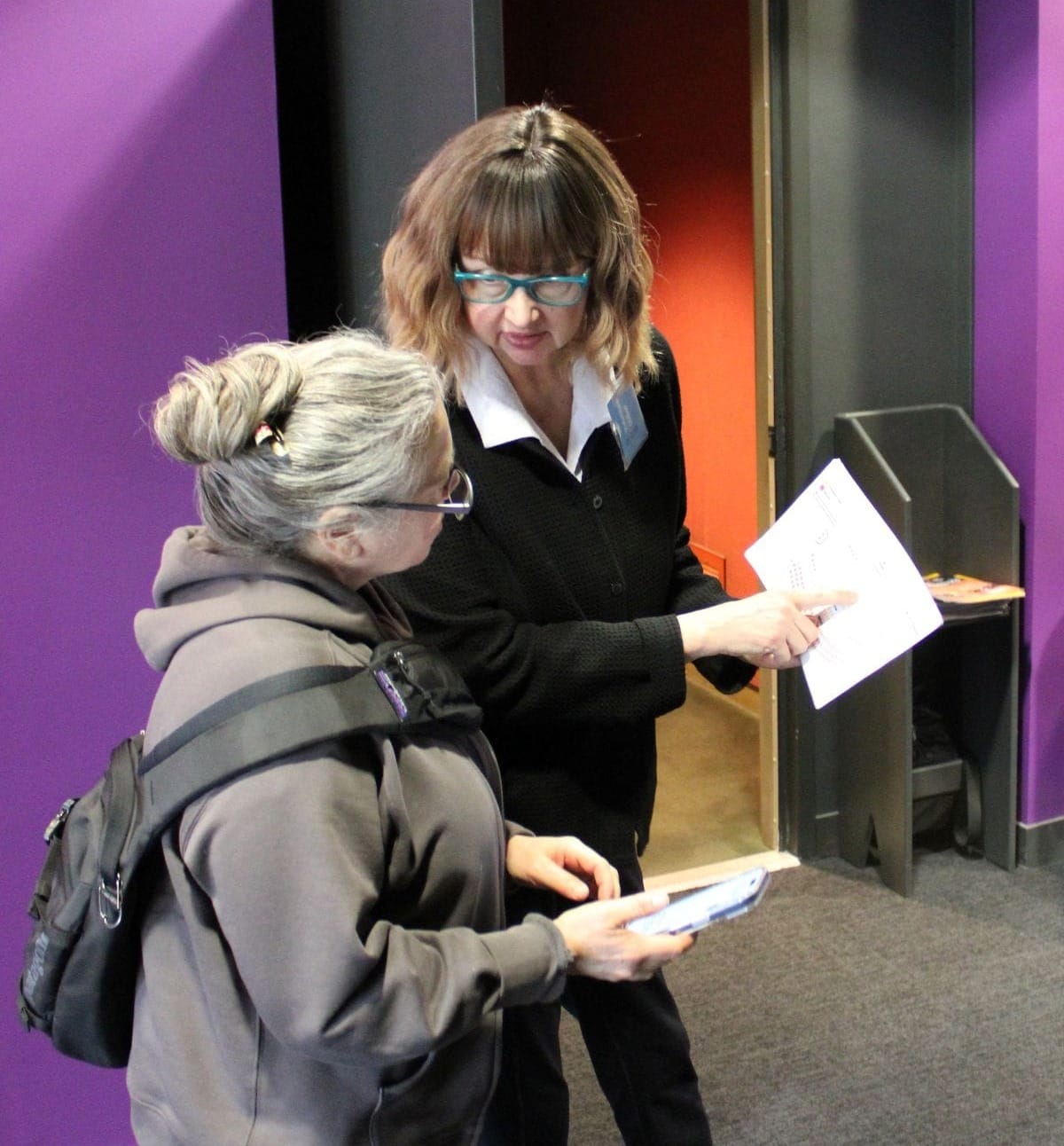
Roughly 100 people are on a waiting list to become volunteer ushers at the 5th Avenue. Ideally, if you joined the waiting list today, you might be called to usher next season. In reality, only so many slots are available. “We are lucky and happy to say not many ushers leave once they start,” said Associate Director of Patron Services Kathleen Mueller. “Some volunteer ushers have been with us for 20 years or more.”
Greenwood’s Taproot Theatre Company doesn’t have a waiting list, but it does have a bank of 400 volunteer ushers. On average, up to 150 people apply for six ushering spots during each Taproot performance. Occasionally, additional ushers are stationed at the front of the company’s 220-seat house to ensure audience members don’t walk onto the stage.
“There are ushers who have their favorite positions and request them every time,” explained Taproot’s Patron Services Manager RyLeigh Thorne. “They’ve just been doing it for so long, and they love returning.”
Ushering is often, but not always, a volunteer gig.
At McCaw Hall, which is owned by the City of Seattle and is home to the Pacific Northwest Ballet and Seattle Opera, ushers are paid City employees. At Seattle Rep, unpaid volunteer ushers like Kemmerling work the 282-seat Leo K. Theater, while two dozen paid, union ushers work the 673-seat Bagley Wright Theater.
The 5th Avenue has a pool of 35 paid head ushers and 650 unpaid volunteer ushers; of that total, roughly 10 head ushers and two dozen volunteer ushers work each performance in the company’s 2,130-seat theatre. Currently, the youngest head usher is a high school senior, while the oldest is over 70.
Newly hired 5th Avenue head ushers are formally interviewed and trained. During their first few shifts, they are paired with an experienced head usher to observe “real-life” situations they might encounter. Head ushers are trained in emergency preparedness and supervise volunteer ushers, who mostly scan tickets, hand out programs, and manage lines. Though unpaid, volunteer ushers at the 5th Avenue are given a seat to watch the show at no cost.
In general, many ushers arrive at the theatre two hours before the show begins. A pre-show “huddle” between the ushers and the house manager helps prepare the team for what to expect, including the show’s runtime, how many tickets have been sold, and any sensory advisories and content concerns.
During the pre-show huddle for Mary Jane at Seattle Rep, a house manager gave a rundown of answers to questions theatregoers might ask. Was there profanity in the show? Yes, but only a handful of curse words. More concerning was the show’s story, which focused on a single mother navigating the American healthcare system while raising her two-year-old son, who has cerebral palsy. “It’s a beautiful show,” the house manager explained, “but some people have walked out, telling us the story was too intense.”
Volunteering to usher is a well-known “hack” when it comes to seeing theatre on the cheap. But it’s not the only reason people sign up. It also lets you take a chance on unproven theatre. If you see a new show while ushering and it’s not to your taste, you’ve only given your time. Similarly, the experience can introduce you to new actors, playwrights, and other theatrical talent you may like.
For married couple Brenda and Shawn Berry, volunteering to usher at Taproot comes with other perks. Coming out of the pandemic, the Kirkland residents noticed many of Taproot’s older and long-time volunteer ushers hadn’t returned to the theatre. “There were some spots open, and we said, ‘Hey, let’s look into it,’” Brenda, 63, recalled. What’s more, Shawn, 64, had just retired from Boeing, so there was a little more flexibility in their schedules. “Being part of a team has always been in our DNA,” Brenda added. “We love being a part of what’s happening. Ushering fits in well. It’s a light touch, but it’s still fun to be part of the theatre.”
Brenda likes seeing sneak peek dress rehearsals during opening week (an invitation-only opportunity for Taproot’s volunteer ushers). Shawn likes scanning tickets and chatting with theatregoers. Occasionally, somebody he knows comes through the line. “Getting to see shows for free while ushering is nice,” Shawn said. “But I think most volunteer ushers want to help out and have some fun. For us, it’s date night. That’s part of the fun.”
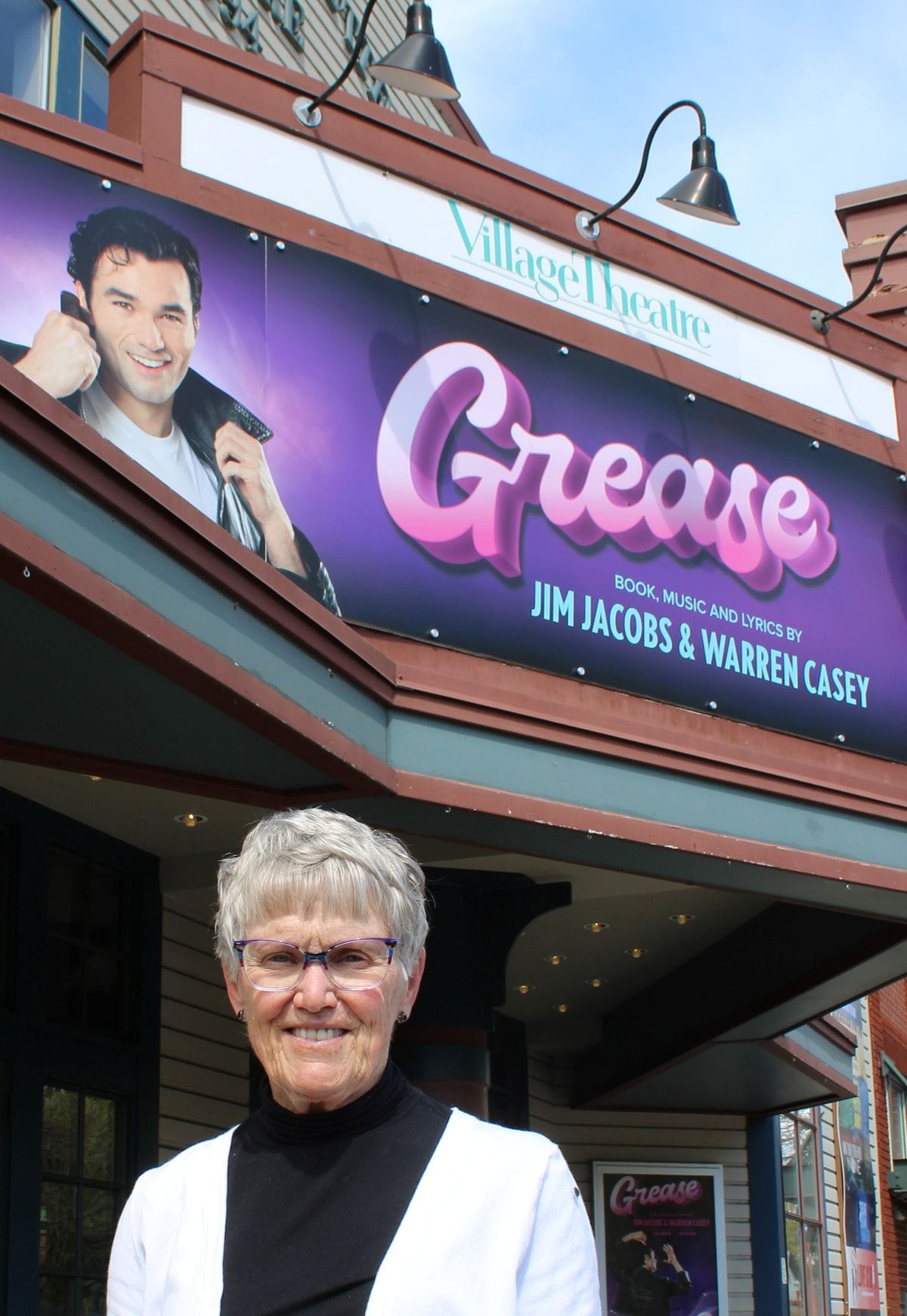
Bellevue resident Marilyn Morrow, 79, has ushered at Seattle Rep, ACT (now Union Arts Center), and Village over the past 30 years. “I usher with a girlfriend who loves theatre, too,” Morrow explained. “That’s a big draw for me. It’s an important time for us together. We usually go out to dinner afterward or go for brunch before a matinee. By doing that, I also have somebody I can discuss the show with before and after.”
Shoreline resident Shari Rosner, 68, ushered for eight years before stepping away in 2023. Yes, she enjoyed seeing shows for free. But the retired occupational therapist also liked to usher at the 5th Avenue on Sundays, when parking downtown is free, as well as at the Paramount, where volunteer ushers could sit in the lounge before the show and eat the free hors d’oeuvres. “Sometimes, I would plan on eating my dinner in the lounge,” she recalled.
Another perk? Seating notable people such as actors, musicians, politicians, and other celebrities. Jayme Gustilo, a Seattle Rep union usher who has worked at the theatre for 35 years, recalled meeting Lily Tomlin in 2000 during her one-woman show The Search for Signs of Intelligent Life in the Universe. “On the night of her closing performance, she personally came to thank the front-of-house ushers,” Gustilo recalled. “Every performance sold out, and she was so grateful for the caliber of work we did. That was a humbling and memorable moment for me.”
Perks aside, ushering is still a job.
“Sure, it’s a budget-friendly way to support the arts,” Kemmerling said. “But you have to be service-oriented, too, helping people and making sure they are having a good time. We all know the cost of theatre has been rising, so you want to make it as comfortable as possible for the people who paid to come see the show.”