In This Program
The Concert
Monday, November 30, 2026, at 7:30pm
Hilary Hahn violin
Matthias Goerne baritone
Gloria Chien piano
Ludwig van Beethoven
Violin Sonata No. 5 in F major, Opus 24, Spring (1801)
Allegro
Adagio molto espressivo
Scherzo: Allegro molto
Rondo: Allegro ma non troppo
Hilary Hahn
Gloria Chien
Ludwig van Beethoven
Selected Songs (ca. 1790–1809)
“Adelaide,” Opus 46
“Mailied” from Acht Lieder, Opus 52
“Der Liebende,” WoO 139
An die ferne Geliebte, Opus 98 (1816)
Auf dem Hügel sitz ich spähend
Wo die Berge so blau
Leichte Segler in den Höhen
Diese Wolken in den Höhen
Es kehret der Maien
Nimm sie hin denn, diese Lieder
Matthias Goerne
Gloria Chien
Reena Esmail
Text: Rebecca Gayle Howell
with excerpts from Paul Celan
Wir (2026)
Die Urnen der Stille
Noone Sees
Einiges Schweig
Finsternis / Wilderness
Einiges Sprach
Silence Come
Wir
San Francisco Symphony Commission
Matthias Goerne
Hilary Hahn
Johann Sebastian Bach
“Hier in meines Vaters Stätte” from
Cantata 32, Liebster Jesu, mein Verlangen (1726)
“Welt, ade, ich bin dein müde” from
Cantata 158, Der Friede sei mit dir (ca. 1727?)
Matthias Goerne
Hilary Hahn
Gloria Chien
This program is presented without intermission.
Program Notes
Violin Sonata No. 5 in F major, Opus 24, Spring
Ludwig van Beethoven
Baptized: December 17, 1770, in Bonn
Died: March 26, 1827, in Vienna
Work Composed: 1801
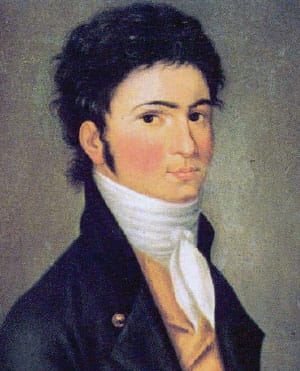
The title page of the first edition of this piece reads “Sonata for the Pianoforte with a Violin,” which would seem to demote the violin to second status, as was common in the 18th century. Perhaps the publisher wasn’t up to speed with the evolutionary changes brought about first by Mozart, then by Beethoven. For this is no accompanied piano sonata. This is a full duo sonata, both instruments engaged in a collaborative partnership.
Furthermore, this is a duo sonata in F major, and in Beethoven, the choice of key speaks volumes. Just as Mozart had a special relationship with A major, so Beethoven with F major; it’s his key for pastoral naturalism and good cheer. Consider Beethoven’s sixth and eighth symphonies, the sparkling Opus 10, no.2, piano sonata, and the first Razumovsky string quartet, Opus 59, no.1: all in F major, and all shot through with an open-air, outdoorsy quality.
The nickname Spring wasn’t Beethoven’s idea, but it’s a good fit. That doesn’t imply a nonstop pastoral idyll. The sonata has its stern moments, not to mention its rowdy ones. But it shares a sunlit, grassy quality with the Pastoral Symphony, and it similarly establishes its country vibe from the get-go. The Allegro first movement is a happy affair that tosses a finely spun lyrical primary theme about before gliding on to a dancelike secondary theme and concluding with a spray of fast scales in both instruments.
The second movement drops down to B-flat major (a resolving motion from the first movement’s F major) and slows to Adagio molto espressivo—relaxed and very expressive. The gently ornamented themes are shared equally between both instruments, the whole marked by an almost nonstop undulation of accompanying arpeggios. Towards the end both instruments start trilling: bird calls, maybe?
The blink-and-you-miss-it Scherzo almost didn’t happen, but happily for posterity, Beethoven decided that the sonata needed a shot of adrenaline. Beethoven even specifies that the first part is to be played without repetition. He wants it short and sweet.
Given the sonata’s overall pastoral character, a slam-bang virtuoso finale would be inappropriate. Instead, Beethoven gives us a genial Allegro ma non troppo, cast in the sonata-rondo form that fuses the overall loose-jointed nature of a rondo with the rhetorical tautness of sonata form. Technically it’s a difficult form to keep under control—tedium lurks—but that posed no challenge to Beethoven. It’s so graceful, free, and spontaneous that its meticulous craftsmanship may well go unnoticed. That’s precisely how it should be.
Selected Songs and An die ferne Geliebte, Opus 98
Ludwig van Beethoven
Works Composed: “Adelaide”—ca. 1795. “Mailied”—ca. 1790. “Der Liebende”—1809. An die ferne Geliebte—1816.
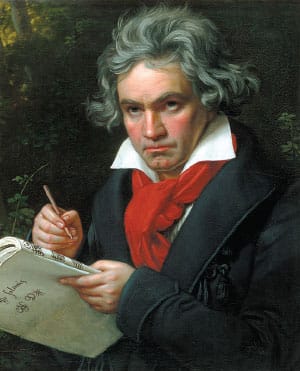
Beethoven isn’t usually the first name on anybody’s lips where art songs are concerned. The honor roll of lieder composers is typically headed by Schubert, followed by Schumann, Brahms, Wolf, and a host of others. Beethoven generally ranks somewhere around the middle, odd for a composer of his Olympian stature. One needn’t look far to find out why that is. For one thing, lieder were peripheral to Beethoven’s musical thinking, even though he wrote more than 100 instances over his career. Then there was his propensity for writing borderline unsingable music, a persistent source of irritation for performers from his day to ours. The well-regarded composer Luigi Cherubini was so unimpressed with the original version of the opera Fidelio that he sent Beethoven a copy of the approved Paris Conservatory manual for vocal writing.
But physical awkwardness is more or less par for the Beethovenian course; he was never one to make things easy for performers, be they vocal or instrumental. When violinist Ignaz Schuppanzigh complained about a particularly intractable passage in a string quartet, Beethoven roared back: “Do you think I care for your silly fiddle when the spirit is upon me?”
Instrumentalists have long learned to cope with Beethoven’s ungainly moments, and after a certain amount of resistance, so have singers. That’s a good thing since Beethoven’s songs reveal him as a clear precursor of the Romantic lieder composers soon to come.
The middle-period opus number is a bit misleading. “Adelaide,” Opus 46, is actually a product of Beethoven’s earlier years in Vienna. The text, by Friedrich von Matthisson, speaks of the poet’s yearning for an unattainable woman, a state of mind and heart that would run as a leitmotif through Beethoven’s life. “My most ardent wish will be fulfilled if you are not dissatisfied with the manner in which I have set your heavenly ‘Adelaide’ to music,” wrote Beethoven to Matthisson.
It’s a through-composed art song, meaning that the music follows the text without being organized into repetitive strophes. But that doesn’t make it formless: its four musical sections correspond to the poem’s stanzas, each of which ends with the exclamation “Adelaide!”
Beethoven’s first setting of a Goethe text, “Mailied,” Opus 52, no.4, might date as early as his years in Bonn. It features a trope that would become ubiquitous among Romantic composers: the awakening of spring as a metaphor for the heady exhilaration of new love.
The piano part departs from the usual simple accompaniment by mimicking the sounds of the wind and bird calls, an early example of Beethoven’s amplification of the piano part beyond the purely supportive. In keeping with the poem’s evocations of the natural world, the song is structured in a simple strophic form in which the music repeats itself for each stanza; the pianistic bird-chirping serves as brief interludes.
The word “Schubertian” comes irresistibly to mind with “Der Liebende,” WoO 139, based on a three-stanza poem by Christian Ludwig Reissig. The piano part even makes use of brief right-hand trills to mimic the “quivering emotion” that has taken control of the poet’s heart. Alas: no matter how deeply the narrator is smitten, “she does not feel what my heart speaks through my eyes.” Ergo, it’s all about that universal emotional catastrophe: unrequited love. Uncharacteristically, Beethoven takes a light-hearted tone towards the text, aiming more for charm than profundity.
An die ferne Geliebte, Opus 98
Popular parlance would have it that the period from roughly 1814–19 is a dead zone in Beethoven’s compositional output. The notion contains just enough of a kernel of truth to be plausible—he produced neither symphonies nor string quartets—but a closer inspection reveals that Beethoven’s creative juices hadn’t really dried out all that much. To be sure, he was struggling with health and family problems. But he was nonetheless Beethoven, and he couldn’t stop composing any more than the wind can stop blowing. Works dating from this period include two cello sonatas, two piano sonatas including the Hammerklavier, a bouquet of songs, and Beethoven’s one-and-only proper song cycle: An die ferne Geliebte, written in 1816 to texts from an otherwise obscure medical student named Alois Isidor Jeitteles.
“To the Distant Beloved” may well be the first Romantic song cycle, soon to be joined by masterful examples by both Schubert and Schumann. Its folk-songish nature, amorous and pastoral in turn, is complemented by a richly interwoven design, the whole ending with the same theme as the beginning—thus a cycle (Liederkreis) in both the literal as well as figurative sense.
Wir
Reena Esmail
Born: February 11, 1983, in Chicago
Work Composed: 2026
SF Symphony Commission
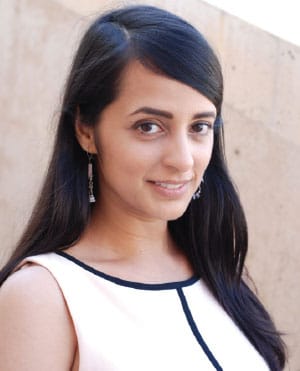
“My life was completely transformed when I heard Samuel Barber’s Knoxville: Summer of 1915 for the first time,” writes Reena Esmail, referring to Barber’s 1947 work for soprano and orchestra, to a text by James Agee. She continues:
At the age of 14, I was sitting under the stars with my parents at the stunning Ford Theater in Los Angeles on a summer night. I could relate to the child’s voice narrating the piece’s text because I was so aware of the vast, complicated world I was witnessing, even through my young eyes. I’m just attempting to analyze everything. I can identify that particular performance as a turning point in my decision to pursue a career in music. All I wanted was to be able to produce such beauty.
Esmail’s primary sphere of occupation has been in fusing two important musical traditions—that of Western classical music, and of Indian classical music, particularly the Hindustani traditions of northern India. To that end, she is the co-founder and artistic director of Shastra, a nonprofit organization that promotes cross-cultural music connecting India and the West.
Now she has written a half-hour-long duo, Wir (German for “we”), for Hilary Hahn and Matthias Goerne, with no other accompaniment except “the silence the piece seeks.” She tells us that “in this time of constant noise, Wir invites us to remember that silence is the nourishing gift we now most need.” Her note continues:
Written by poet Rebecca Gayle Howell, this new bespoke text moves us through a lyric elegy for the quiet we risk losing. As Howell prays for its return, she weaves her own English poetry with German fragments from Paul Celan, a poet survivor of the Holocaust who knew all too well the dangers caused by constant din.
We begin with a sober chant—“Die Urnen der Stille sind leer / Die Urnen der Stille sind leer / Silence, your ash is spread.” As the cycle advances, the two poets call and respond to each other in a dialogue that echoes across the canyons of history into our present hope that it’s not too late to recover solitude.
Silence and faith: Wir aims to “guide us back to one another and to ourselves.”
Selections from Cantatas 32 and 158
Johann Sebastian Bach
Born: March 21, 1685, in Eisenach, Germany
Died: July 28, 1750, in Leipzig
Works Composed: Cantata 32—1726. Cantata 158—ca. 1727?
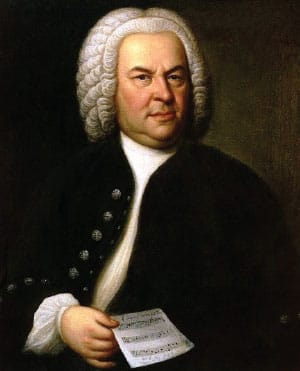
Nestled throughout the vast treasure trove that is Bach’s 200 some-odd extant cantatas are arias cast as duets for voice and a solo instrument, sometimes oboe d’amore—has there ever been a better-named instrument than the “oboe of love?”—other times solo violin or flute.
Thus it is with Cantata 32 of 1726, with a libretto that posits a conversation between the believer (a soprano) with Jesus (bass). In this aria accompanied by violin solo, the troubled soul is invited into a place of peace.
Cantata 158 is one of Bach’s most tender and beguiling utterances. It’s also a bit mysterious. Is it complete or a fragmentary compilation? Who, precisely, wrote the libretto? And what is the solo instrument in the central bass aria—flute or violin piccolo? Let the scholars thrash those out, and bask in the aria’s exquisitely ornamented obbligato line and the sweet resignation of its text: “World, farewell, I am weary of you.”
—Scott Foglesong
About the Artists
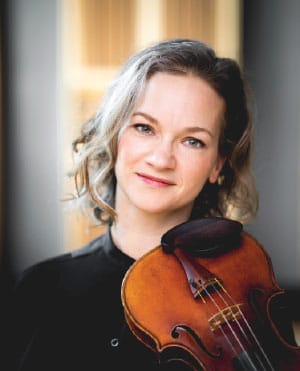
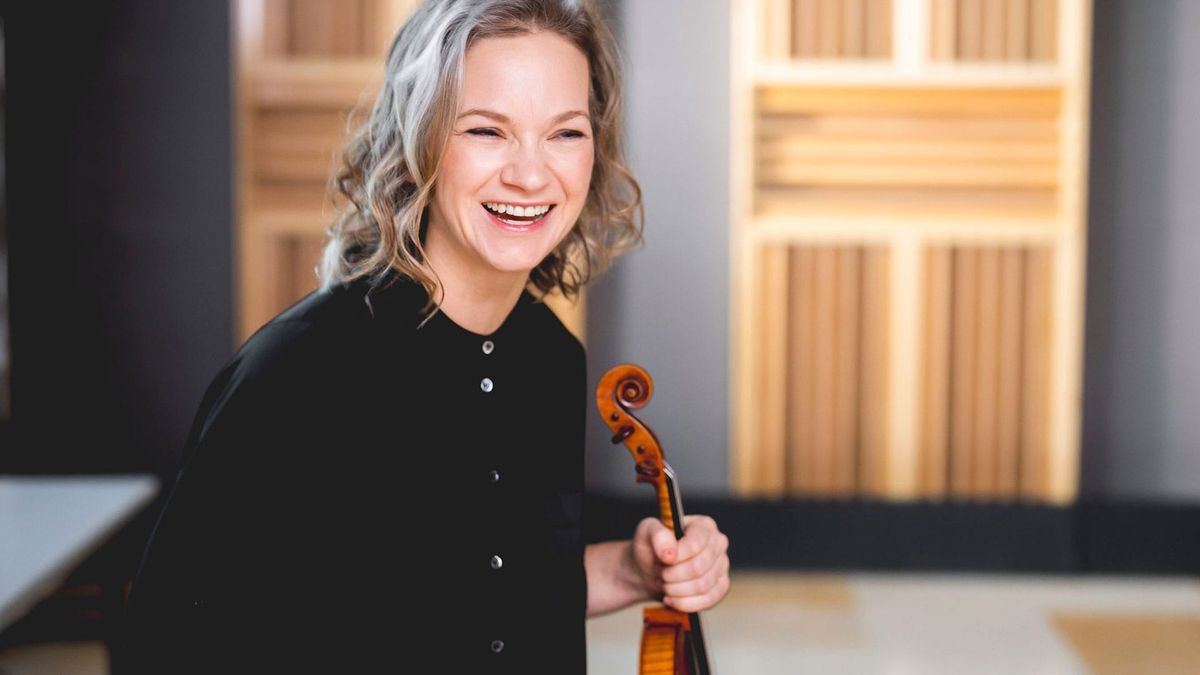
Hilary Hahn
Three-time Grammy Award–winning violinist Hilary Hahn melds expressive musicality and technical expertise with a diverse repertoire guided by artistic curiosity. She is a prolific recording artist and commissioner of new works, and her 23 feature recordings have received numerous international prizes and acclaim. Her new role on the violin faculty of the Juilliard School follows her earlier tenure as a Juilliard visiting artist. Recent seasons have also seen her serve as an artist in residence at the Chicago Symphony and New York Philharmonic, and as a curating artist of the Dortmund Festival. She made her San Francisco Symphony debut in October 1999 as a Shenson Young Artist and most recently appeared at last September’s Opening Gala.
Hahn has related to her fans naturally from the very beginning of her career. Her social media initiative, #100daysofpractice, has transformed practice into a community-building celebration of artistic development. Since Hahn created the hashtag in 2017, fellow performers and students have contributed more than one million posts. A former Suzuki student, she released new recordings of the first three books of the Suzuki Violin School in 2020. In 2019, she released a book of sheet music, In 27 Pieces: the Hilary Hahn Encores, which includes her own fingerings, bowings, and performance notes for each work. Hahn is a prolific and celebrated recording artist whose feature albums on Decca, Deutsche Grammophon, and Sony have all opened in the top 10 of the Billboard charts.
In recent seasons, Hahn received the Avery Fisher Prize, was named Musical America’s artist of the year for 2023, delivered the keynote speech of the second annual Women in Classical Music Symposium, received the 2021 Herbert von Karajan Award, and was awarded the 11th annual Glasshütte Original Music Festival Award, which she donated to the Philadelphia-based music education nonprofit Project 440. Hahn was the 2022 Chubb Fellow at Yale University’s Timothy Dwight College; she also holds honorary doctorates from Middlebury College and Ball State University, where there are three scholarships in her name.
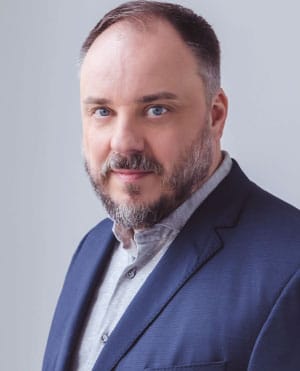
Matthias Goerne
Matthias Goerne is a frequent guest with leading orchestras and festivals worldwide. He has appeared on the world’s principal opera stages, including the Metropolitan Opera; Royal Opera House, Covent Garden; Teatro Real; Paris Opera; Bavarian State Opera; and Vienna State Opera. His roles range from Amfortas in Parsifal, Marke in Tristan und Isolde, Wolfram in Tannhäuser, Wotan in the Ring Cycle, Orest in Elektra, and Jochanaan in Salome, to the title roles in Bluebeard’s Castle and Wozzeck. Among his musical partners are conductors Claudio Abbado, Herbert Blomstedt, Riccardo Chailly, Christoph von Dohnányi, Gustavo Dudamel, Christoph Eschenbach, Daniele Gatti, Bernard Haitink, Manfred Honeck, Mariss Jansons, Neeme Järvi, Paavo Järvi, Vladimir Jurowski, Yannick Nézet-Séguin, Seiji Ozawa, Antonio Pappano, Kirill Petrenko, Simon Rattle, Esa-Pekka Salonen, and Franz Welser-Möst. He made his San Francisco Symphony debut in May 1996.
Goerne’s recordings have earned him five Grammy Award nominations, an ICMA Award, a Gramophone Award, the BBC Music Magazine Vocal Award, Diapason d’Or Arte, and the Echo Klassik 2017 “Singer of the Year.” He was an artist in residence at the Hamburg Elbphilharmonie in 2017–18, artist in residence with the New York Philharmonic in 2018–19, and artist in residence with the Shanghai Symphony in 2024–25. Goerne is an honorary member of the Royal Academy of Music in London and has also been an ambassador for the Weimar Art Festival since 2019. Born in Weimar, he studied with Hans-Joachim Beyer, Elisabeth Schwarzkopf, and Dietrich Fischer-Dieskau.
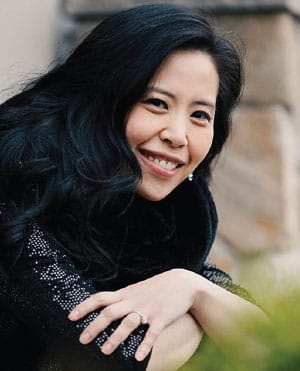
Gloria Chien
Taiwanese-born pianist Gloria Chien has a diverse musical life as a performer, concert presenter, and educator. She made her orchestral debut at age 16 with the Boston Symphony and was subsequently selected by the Boston Globe as one of its “superior pianists” of the year. In recent seasons, she has performed as a recitalist and chamber musician at Alice Tully Hall, the Library of Congress, Phillips Collection, Dresden Chamber Music Festival, and National Concert Hall in Taiwan. She performs frequently with the Chamber Music Society of Lincoln Center. In 2009, she launched String Theory, a chamber music series in Chattanooga, Tennessee, that has become one of the region’s premier classical music presenters. The following year, she was appointed director of the Chamber Music Institute at Music@Menlo, a position she held for the next decade. In 2017, she joined her husband, violinist Soovin Kim, as artistic director of the Lake Champlain Chamber Music Festival in Burlington, Vermont. The duo became artistic directors at Chamber Music Northwest in Portland, Oregon, in 2020. Most recently, she released two albums: Gloria Chien Live from the Music@Menlo Live label and Here With You with clarinetist Anthony McGill on Cedille Records.
Chien studied extensively at the New England Conservatory of Music with Wha Kyung Byun and Russell Sherman. She is artist in residence at Lee University in Cleveland, Tennessee, and is a Steinway Artist. She makes her debut at the San Francisco Symphony with this performance.
Supertitles: Ron Valentino