In This Program
The Concert
Sunday, November 22, 2026, at 6:00pm
Radu Paponiu conducting
Wattis Foundation Music Director
Michael Tilson Thomas
Agnegram (1998)
Zoltán Kodály
Dances of Galánta (1933)
Lento
Allegretto moderato
Allegro con moto, grazioso
Allegro
Allegro vivace
Intermission
Johannes Brahms
Symphony No. 4 in E minor, Opus 98 (1885)
Allegro non troppo
Andante moderato
Allegro giocoso
Allegro energico e passionato–Più allegro
This concert is generously supported by the Phyllis C. Wattis Youth Symphony Fund.
Program Notes
Agnegram
Michael Tilson Thomas
Born: December 21, 1944, in Los Angeles
Died: April 22, 2026, in San Francisco
Work Composed: 1998 (rev. 2016/24)
Instrumentation: 2 flutes, piccolo, 2 oboes, English horn, 2 clarinets, E-flat clarinet, bass clarinet, 2 bassoons, contrabassoon, 4 horns, 3 trumpets, 3 trombones, tuba, timpani, percussion (chimes, bass drum, glockenspiel, suspended cymbal, xylophone, crotales, snare drum, whip, wood blocks, triangle, crash cymbals, ratchet, lion’s roar, vibraphone, police whistle, tambourine, finger cymbals, siren, guiro, medium gong, tom-toms, and cowbell), harp, piano, and strings
Duration: About 6 minutes
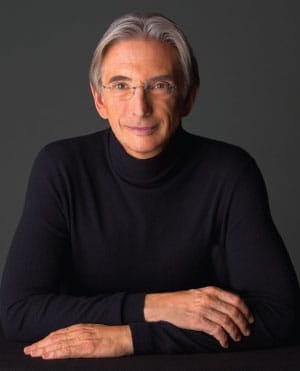
Michael Tilson Thomas was acclaimed internationally as a triple threat—as a conductor, of course, but also as an impressive pianist and a composer of imagination and eloquence. In the 1994 book Viva Voce, a collection of conversations with the critic Edward Seckerson, he described himself as “a fledgling composer,” but things developed quickly after that. He had already written a few works that gave him confidence, including his Street Song (1988) for brass instruments and From the Diary of Anne Frank (1989–90), a large-scale piece for narrator and orchestra, both of which continue to receive regular performances. “What these . . . experiences did,” he explained, “was to cause me to take my writing seriously, to care about it, and to care about wanting to have people hear what was going on inside my head.”
Balancing the creative impulse of a composer with the demands of a music director proved challenging but not insurmountable. He took pains to carve out blocks of time for composition, and his work list grew steadily through nearly four decades. His publisher lists two dozen compositions in print today, and San Francisco Symphony audiences have heard more than 20 of them, some on multiple occasions. In 2020, SFS Media released an album of his works—live concert recordings of From the Diary of Anne Frank and the orchestral song cycle Meditations on Rilke—that won the 2021 Grammy Award for Best Classical Compendium. Among the major recording projects marking his 80th birthday, in 2024, was Grace: The Music of Michael Tilson Thomas, a four-disc box set on Pentatone.
MTT’s short orchestral movement Agnegram was introduced here in 1998 and dedicated as a 90th-birthday tribute to longtime SF Symphony Board member Agnes Albert, who was instrumental to the creation of the SF Symphony Youth Orchestra. The title of this birthday card involves a bit of affectionate wordplay with her name, which is then carried over as “music-play” in the composition itself. Each letter of her name is encoded as an equivalent musical pitch to yield what he calls “a basic scale,” which gives rise to themes (and their transpositions) that spell out her name; in short, there is more to this piece than immediately meets the ear.
“The piece itself is a march for large orchestra,” wrote MTT when the SF Symphony premiered Agnegram in 1998. “The first part of the march is in 6/8 and is almost a mini-concerto for orchestra, giving brief sound-bite opportunities for the different sections of settling into a jazzy and hyper-rangy tune. The middle section of the march, or trio, is in 2/4 [after which] the jazzy 6/8 tune reappears, now in canon, and the piece progresses to a jubilant and noisy ending.”
Agnegram continued to evolve. Prior to including it on the SF Symphony’s 2016 Asia tour, MTT decided to “customize” the piece while still respecting its essence as an homage. He wrote at the time:
This piece is still in the form of a march. But now the middle section, a kind of John Philip Sousa-like trio, explores a musical joke that I had planned, but not finished in time, for the premiere performance. The trio recalls many famous tunes that amused Agnes. There are surreal references to Schumann, Tchaikovsky, Verdi, and Irish lullabies, but they appear only to the degree that the notes that they have in common with her name will allow.
I think she would have enjoyed discovering them and chuckling over them.
—James M. Keller
Dances of Galánta
Zoltán Kodály
Born: December 16, 1882, in Kecskemét, Hungary
Died: March 6, 1967, in Budapest
Work Composed: 1933
Instrumentation: 2 flutes (2nd doubling piccolo), 2 oboes, 2 clarinets, 2 bassoons, 4 horns, 2 trumpets, timpani, percussion (triangle, snare drum, and glockenspiel), and strings
Duration: About 15 minutes
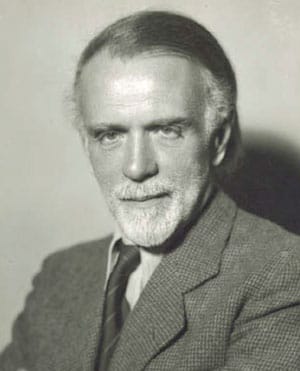
Zoltán Kodály was a firm believer in the power of music as a historical, educational, and civic tool, and a passionate advocate for the musical traditions of his native Hungary. Born in 1882 in what was then known as Austria-Hungary to amateur musician parents, Kodály’s vision in composing, cataloging folk music, and devising his pedagogical system revolved around the articulation of a distinctly Hungarian identity free from “Germanization.”
Despite living through periods of seismic political change (which included both World Wars, an antisemitic and right-wing regime, a Stalinist government, and the 1956 Uprising), this commitment never wavered. From his student days, Kodály’s musical talent was always paired with an academic spirit of inquiry. These interests would manifest in the folk-song collection tours he undertook in the years preceding World War I with Béla Bartók (a close friend and collaborator)—the tours were his primary inspiration for both his developing practices as a composer and educator.
In the interwar period, Kodály began to travel more widely as his orchestral and choral compositions found an international audience. But he remained equally devoted to his work in Hungary: lecturing, writing, and teaching composition in order to popularize his folk music–centric philosophy. Despite his vocal opposition to Hungary’s Nazi-allied government and antisemitic discrimination during World War II, Kodály remained in the country and retained a prominent position in Hungary’s musical life while Bartók emigrated to the United States.
Kodály’s ideas—about the preservation of folk traditions and their use in music education—have since found significant influence both inside and outside of his home country. In the later decades of his life, his educational system was introduced in more than 100 schools across Hungary—meanwhile, two years after his death in 1967, the first foreign Kodály Society (chapters now operate in 34 countries) dedicated to his methods was founded just across the Bay in Oakland.
The Music
Named for the rural town in present-day Slovakia where Kodály spent his early childhood, Dances of Galánta was commissioned by the Budapest Philharmonic Society on the occasion of its 80th anniversary.
Despite Kodály’s extensive study of his native folk music, Galánta is instead rooted in a style of music called verbunkos, which, as scholar Courtney Nichols notes, was Romani in origin, widely referenced in classical music from across Europe, and only later associated with Hungarian tradition. You can hear its signature elements—a recurring slow section (lassú) defined by a dotted rhythm and fast, rhythmic passages (friss)—clearly in the work, though these elements are amplified with classical techniques: rich orchestration, the introduction of major and minor harmonies underneath pentatonic and modal melodies, and detailed rhythmic notation which mimics a sense of freedom in timing.
Though many instruments—among them cellos, horns, and violins—get their turn with the lassú theme, it is the clarinet whose keening voice most often takes up the material. The friss sections—full of nimble doubling in the winds, stretches of rhythmic unison across many sections of the orchestra, and breakneck syncopations—demand virtuosity from nearly every section of the orchestra.
After the opening’s lyric and roving examination of the lassú themes, the piece’s first friss deviation is light and sparkling. These affects change as the alternation continues—some subsequent statements of the lassú are full-voiced and emotionally intense, while the additional friss interludes between them range from the spunkily syncopated to the off-kilter and lumbering.
As the longest and most substantial friss section integrates these different emotional registers and builds towards a feverish intensity, it is interrupted by one more contemplative, lyrical interlude. As the clarinet’s pondering dissipates, the high-tempo material returns as quickly as it was halted, ending the piece in a dramatic flash.
—Lev Mamuya
Lev Mamuya is a Contributing Writer for the San Francisco Symphony and a staff member at the Los Angeles Philharmonic.
Symphony No. 4 in E minor, Opus 98
Johannes Brahms
Born: May 7, 1833, in Hamburg
Died: April 3, 1897, in Vienna
Work Composed: 1884–85
Instrumentation: 2 flutes (2nd doubling piccolo), 2 oboes, 2 clarinets, 2 bassoons, contrabassoon, 4 horns, 2 trumpets, 3 trombones, timpani, triangle, and strings
Duration: About 40 minutes
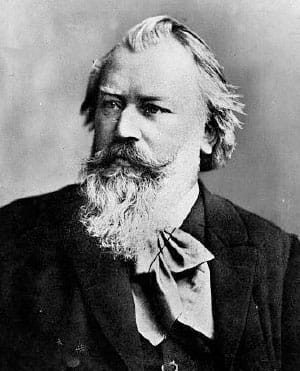
Johannes Brahms’s fourth and final symphony draws on a lifetime of experience and immersive musical study. But even though the E-minor Symphony is acknowledged today as the capstone of Brahms’s career as a symphonist, it was not always warmly welcomed by his contemporaries.
After the composer and pianist Ignaz Brüll performed a two-piano reduction of the score for a small gathering of Brahms’s closest friends, an awkward silence fell. The conductor Hans Richter and the music critics Eduard Hanslick and Max Kalbeck, all three loyal supporters, were unable to say a single nice thing about it. Hanslick later wrote, “I felt as though I were being thrashed by two extremely clever fellows.” Kalbeck told Brahms that the finale was unsuitable for a symphony and advised him to replace it.
Although the Fourth Symphony’s premiere, conducted by the composer on October 25, 1885, in Meiningen, was a great success, later performances in Vienna were underwhelming. The Austrian composer and critic Hugo Wolf dismissed the symphony as “the art of composing without ideas.” Even the conductor Hans von Bülow, who famously anointed Brahms the successor to Bach and Beethoven, described it as “difficult, very.” For more than a decade, many listeners were unmoved, and a few were openly hostile.
Less than a month before he died, at his last appearance in public—in Vienna, on March 7, 1897—Brahms and his symphony were finally vindicated. His biographer and former student Florence May recounted the anecdote in poignant detail: “A storm of applause broke out at the end of the first movement, not to be quieted until the composer, coming to the front of the artists’ box in which he was seated, showed himself to the audience. . . . The applauding, shouting house, its gaze riveted on the figure standing in the balcony, so familiar and yet in present aspect so strange, seemed unable to let him go. Tears ran down his cheeks as he stood there in shrunken form, with lined countenance, strained expression, white hair hanging lank; and through the audience there was a feeling as of a stifled sob, for each knew that they were saying farewell.”
The Music
Today, in the wake of modernism, postmodernism, and all its offshoots, we might struggle to understand why Brahms’s contemporaries found the Fourth Symphony so perplexing. Although it is certainly cunningly made, its cerebral qualities never detract from its beauty. The repeating cycles of descending thirds, which appear throughout the symphony in myriad patterns, unite contrasting moods. Darkness permeates light, minor shifts to major. Sometimes the opposite transpires, and it’s equally powerful. The Fourth never lets us forget that we can’t have love without loss, joy without grief. If you’re happy and you know it, well, just wait.
Brahms lays out his MO in the first movement, when his springing Allegro theme perversely spawns a quotation from one of his Four Serious Songs: “Oh death, how bitter you are.” The Andante moderato, a pensive nocturne in E major, begins with a theme in the medieval-church Phrygian mode—which Brahms understood as the expression of deep need, a longing for heavenly comfort—and then erupts in the scherzo-like Allegro giocoso, a triangle-happy romp in C major. Along with the triangle, Brahms adds a piccolo to the third movement, ramping up the mood of zany mischief while expanding the instrumental palette. He described the general feel as “Alexander the Great’s March to India.”
Despite the energy and variety of the first three movements, it’s the finale that approaches the sublime. Brahms structured it as a passacaglia, a set of variations over a repeated bass line, typically in triple meter. The form, which originated in early 17th-century Spain, was embraced by the likes of J.S. Bach and Dietrich Buxtehude, but it was considered archaic—maybe even a bit cringe—by Brahms’s era.
Redeeming the passacaglia, or rescuing it from obscurity, would have appealed to Brahms the aficionado, who loved nothing more than poring over antique manuscripts and forgotten primary sources. Marked Allegro energico e passionato, the last movement translates decades of historical research into his own harmonic language. The main theme is loosely based on his own death-drunk setting of Bach’s Cantata No. 150, “For Thee, O Lord, I Long.” The Fourth is the only Brahms symphony that ends in a minor key, but the fortissimo coda is too intensely full of life to wallow in the tragic. Even a futile resistance brings hope.
—René Spencer Saller
About the Artists
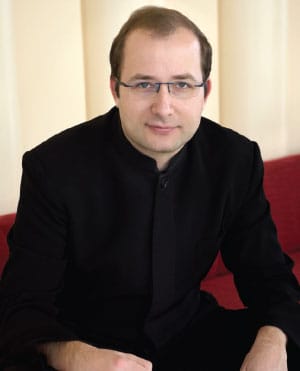
Radu Paponiu
Radu Paponiu was appointed Wattis Foundation Music Director of the San Francisco Symphony Youth Orchestra in fall 2024 and has extended his contract through the 2028–29 season. He was previously associate conductor of the Naples (Florida) Philharmonic and music director of the Naples Philharmonic Youth Orchestra. He has also served as music director of the Southwest Florida Symphony, assistant conductor of the Naples Philharmonic, and as a member of the conducting faculty of the Juilliard Pre-College.
As a guest conductor, Paponiu has appeared with the Romanian National Radio Symphony, Teatro Comunale di Bologna Orchestra, Transylvania State Philharmonic, Banatul Philharmonic, Louisiana Philharmonic, Rockford Symphony, Colorado Music Festival Orchestra, North Carolina Symphony, California Young Artists Symphony, and National Repertory Orchestra. He has collaborated with soloists such as Evgeny Kissin, Yefim Bronfman, Emanuel Ax, Gil Shaham, Midori, Vladimir Feltsman, Robert Levin, Charles Yang, Nancy Zhou, Stella Chen, and the Ébène Quartet.
Born in Romania, Paponiu began his musical studies on the violin at age seven, came to the United States at the invitation of the Perlman Music Program, and later completed two degrees in violin performance at the Colburn School. He went on to earn a master’s degree in orchestral conducting at New England Conservatory, where he studied with Hugh Wolff.
San Francisco Symphony Youth Orchestra
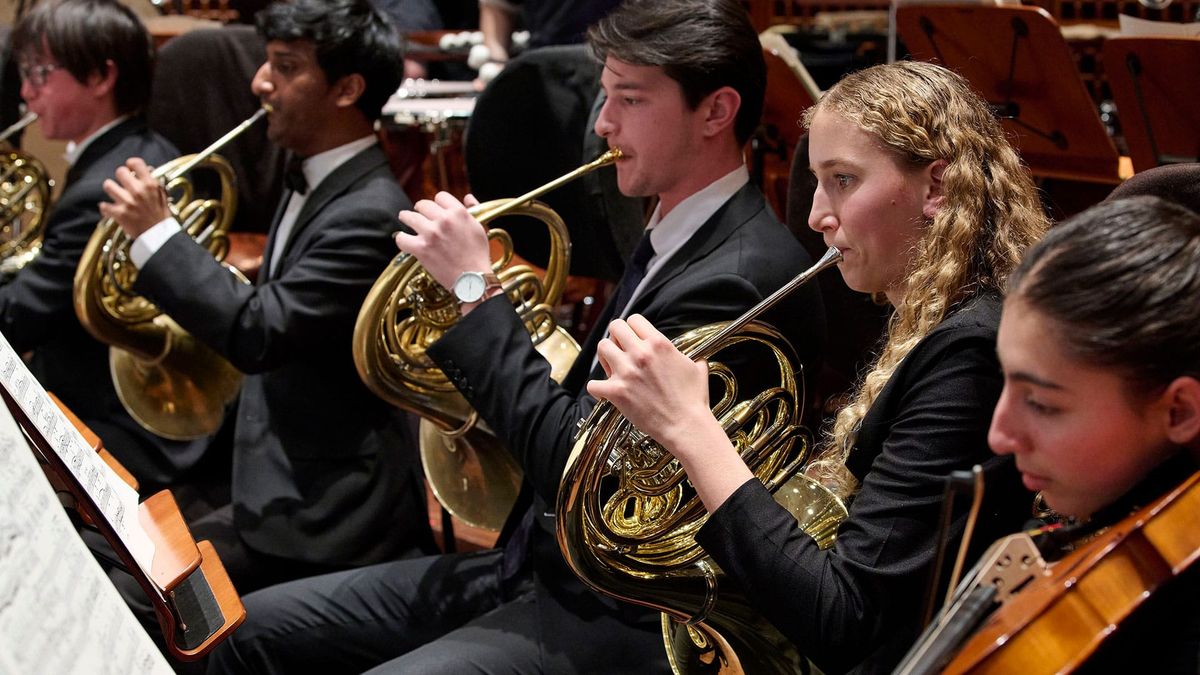
The San Francisco Symphony Youth Orchestra is recognized internationally as one of the finest youth orchestras in the world. Founded by the San Francisco Symphony in 1981, the SFSYO’s musicians are chosen from more than 200 applicants in annual auditions. The SFSYO’s purpose is to provide an orchestral experience of pre-professional caliber, tuition-free, to talented young musicians. The more than 100 musicians, ranging in age from 12 to 21, represent communities from throughout the Bay Area. The SFSYO rehearses and performs at Davies Symphony Hall under the direction of Radu Paponiu, who joined the San Francisco Symphony as Wattis Foundation Music Director of the San Francisco Symphony Youth Orchestra in the 2024–25 season. Jahja Ling served as the SFSYO’s first Music Director, followed by David Milnes, Leif Bjaland, Alasdair Neale, Edwin Outwater, Benjamin Shwartz, Donato Cabrera, Christian Reif, and Daniel Stewart.
As part of the SFSYO’s innovative training program, musi-cians from the San Francisco Symphony coach the young play-ers each Saturday afternoon in sectional rehearsals, followed by full orchestra rehearsals with Radu Paponiu. Youth Orchestra members regularly meet and work with world-renowned artists: Esa-Pekka Salonen, Michael Tilson Thomas, Herbert Blomstedt, Kurt Masur, John Adams, Yo-Yo Ma, Valery Gergiev, Isaac Stern, Yehudi Menuhin, Wynton Marsalis, Midori, Joshua Bell, Mstislav Rostropovich, Simon Rattle, and many others have worked with the Youth Orchestra. Of equal importance, Youth Orchestra members are able to speak with these prominent musicians about their professional and personal experiences, and about music. The ensemble has toured Europe and Asia, given sold-out concerts in such legendary halls as Berlin’s Philharmonie, Vienna’s Musikverein, Saint Petersburg’s Mariinsky Theater, and Amsterdam’s Concertgebouw, and won first prize in Vienna’s International Youth and Music Festival.
San Francisco Symphony Youth Orchestra
First Violins
Euisun Hong, Co-Concertmaster,
Lawrence V. Metcalf Chair
Sydney Li-Jenkins, Co-Concertmaster
Lawrence V. Metcalf Chair
Aaron Ma, Co-Concertmaster
Lawrence V. Metcalf Chair
Andrew Zhang, Co-Concertmaster
Lawrence V. Metcalf Chair
Ethan Chang
Asher Cupp
Brandon Gao
Christina Hong
Hyesun Hong
Kayla Hwang
Constance Kuan
William Liang
Henry Miller
Carolyn Ren
Lisa Saito
Yujin Shin
Oliver Spivey
Kate Vo
Lucy Wang
Riona Zhu
Second Violins
Serena She, Co-Principal
Yihe Wang, Co-Principal
Maggie Cai
Priscilla Chai
Janet Chan
Dylan Chua
Evelyn Holmes
Kirsten Huang
Katherine Jang
Noa Kumayama
Sarah Kumayama
Edan Leung
Jessie Shang
Calliope Smith
Caroline Stevens
Mia Turakhia
Nishanth Viswanathan
Braden Wang
Junnosuke Yanagisawa
Emma You
Violas
Jamie Cheung, Co-Principal
Daphna Rave Glassman, Co-Principal
Jaydon Li, Co-Principal
Rohan Sangani, Co-Principal
Harper Berry
Timothy Cheung
Onyx Haddick
Violet Ozalp
Olivia Park
Olivia Ramirez
Galen Russell
Laurelin Stroh
Nicole Targosz
Annie Vo
Chao-Han Yang
Cellos
Timothy Huang, Co-Principal
Ethan Lee, Co-Principal
Cara Wang, Co-Principal
Hailey Ely
Anya Finsterle
Jackson Hardy
Anthony Jung
Donghu Kim
Sophie Kou
Lukas Masur
Yoonsa Park
Anya Zhang
Basses
Rouyan Lechner, Co-Principal
Allison Prakalapakorn, Co-Principal
Raiden Tan, Co-Principal
Max Balansay
Haku Homma
Hani Khayatei Houssaini
Rudie Sheehy
Adeline Wang
Dominick Weng
Eric Zhang
Flutes
Tiffany Chou
Eileen Lee
Antoine Leung
Cadence Liu
Oboes
Alexander Erlebacher
Jesse Spain
Liam Ta
Asher Wong
Clarinets
Terri Choi
Subin Kim
Hanting Liu
Timothy Park
Bassoons
Julia Borin
Stuthi Jaladanki
Abigail Pinto
Eileen Zhao
Horns
Ciera Alkhoury
Elinor Cooper
Owen Ellis
Violet MacAvoy
Mykah Williams
Trumpets
Marcus Chu
Julian Moran
Ivan Sokolenko
Oliver Zhou
Trombones
Harvy Chang
Ethan Moran
Lenel Elison Gomintong, Bass Trombone
Tuba
Cameron Strahs
Percussion & Timpani
Nava Gold
Garrett Guo
Joshua Hsieh
Roshni Rath
Aeneas Yu
Harps
Camille Chu
Charlotte Trinh
Keyboard
Kartikeya Akella
Radu Paponiu,
Wattis Foundation Music Director
Emilia Díaz Delgado,
Conducting Apprentice
Coaching Faculty
In Sun Jang, First Violin
David Chernyavsky, Second Violin
Chen Zhao, Second Violin
Adam Smyla, Viola
Jill Brindel, Cello
Davis You, Cello
Stephen Tramontozzi, Bass
Catherine Payne, Flute
Russell deLuna, Oboe
Brooks Fisher, Oboe
Matthew Griffith, Clarinet
Jerome Simas, Clarinet
Justin Cummings, Bassoon
Jack Bryant, Horn
Jeff Biancalana, Trumpet
Nicole Hillis, Trombone & Tuba
Marty Thenell, Percussion & Timpani
Katherine Siochi, Harp
Marc Shapiro, Keyboard
Youth Orchestra Administration
Daniel Hallett, Director
Lily Wang, Music Librarian
Katie Lee, Administrative Apprentice
Emma Westerfield, Administrative Apprentice