In This Program
The Concert
Thursday, September 24, 2026, at 7:00pm
Giancarlo Guerrero conducting
John Adams
The Chairman Dances (1985)
Felix Mendelssohn
Violin Concerto in E minor, Opus 64 (1844)
Allegro molto appassionato
Andante–
Allegretto non troppo–Allegro molto vivace
Hilary Hahn
Nicolai Rimsky-Korsakov
Capriccio espagnol, Opus 34 (1887)
Alborada
Variazioni
Alborada
Scena e canto gitano
Fandango asturiano
This program is performed without intermission.
Program Notes
The Chairman Dances
John Adams
Born: February 15, 1947, in Worcester, Massachusetts
Work Composed: 1985
SF Symphony Performances: First—November 1986 (also recorded and released by Nonesuch). Edo de Waart conducted.
Most recent—April 1990. Edo de Waart conducted.
Instrumentation: 2 flutes (doubling piccolos), 2 oboes, 2 clarinets (2nd doubling bass clarinet), 2 bassoons, 4 horns, 2 trumpets, 2 trombones, tuba, timpani, percussion (triangle, crash cymbals, suspended cymbal, sizzle cymbal, high-hat, tambourine, snare drum, bell tree, bass drum, claves, castanets, wood blocks, sandpaper blocks, crotales, glockenspiel, vibraphone, and xylophone), harp, piano, and strings
Duration: About 12 minutes
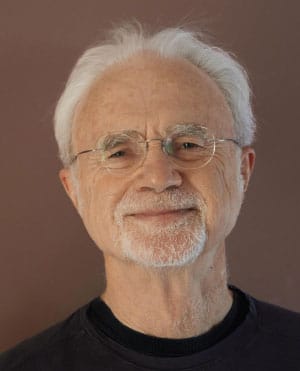
John Adams is perhaps the San Francisco Bay Area’s most famous living orchestral composer, and his collaboration with the San Francisco Symphony dates back decades. Adams moved to the Bay Area in 1971 and soon became a fixture of the music community here. He taught at the San Francisco Conservatory of Music from 1972 to 1982, was appointed as new music advisor to the San Francisco Symphony in 1978, then became the Symphony’s composer in residence from 1982 to 1985. His most recent SF Symphony commission was his second piano concerto, After the Fall, premiered in January 2025 with Víkingur Ólafsson as soloist. The Symphony celebrates his 80th birthday throughout the 2026–27 season.
Adams’s first opera, Nixon in China, was inspired by Richard Nixon’s 1972 trip to China to meet Mao Zedong, and was premiered by Houston Grand Opera in October 1987. Despite the clear connection, The Chairman Dances is not an excerpt from Nixon in China, but rather an outgrowth or, as the composer describes it, “out-take” from Act III and premiered almost two years earlier.
Adams had been commissioned to write a piece for the Milwaukee Symphony, and by 1985 was behind on the work but completely enthralled with his Nixon in China project. The composer was keenly interested in the relationship between Chairman Mao and Jiang Qing (known more commonly as Madame Mao) and decided to expand on this for the Milwaukee commission. Jiang and Mao had a tumultuous relationship over the decades they were together. News of their relationship and eventual marriage in 1938 caused an uproar, not least of all because Mao’s former marriage had not been formally dissolved. The new marriage was restricted largely to the private sphere, and Jiang was barred from publicly bearing the title of wife to Mao. By the time President Nixon visited China in 1972, he and First Lady Pat Nixon watched a ballet performance of The Red Detachment of Women with Jiang Qing, an event dramatized in Act II of Nixon in China.
There are several dance numbers that fade from one to the next over the course of the piece, as if turning the dial on an old radio. Jiang Qing had been a Shanghai movie actress before her involvement with Mao, which is reflected in the music. Adams describes the different dance vignettes as “sometimes slinky and sentimental, at other times bravura and bounding.” Pointillistic accents and other outbursts beckon the ear away from the orchestral ship slowly shifting in the water. One is liable to miss the way the piece has shifted until it has already ruptured into a new dance.
The scenario provided by Peter Sellars and Alice Goodman reads:
[Madame Mao] has gatecrashed the Presidential Banquet. She is first seen standing where she is most in the way of the waiters. After a few minutes, she brings out a box of paper lanterns and hangs them around the hall, then strips down to a cheongsam, skin-tight from neck to ankle and slit up to the hip. She signals the orchestra to play and begins dancing by herself. Mao is becoming excited. He steps down from his portrait on the wall and they begin to foxtrot together. They are back in Yenan, dancing to the gramophone . . .
Violin Concerto in E minor, Opus 64
Felix Mendelssohn
Born: February 3, 1809, in Hamburg
Died: November 4, 1847, in Leipzig
Work Composed: 1838–44
SF Symphony Performances: First—February 1915. Henry Hadley conducted with Albert Spalding as soloist. Most recent—October 2019. Marek Janowski conducted with María Dueñas as soloist.Instrumentation: solo violin, 2 flutes, 2 oboes, 2 clarinets, 2 bassoons, 2 horns, 2 trumpets, timpani, and strings
Duration: About 27 minutes
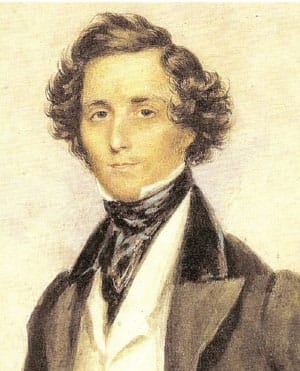
Felix Mendelssohn’s love of classical forms, his desire to write a serious piece of music for the violin, and his consideration for his place in the canon all helped lead him to compose his violin concerto. This contrasted with concertos by composer-performers such as Paganini or the young Chopin, who wrote flashy pieces full of virtuosic pyrotechnics and showmanship. Ferdinand David, the soloist who premiered Mendelssohn’s work, was one of the most important violinists of his time: he was the leader of a string quartet, concertmaster of the Leipzig Gewandhaus Orchestra (where Mendelssohn was music director), and a teacher at the Leipzig Conservatory (which Mendelssohn founded in 1843). Mendelssohn and David collaborated on the concerto and it is likely that David helped with the writing of the cadenza.
Mendelssohn’s violin concerto was innovative in several ways that reflect shifts in concert culture and composition at the time. For European concertgoers before the mid-19th century, today’s expectations of silence in the concert hall would have been wholly unfamiliar. Multi-movement works were broken up into different parts of the program, with shorter pieces and lighter fare interspersed between. Audience members would chat during the performances and interact with the musicians as they were performing. Concerts were social events, places to see and be seen, just as much as they were musical events. Listeners would applaud after each movement, or even demand encores of a particularly spectacular one. Concert culture eventually began to change (particularly after Beethoven’s death in 1827), and audiences became more interested in hearing works in their entirety, as the “genius” composer would have conceived it.
Mendelssohn’s violin concerto is an interesting case study in these shifting mores. In order to create continuity, he does not allow a break between the movements, but rather continues directly from one into the next, with a sustained bassoon between the first and second movements and a transitional passage with the orchestra and soloist between the second and third. This was likely to prevent overeager audience members from applauding at inopportune times, and to encourage them to focus on the piece until the end, when the catharsis of applause would be even greater. This way Mendelssohn ensured that the premiere with his home orchestra at the Leipzig Gewandhaus would proceed the way he wanted it to.
Then in an effort to create a serious concerto that would not be meddled with by nefarious self-serving virtuosos, Mendelssohn wrote out the concerto’s cadenza. Typically, earlier composers would leave it to the soloist to improvise a cadenza, but in the 19th century it became more common for composers to provide one, which would later become the standard practice.
Mendelssohn’s violin concerto was a harbinger of how concertos would shift over the course of the 19th century, from the brilliant concerto to the symphonic concerto. The former was a showpiece, serving as a vessel for a composer-performer’s virtuosity and dazzling technique, to the latter, a serious piece of music that would be treated on par with other works in the concert hall. Mendelssohn deftly weaves this transition, gently shifting audiences’ expectations and behavior through the work alone.
Capriccio espagnol, Opus 34
Nicolai Rimsky-Korsakov
Born: March 18, 1844, in Tikhvin, Russia
Died: June 21, 1908, in Liubensk, Russia
Work Composed: 1887
SF Symphony Performances: First—October 1912. Henry Hadley conducted. Most recent—July 2022 at Stern Grove. Daniel Bartholomew-Poyser conducted.
Instrumentation: 2 flutes, piccolo, 2 oboes, English horn, 2 clarinets, 2 bassoons, 4 horns, 2 trumpets, 3 trombones, tuba, timpani, percussion (triangle, cymbals, tambourine, snare drum, bass drum, and castanets), harp, and strings
Duration: About 15 minutes
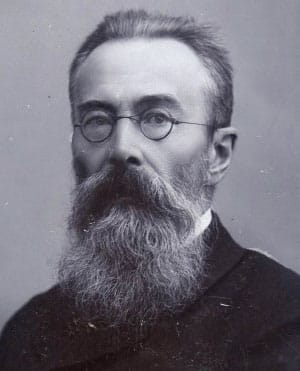
Nicolai Rimsky-Korsakov set out to develop a Russian national style along with his four compatriots, together known as the “Mighty Handful” or “The Five.” When he composed Capriccio espagnol, he did not imagine that it would gain him much renown. And yet today, along with his Russian Easter Overture and Scheherazade, the Spanish Capriccio serves as a shining example of his inspired orchestration, running the gamut of textures and timbres.
The piece is a series of vignettes depicting Spanish life through a 19th-century Russian musical lens. Even while indulging in imagined musical notions of a faraway land, the composer remains tethered to his Russian style, and most importantly, the ideals of the Mighty Handful, which disregarded Western European ideologies about theory, harmony, and form.
The Music
Each of the five movements elides into the next. The first and third are both titled Alborada, a Spanish folksong or serenade. Traditionally, the alborada or alvorada would have been performed at dawn on religious calendar days under the balconies of noble Spanish households. Rimsky-Korsakov’s version is a joyful celebration of daybreak with its spirited melody in the high strings. The clarinet then takes over, a warbling birdsong heralding the bright sun’s dawning.
The second movement begins placidly, with a dolce, lyrical horn quartet. The movement is a study in timbral inventiveness. When the strings take over from the horns, it is the cellos who play the melody above the violins, putting the lower instrument higher for an interesting inverted color. Then the English horn continues the melody, the horn responding with a reflective fanfare: first open, then stopped with the hand in the bell, creating a distant, nasal quality. At the end of the movement the flute meanders chromatically, like a hummingbird flitting around in search of blooming flowers. The flute finally finds its nectar in the opening of the third movement, a transformation of the Alborada, with the woodwinds bounding through the returning theme. The concertmaster plays a spiccato solo, the bouncing bow paying homage to technical finger- strumming passages on the Spanish guitar. The violinist trades off phrases with the clarinet, each iteration growing wider, and wilder in their arpeggiation until the final cadence of the movement.
The fourth movement, titled Scena e canto gitano, is almost narrative in form, a standoff between the Spanish and the gitano, or imagined Romani characters. The trope of “Romani-style” music was popular in the 19th century, loosely based on the music of nomadic groups, and used to exoticize and paint a musical “other.” It was one way in which composers such as Rimsky-Korsakov employed musical stereotypes to create a sense of both “home” and “faraway” in their music.
After the military recitative (depicted in the opening brass section cadenza) finishes, the snare drum remains, a quiet drum roll in the background. The percussion section maintains these persistent rolls during each of the cadenzas in the movement, as if a reminder that while the Romani characters may have their moments, the powerful Spaniards are always present in the background.
The final movement is the Fandango asturiano. The term is of ambiguous origins, but what is generally agreed upon is that it is a piece in triple meter, often performed as a couples dance, and accompanied by the guitar with castanets or hand clapping. Rimsky-Korsakov’s version opens with castanets and folksy open E strings on the violins. The coda reiterates the Alborada theme once again, but as a race to the finish line with a very long, very Russian, extended coda.
—Alicia Mastromonaco
About the Artists
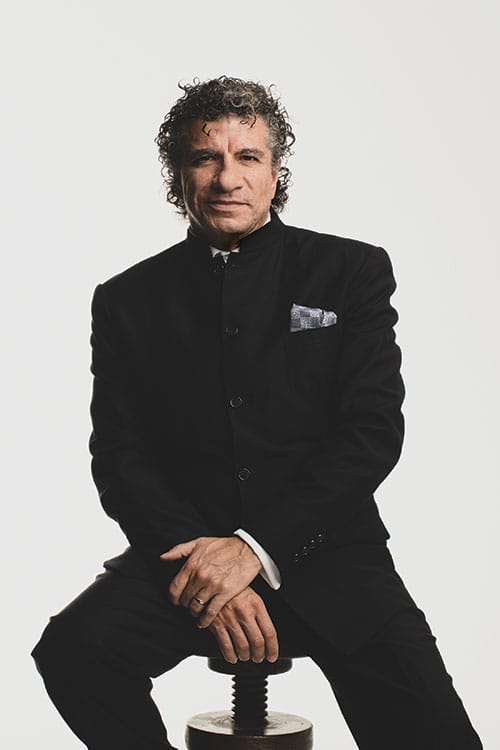
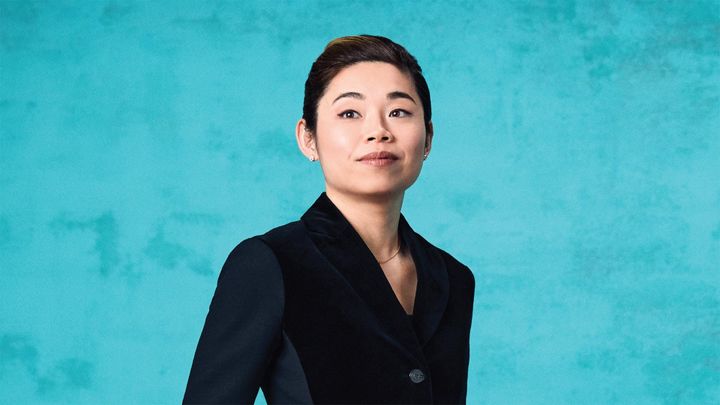
Giancarlo Guerrero
Giancarlo Guerrero is music director of the Sarasota Orchestra and artistic director and principal conductor of the Grant Park Music Festival in Chicago. He continues to serve as music director laureate of the Nashville Symphony after a 16-year tenure during which he released 24 commercial recordings that garnered six Grammy Awards and 13 Grammy nominations.
This season, Guerrero appears with the Chicago Symphony, Oregon Symphony, Baltimore Symphony, Indianapolis Symphony, Orquesta Sinfónica de Galicia, Brussels Philharmonic, Frankfurt Museumsorchester, Sinfónica de Tenerife, and Orquesta Sinfónica del Principado de Asturias. He also appears with NFM Wrocław Philharmonic, where he recently completed a six-season tenure as music director and recorded the Billboard chart-topping Bomsori: Violin on Stage on Deutsche Grammophon.
In recent seasons, Guerrero has led the New York Philharmonic, Boston Symphony, Cleveland Orchestra, Philadelphia Orchestra, Los Angeles Philharmonic, National Symphony, Atlanta Symphony, Dallas Symphony, Detroit Symphony, Seattle Symphony, Houston Symphony, Deutsches Symphonie-Orchester Berlin, London Philharmonic, Orchestre National de France, NDR Radiophilharmonie, Sydney Symphony, and New Zealand Symphony, among others. In 2026, he conducted in Bad Bunny’s Super Bowl LX Halftime Show. He made his San Francisco Symphony debut in February 2013.
Guerrero previously held posts as principal guest conductor of the Cleveland Orchestra’s Miami residency, music director of the Eugene Symphony, and associate conductor of the Minnesota Orchestra. Born in Nicaragua, Guerrero immigrated during his childhood to Costa Rica, where he joined the local youth symphony. He studied percussion and conducting at Baylor University and earned his master’s degree in conducting at Northwestern University.
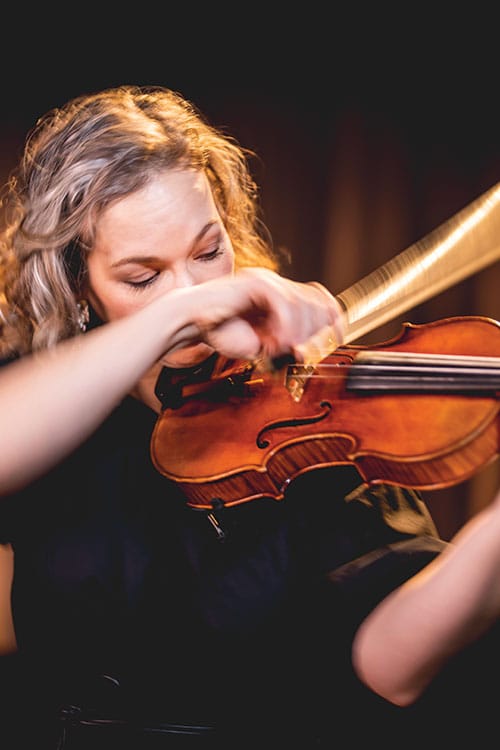
Hilary Hahn
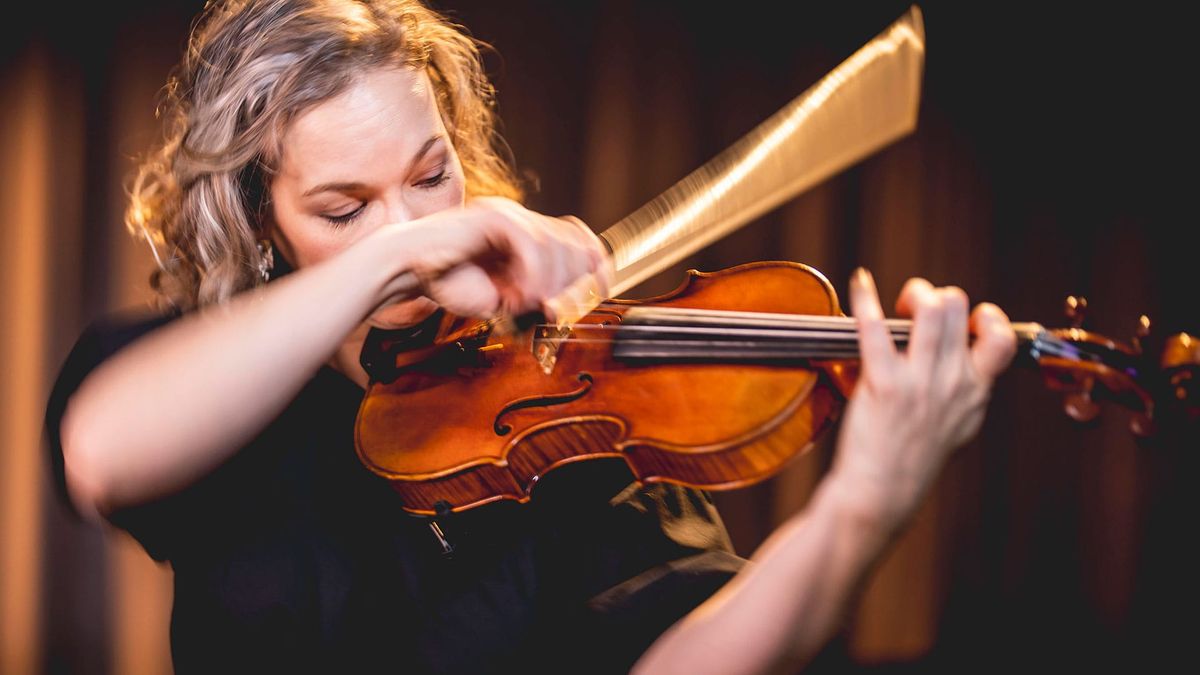
Three-time Grammy Award–winning violinist Hilary Hahn melds expressive musicality and technical expertise with a diverse repertoire guided by artistic curiosity. She is a prolific recording artist and commissioner of new works, and her 23 feature recordings have received numerous international prizes and acclaim. Her new role on the violin faculty of the Juilliard School follows her earlier tenure as a Juilliard visiting artist. Recent seasons have also seen her serve as an artist in residence at the Chicago Symphony and New York Philharmonic, and as a curating artist of the Dortmund Festival. She made her San Francisco Symphony debut in October 1999 as a Shenson Young Artist.
Hahn has related to her fans naturally from the very beginning of her career. Her social media initiative, #100daysofpractice, has transformed practice into a community-building celebration of artistic development. Since Hahn created the hashtag in 2017, fellow performers and students have contributed more than one million posts. A former Suzuki student, she released new recordings of the first three books of the Suzuki Violin School in 2020. In 2019, she released a book of sheet music, In 27 Pieces: the Hilary Hahn Encores, which includes her own fingerings, bowings, and performance notes for each work. Hahn is a prolific and celebrated recording artist whose feature albums on Decca, Deutsche Grammophon, and Sony have all opened in the top 10 of the Billboard charts.
In recent seasons, Hahn received the Avery Fisher Prize, was named Musical America’s artist of the year for 2023, delivered the keynote speech of the second annual Women in Classical Music Symposium, received the 2021 Herbert von Karajan Award, and was awarded the 11th annual Glasshütte Original Music Festival Award, which she donated to the Philadelphia-based music education nonprofit Project 440. Hahn was the 2022 Chubb Fellow at Yale University’s Timothy Dwight College; she also holds honorary doctorates from Middlebury College and Ball State University, where there are three scholarships in her name.
About San Francisco Symphony
- San Francisco Symphony
- Calendar
- How to Donate
- Advocacy, Community & Volunteering
- Board of Governors
- Administration
- Your Visit & Experience
Print Edition