In This Program
The Concert
Friday, June 12, 2026, at 7:30pm
Saturday, June 13, 2026, at 7:30pm
Sunday, June 14, 2026, at 2:00pm
Tianyi Lu conducting
Iman Habibi
Zhiân (2023)
First San Francisco Symphony Performances
Erich Wolfgang Korngold
Violin Concerto in D major, Opus 35 (1945)
Moderato mobile
Romance
Finale
María Dueñas
Intermission
Nicolai Rimsky-Korsakov
Scheherazade, Opus 35 (1888)
The Sea and Sinbad’s Ship
The Tale of the Kalendar Prince
The Young Prince and the Young Princess
The Festival at Baghdad–The Sea–The Ship Goes to Pieces on a Rock Surmounted by a Bronze Warrior
Lead support for this concert series is provided by a generous donor and

Tianyi Lu’s appearances are generously supported by the Shenson Young Artist Debut Fund.
Program Notes
At a Glance
Erich Wolfgang Korngold’s segue into film composing likely saved his life—in 1938, the Jewish former prodigy happened to be in Hollywood when Nazi Germany annexed Austria. His Violin Concerto, performed here by María Dueñas, was premiered by his neighbor, none other than Jascha Heifetz, who helped ensure that the violin writing was perfectly pitched between lyricism and virtuosity.
Zhiân
Iman Habibi
Born: September 10, 1985, in Tehran
Work Composed: 2023
First SF Symphony Performances
Instrumentation: 2 flutes, piccolo, 2 oboes, English horn, 2 clarinets, bass clarinet, 2 bassoons, contrabassoon, 4 horns, 3 trumpets, 3 trombones, tuba, timpani, percussion (cymbals, suspended cymbals, tam-tam, whip, brake drum, snare drum, bass drum), harp, and strings
Duration: About 13 minutes
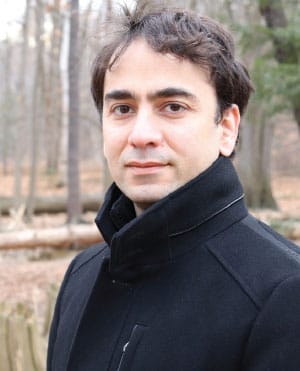
Iranian Canadian composer and pianist Iman Habibi has developed a body of work that often engages with cultural memory and historical sources. He was born in Tehran in 1985 and came of age during a period of war with neighboring Iraq. As a child, Habibi began improvising on a small keyboard and pursued his musical training despite unfavorable conditions for formal study. Still, his parents—a chemical engineer and an English teacher and translator—encouraged his love of music. The family left Iran in 2003 and, after an uncertain period abroad, began a new life in Canada. Habibi went on to study at the University of British Columbia and completed his doctoral degree at the University of Michigan.
Habibi has received commissions from organizations including the Gabriela Lena Frank Creative Academy of Music, the Philadelphia Orchestra, Toronto Symphony, and Boston Symphony, for which he composed Zhiân. He is also a laureate of the Azrieli Music Prizes, for which he was commissioned to write the orchestral song cycle Shāhīn-nāmeh, based on the 14th-century Persian Jewish poet Shāhin-i Shirāzi’s reframing of the biblical story of Esther.
Several of Habibi’s compositions, which include orchestral, choral, chamber, and solo works, as well as music for film, reveal his commitment to questions of social and climate justice, with particular concern for the struggles affecting the Iranian people. “For decades,” the composer remarks, “Iranians have been kept hostage, continually fighting to retrieve their most basic human rights, their freedom, justice, and their environmental and ecological health.”
Zhiân was prompted by the revolutionary wave of civil unrest and protests following the death in 2022 of Mahsa Amini, a 22-year-old Kurdish Iranian woman who had been held in custody by the Guidance Patrol, the Iranian government’s morality police. The title is taken from the second word of the slogan that became omnipresent during the protests: Zhen, Zhiân, Âzâdi (Woman, Life, Freedom)—a slogan inspired by Amini’s Kurdish name, Zhina or Jina. As Habibi explains, Zhiân means “life” in Kurdish and “indignant” or “formidable” in Persian. “Those are the best words I can use to describe the bravery of the Iranian people who came to the streets to protest and to advocate for their basic human rights.”
More recently—though before the current Iran war—Habibi remarked on the ongoing relevance of Zhiân: “While originally written in solidarity with the ‘Woman, Life, Freedom’ movement, this piece resonates with renewed urgency in the wake of the 2026 protests and the subsequent violence—now one of the deepest wounds in Iran’s long history. I stand with my compatriots in their quest for a free, just, and green future.”
The Music
The slogan Zhen, Zhiân, Âzâdi is not only a point of reference but a source of musical material that provides coherence throughout Zhiân. Habibi points out that the slogan’s spoken rhythm “forms the main motivic element of this piece,” while “massive bodies of sound wash over” the listener, recalling “the crowd of millions of people” and inspiring us to “join them in their protests and in their cause.”
The composer continues: “The music carries us through darkness and light, but resolves in the end with a determination to continue striving towards a just, sustainable, and vibrant future. In the months I spent writing this piece, I was surrounded by images and videos of Iranian protesters inside and outside of Iran, many of whom lost their loved ones, lost their own lives, or are currently imprisoned or on death row. This piece is my humble attempt to stand in solidarity with them, and I dedicate it to the brave people of Iran, in the hope of better days ahead.”
—Thomas May
Violin Concerto in D major, Opus 35
Erich Wolfgang Korngold
Born: May 29, 1887, in Brno, Moravia
Died: November 29, 1957, in Hollywood, California
Work Composed: 1945
SF Symphony Performances: First—January 1994. André Previn conducted with Raymond Kobler as soloist. Most recent—December 2006. David Zinman conducted with Hilary Hahn as soloist.
Instrumentation: solo violin, 2 flutes (2nd doubling piccolo), 2 oboes (2nd doubling English horn), 2 clarinets, bass clarinet, 2 bassoons (2nd doubling contrabassoon), 4 horns, 2 trumpets, trombone, timpani, percussion, harp, celesta, and strings
Duration: About 25 minutes
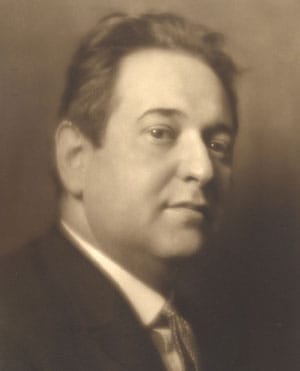
Being the son of Vienna’s leading music critic might have been intimidating to someone less gifted, but it didn’t impede Erich Wolfgang Korngold’s progress. He raised the bar for child prodigy composers through the quality of his early achievements. He began to compose at age eight, and was only 13 when his ballet Der Schneemann (The Snowman) received its premiere at the Vienna Opera. Gustav Mahler—no pushover in matters of musical judgment—was so impressed that he recommended a mentor for the astonishingly gifted youngster. Decades later, long after the elder composer’s death, Korngold would dedicate his Violin Concerto to Mahler’s widow, Alma Mahler-Werfel.
Korngold composed both brilliantly orchestrated large-scale works and intimate chamber pieces, but he gained particular attention for his operas. In 1920, “Korngold fever” broke out when his first full-length opera, Die tote Stadt (The Dead City), written in his signature late-romantic, fin-de-siècle idiom, generated so much buzz that a fierce bidding war broke out among German opera houses for the right to present its premiere.
Korngold’s career path took a dramatic turn in the 1930s, when he pursued opportunities in the rapidly expanding film industry. He had collaborated with Max Reinhardt—a mover and shaker in the theater world—on a high-profile adaptation of Johann Strauss Jr.’s Die Fledermaus in Berlin in 1929. Reinhardt persuaded Korngold to join him in Hollywood, where he wanted his colleague to arrange Felix Mendelssohn’s incidental score to Shakespeare’s A Midsummer Night’s Dream for a new film version of the play, directed by Reinhardt. (Film buffs will recall this is the Midsummer in which James Cagney plays Bottom and Mickey Rooney is a giddy-voiced Puck.)
Korngold tried to have it all by leading a bicontinental existence, split between Old World Vienna and sunny California. He happened to be in Hollywood, working on his score for The Adventures of Robin Hood starring Errol Flynn, when the Nazis annexed his homeland of Austria. Korngold, who was Jewish, was able to arrange for his family to join him in California, which then became their new home. Until the end of the Second World War, he focused on writing film scores for Warner Brothers.
But Korngold longed to reclaim his position as a “classical” composer and abandoned the screen after Deception, the 1946 film starring Bette Davis. He began to return to classical forms, drawing on the musical inspiration he had been channeling into films; the Violin Concerto, in fact, mines themes from several of his film scores. The Polish violinist Bronisław Huberman, founder of the Palestine Symphony (later Israel Philharmonic), for years had been encouraging Korngold to write a concerto for him. Finally, in the summer of 1945, he was able to complete the project, but Huberman died before he could perform it. Jascha Heifetz introduced the concerto in 1947, performing it to great success with the St. Louis Symphony; Heifetz went on to make the first recording.
Korngold hoped that the Violin Concerto would mark his concert hall comeback, but he had by now become typecast as a Hollywood artist. His “serious” music, by contrast, was frequently derided by critics as passé. One of the meanest quips appeared in the New York Sun, where critic Irving Kolodin sneered that the concerto was “more corn than gold.”
Ironically, even as Korngold was enduring a sequence of rejections in his final decade, he had already become a significant figure in American musical culture—albeit one without wide name recognition—thanks to the success of the films he worked on and his influence with his fellow movie composers. In recent decades, the quality of both his film scores and his “classical music”—particularly the Violin Concerto and the opera Die tote Stadt—has been widely reappraised.
The Music
Paying homage to one of the best-known classical models, the violin concerto of Felix Mendelssohn (another storied prodigy), Korngold has the soloist enter at the outset. The yearning, widely spanning opening theme (originally used in the film Another Dawn) is complemented by a tenderly woven melody taken from the period film Juarez (which featured Bette Davis as the wife of the 19th-century puppet ruler of Mexico, Maximilian I).
The radiant middle movement, which the composer titled Romanze, highlights the soulful character of the solo writing. The source here is the Academy Award–winning Anthony Adverse. Korngold seems to channel something of his personality as an opera composer—a sensationally successful career cut short by the barbarity that had overtaken his homeland. Even if straightforward expression of emotions was considered verboten in avant-garde circles in the postwar years, movies provided an outlet. (Film scores also introduced mass audiences to some of the most experimental musical styles of the era.)
As a counterweight to the first two movements’ elevated lyricism, Korngold gives the rondo finale a swashbuckling, rhythmically incisive virtuosity. The main theme, from the Mark Twain–inspired 1937 flick The Prince and the Pauper, bursts with extroverted exuberance. In its high-spirited confidence, the listener senses something of the vitality of Korngold’s adoptive country.
—T.M.
Scheherazade, Opus 35
Nicolai Rimsky-Korsakov
Born: March 18, 1844, Tikhvin, Russia
Died: June 21, 1908, Liubensk, Russia
Work Composed: 1888
SF Symphony Performances: First—February 1913. Henry Hadley conducted. Most recent—May 2023. Giancarlo Guerrero conducted.
Instrumentation: 2 flutes (doubling piccolos), 2 oboes (2nd doubling English horn), 2 clarinets, 2 bassoons, 4 horns, 2 trumpets, 3 trombones, tuba, timpani, percussion (triangle, tambourine, cymbals, tam-tam, tamburo, piccolo tamburo, and bass drum), harp, and strings
Duration: About 45 minutes
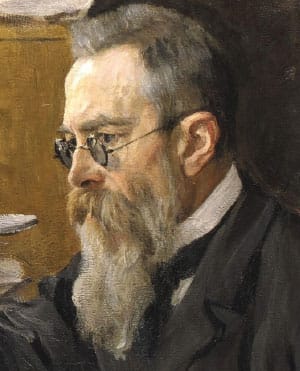
One of the first smash hits of the Ballets Russes, the renegade dance company that took Paris by storm in the early part of the 20th century, was a ballet adaptation of Scheherazade, Nicolai Rimsky-Korsakov’s 1888 symphonic suite. In adding opulent costumes, sensual choreography, and a lurid murder-in-the-harem scenario to Rimsky-Korsakov’s lush score, impresario Sergei Diaghilev was poised to profit to the full from Belle Époque Paris’s ongoing fascination with the Orient—and profit he did. Indeed, the ballet amplified that fascination still further, with its costumes in particular fueling a craze amongst the city’s bon ton for turbans, harem pants, and Eastern-themed tableaux-vivants.
Both Scheherazades—the suite (premiered in Saint Petersburg in October 1888) and the 1910 ballet—conjure the world depicted in European translations of One Thousand and One Nights, the collection of Middle Eastern folk tales first compiled in Arabic during the Islamic Golden Age. This perfumed realm of color and spice, of sultans and sultanas, of jinn, ghouls, and sorcerers is not the real East, of course: it’s a fantasy of the East, and a Western fantasy at that. The translations of One Thousand and One Nights to which both Rimsky-Korsakov and Diaghilev had access tended to exercise eyebrow-raising amounts of poetic license, departing substantially from the original tales in ways designed to boost their perceived exoticism to a Western reader. Both Scheherazades are Orientalist, then: there’s no getting around that. But Rimsky-Korsakov’s Scheherazade differs from Diaghilev’s not just musically (Diaghilev abridged Rimsky-Korsakov’s score without permission, angering his widow), but in overall spirit, too. The most striking difference between the two works is that Scheherazade herself, the main character in One Thousand and One Nights, is nowhere to be seen in Diaghilev’s ballet—but she occupies center stage in the symphonic suite.
Rimsky-Korsakov’s Scheherazade is a musical portrayal of Scheherazade, the main character in the “frame narrative” of One Thousand and One Nights—that is, the story in which the collection’s constituent tales are all embedded. Scheherazade is a virtuosic raconteur who uses her gift for storytelling to save herself from destruction at the hands of her sadistic bridegroom, the Sultan Shahriar. Convinced of the duplicitousness of all women, the Sultan has resolved to murder each of his wives the morning after his wedding to them. But Scheherazade thwarts her new husband’s plan by telling him a tale on their wedding night that so enraptures him that, when she breaks it off prematurely at dawn, he spares her life for one more day so that she can finish it the following night. (The Sultan has essentially embarked on the world’s first Netflix binge.) She does the same thing the next night, and the next, and so on for 1,001 nights, until the Sultan finally agrees to spare her life indefinitely.
The Music
Scheherazade opens with a musical depiction of that first tense encounter between the newlyweds. A shouty descending motif dominated by the brass section announces the Sultan, and after a few tremulous measures of almost-silence, Scheherazade responds with her own motif: a lyrical, curlicued solo violin melody accompanied by strums on the harp. The Sultan immediately falls silent, and the music turns it back on him, taking on the glimmering delicacy of the “Scheherazade” motif as it gives itself over entirely to Scheherazade’s unfurling poetic vision.
For the rest of the piece, we remain within Scheherazade’s freewheeling narrative perspective, with the Sultan’s occasional interjections appearing as petulant interruptions to her tale. We imagine what she imagines: from boats, seabirds, and sudden squalls (The Sea and Sinbad’s Ship), to the thrill of a dangerous quest (The Tale of the Kalendar Prince), to the tender, whirling giddiness of young love (The Young Prince and the Young Princess). After relishing the drama of a riotous street festival, we return to the sea, where the terror of a shipwreck eventually gives way to a sense of peace and reconciliation.
Rimsky-Korsakov’s genius for orchestration is on full display in Scheherazade. For example, the combination of violas, oboe, and English horn in the third movement results in a new timbre whose color is not reducible to the sum of its parts: the resonance of the strings is strengthened, and the quality of the woodwinds softened. (Were Rimsky-Korsakov alive today, he might very well be an electronic-sound synthesist.) His harmonic and rhythmic ingenuity is in evidence, too. The Sultan’s motif is built on an octatonic scale (one with eight degrees rather than the more usual seven) composed of alternating tones and half-tones. This innovation, which lends the motif much of its piquancy, was later seized on to great effect by Rimsky-Korsakov’s student, Igor Stravinsky. And the metrical instability of the beginning of the second movement—it feels like it’s in four, but you eventually realize it’s in three—has shades not only of Stravinsky, but arguably also of the metrical fake-outs of late 20th-century prog rock.
Scheherazade is a portrait of Scheherazade—but not merely that. It’s a moving picture of her intellect. Every quick pivot and feint that the music makes acquaints us with a facet of the fleet, darting consciousness of a woman in full control of her storytelling craft. Diaghilev’s ballet, with its eroticized choreography and its gauzy costumes, encouraged viewers to admire the female dancers of the Ballets Russes for the beauty of their bodies. But Rimsky-Korsakov’s symphonic suite encourages us to admire Scheherazade for the brilliance of her mind.
—Jenny Judge
About the Artists
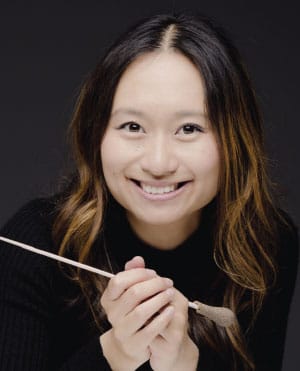
Tianyi Lu
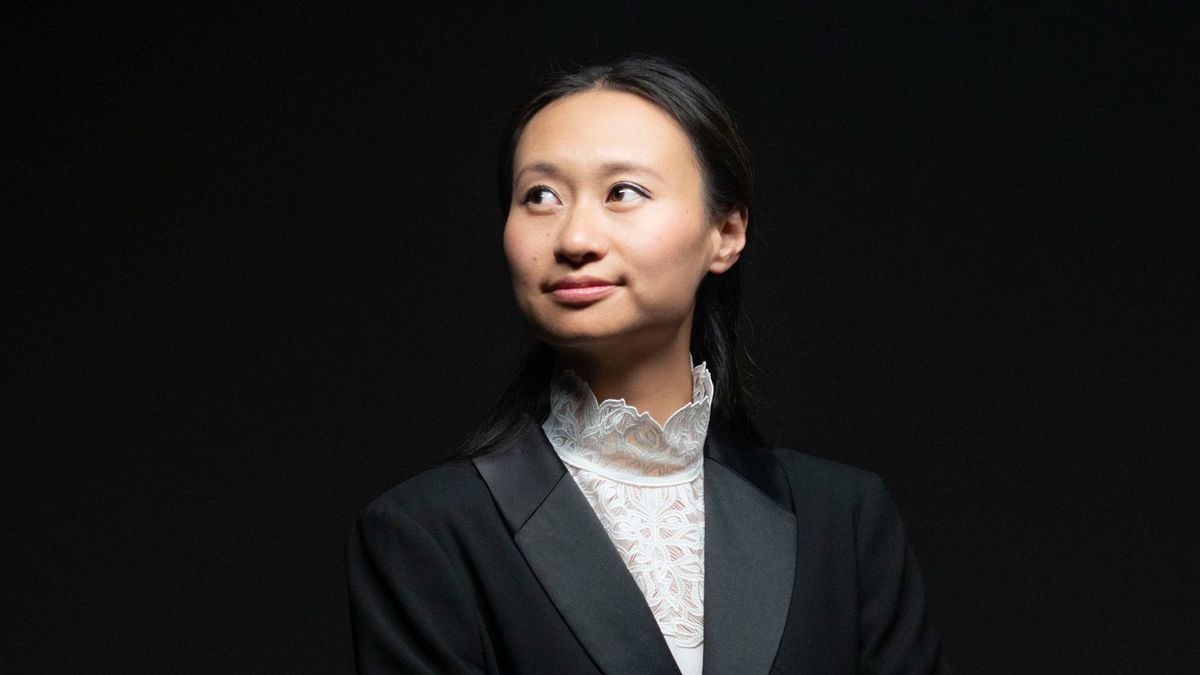
Tianyi Lu won first prize at both the 2020 Sir Georg Solti International Conductors’ Competition and the 2020 International Conducting Competition “Guido Cantelli” in Italy. She was subsequently appointed conductor in residence with the Stavanger Symphony in Norway, where she served through the 2023–24 season. She has also served as principal conductor of the St Woolos Sinfonia and assistant conductor of the Melbourne Symphony. A former Dudamel Fellow, she made her Hollywood Bowl debut with the Los Angeles Philharmonic in 2021 and her Disney Hall debut in 2023. Other recent highlights include her BBC Proms debut with the BBC Symphony, as well as appearances with the New York Philharmonic, Montreal Symphony, London Philharmonic, Frankfurt Radio Symphony, Philharmonia Orchestra, the Hallé, MDR Leipzig Radio Symphony, Orchestre National de Lyon, Helsinki Philharmonic, San Diego Symphony, and Sydney Symphony.
This season, Lu debuts with Deutsches Symphonie-Orchester Berlin, National Symphony, New World Symphony, Norwegian Radio Orchestra, and Utah Symphony, among others, and tours with Orchestre National de Belgique. She also returns to perform with the Residentie Orkest, City of Birmingham Symphony, Lahti Symphony, and Pacific Symphony. She makes her San Francisco Symphony debut with these performances.
The Chinese-born New Zealander completed her master of music in orchestral conducting with distinction at the Royal Welsh College of Music & Drama, where she now serves on the board of directors. She is also an alumna of the Hart Institute for Women Conductors at the Dallas Opera.
Read an interview with Tianyi Lu as part of our June features.
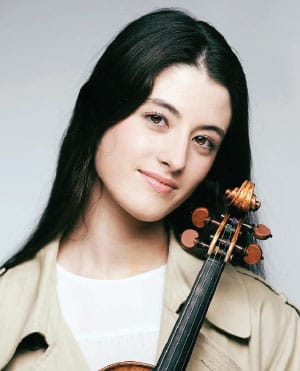
María Dueñas
María Dueñas is a Deutsche Grammophon artist, having released Beethoven and Beyond in 2023, which won the Opus Klassik award as Young Artist of the Year. She has also won top prizes in the senior division of the Menuhin Competition, the Vladimir Spivakov International Violin Competition, and the Zhuhai International Mozart Competition. Her most recent recording of Paganini’s 24 Caprices and related works brought her recognition as Young Artist and Instrumentalist of the Year at the Gramophone Classical Music Awards.
As a soloist, Dueñas has appeared with the Philadelphia Orchestra, Pittsburgh Symphony, Cleveland Orchestra, Staatskapelle Berlin, Staatskapelle Dresden, NHK Symphony, Munich Philharmonic, NDR Elbphilharmonie Orchestra, Vienna Symphony, Philharmonia Orchestra, Accademia di Santa Cecilia, and Orchestre de Paris, among others. With the Los Angeles Philharmonic and Gustavo Dudamel, she performed at the Hollywood Bowl’s 100th anniversary celebration, and premiered and recorded Gabriela Ortiz’s violin concerto. Highlights this season include debuts with the Vienna Philharmonic at Salzburg Mozart Week, the New York Philharmonic, and West-Eastern Divan Orchestra. She made her San Francisco Symphony debut in October 2019.
Dueñas is also a composer and has written cadenzas for most of her concerto repertoire. As an actress, she appeared in Sofia Bohdanowicz’s Measures for a Funeral. Dueñas plays the Giambattista Guadagnini violin of 1779 from the Deutsche Stiftung Musikleben as well as the Stradivarius “Michelangelo” of 1718, on generous loan from the Karolina Blaberg Foundation.