In This Program
The Concert
Tuesday, November 10, 2026, at 7:30pm
Hélène Grimaud piano
Ludwig van Beethoven
Piano Sonata No. 32 in C minor, Opus 111 (1822)
Maestoso–Allegro con brio ed appassionato
Arietta: Adagio molto semplice cantabile
Intermission
Franz Schubert
Piano Sonata in B-flat major, D.960 (1828)
Molto moderato
Andante sostenuto
Scherzo: Allegro vivace con delicatezza
Allegro ma non troppo
Program Notes
Beethoven and Schubert: The Last Testament
Making connections between an artist’s life and work became increasingly common during the 19th century. Beethoven long served as the most influential example among composers in this regard. His gradual overcoming of difficult personal circumstances to achieve extraordinary professional success exemplified a familiar biographical strategy of dividing a career into three creative phases—early, middle, and late—analogous to the life stages of youth, maturity, and old age. It became hard to escape this satisfying way of situating a creative output even if the relationship between an artist’s daily existence and the art itself is not always self-evident or necessarily meaningful.
The magnificent last piano sonatas by Beethoven and Schubert culminate their engagement with the genre and, in the latter’s case, is his final instrumental composition. Beethoven started writing his Sonata in C minor, Opus 111, in December 1821 and finished it in February of the following year (with some further revisions in April). Schubert composed the Sonata in B-flat major six years later, shortly before his death in November 1828 at age 31.
Posterity is understandably fascinated with a composer’s late works, especially last ones. Are they valedictory? Were they meant as a farewell? To what? To a genre, to composing, to life itself? Some careers conclude with a distinctive late style, such as commentators were already delineating for Beethoven during his lifetime. Schubert’s career in this regard poses a challenge. It may seem inappropriate to characterize a late style, rather than just last works, for someone who died prematurely. Yet Schubert became seriously ill due to syphilis at age 25 and lived his last six years under a cloud of poor health. He repeatedly said he would never recover and apparently anticipated an early demise.
Vienna: Land of the Piano
Both the piano and the sonata underwent gradual transformations in the decades before the 1820s, when Beethoven and Schubert composed their final ones. Mozart moved to Vienna in 1781 and wrote an enthusiastic letter to his father proclaiming that the imperial city was “certainly the land of the piano” (ein wahres Clavierland). The piano was already changing when Beethoven first composed in his teens, near the end of Mozart’s life. As with technology today, there were significant innovations in hardware: the range of the piano was expanding (that is, the lowest to the highest notes that it was possible to play), as were the effects an instrument could produce, all while buying a piano became more affordable as new piano firms emerged.
By the time Beethoven moved to Vienna in 1792, at age 21, he was already recognized as a brilliant keyboard virtuoso. Like Mozart before him, he dazzled audiences and aristocratic patrons with his gifts in playing, improvising, and composing. Piano sonatas were then rarely performed at public concerts, but they nonetheless represented his first great published compositions, nearly a dozen appeared before he began tackling the high-prestige genres of the string quartet, symphony, and opera. Sonatas helped Beethoven establish his early career, leading to famous middle- period works (some of which eventually acquired nicknames), such as the Moonlight, Waldstein, and Appassionata sonatas. By the end of his life, Beethoven had produced 32 canonical sonatas, which the celebrated pianist and conductor Hans von Bülow dubbed the New Testament of the keyboard literature, alongside
J. S. Bach’s 48 preludes and fugues of the Well-Tempered Clavier as the Old Testament.
Piano Sonata No. 32 in C minor, Opus 111
Ludwig van Beethoven
Baptized: December 17, 1770, in Bonn
Died: March 26, 1827, in Vienna
Work Composed: 1821–22
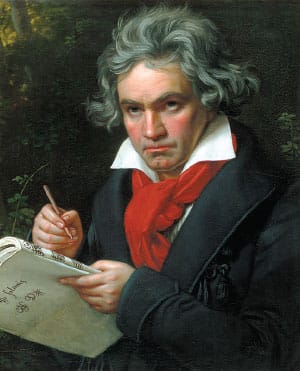
Beethoven first acknowledged that he was losing his hearing at age 30 in 1801 and he experienced a gradual decline over the coming years. He stopped concertizing in 1814 and thereafter wrote fewer pieces, which tended to be longer and more difficult. By this point the piano had a larger range than in his youth and he fully exploited the highest and lowest notes—which he perhaps could feel or hear better—beginning most notably in the monumental Hammerklavier Sonata, Opus 106. After that, in April 1820, the publisher Adolph Martin Schlesinger requested three more sonatas, which the firm released from 1821–23 as Opus 109, 110, and 111. Beethoven went on to compose further keyboard music with the Diabelli Variations, Opus 120, as well as a last set of bagatelles, Opus 126.
As with late works in other genres, the Piano Sonata in C minor, Opus 111, represents yet another advance in Beethoven’s “spiritual development,” to recall the evocative title of an enduring study of Beethoven’s music by J. W. N. Sullivan from 1927. Most of Beethoven’s piano sonatas are in three movements, some in four, and a few with just two movements, as in Opus 111. The work is in C minor, the key of the Fifth Symphony, the Coriolan Overture, and other particularly intense works. The Maestoso introduction is dramatic, dissonant, and disturbing, beginning loudly with the dotted rhythm associated with the so-called French Overture. Beethoven originally planned for this to lead to a fugue, a procedure that had already played a large role in the companion sonatas. In the sketches for Opus 111 he jotted down fugal parts from Mozart’s Requiem and the finale of Haydn’s String Quartet in F minor, Opus 20, no.5, but he abandoned this scheme for what is nonetheless a highly contrapuntal Allegro con brio ed appassionato in sonata form.
The second movement offers a stark contrast: Arietta: Adagio molto semplice e cantabile (Little Aria: Adagio to be played very simply and in a singing manner), which unfolds as a series of variations after a lyrical opening, an instance of what the musicologist Joseph Kerman aptly called Beethoven’s “vocal impulse” evident in many late works. After four variations, Beethoven abandons the procedure for an extended conclusion that builds to a passage with sustained trills sounding simultaneously in three registers, the top one at the extreme height of the keyboard against the lowest notes of the instrument. The trilling top continues as the music modulates from minor to major for an incandescent conclusion that ends slowly and softly.
This surprising but magnificent conclusion has long prompted questions about whether more should follow—the publisher even wrote to Beethoven asking if a finale had been “accidentally forgotten by the copyist.” Anton Schindler, Beethoven’s unreliable assistant and later biographer, reports that Beethoven told him he didn’t have time to write another movement, entirely missing the irony of the reply. While there are sketches for the first two movements, none exist for anything more.
The philosophical explanation to the question came from the German novelist Thomas Mann, who enlisted help from the formidable critic Theodor W. Adorno. In an extended discussion of the sonata in Mann’s Doctor Faustus (1947), the fictional musicologist Wendell Kretzschmar delivers a lecture that touches on the issue of why there are just two movements:
We had only needed, he said, to hear the piece to answer the question ourselves. A third movement? A new approach? A return after this parting—impossible! It had happened that the sonata had come, in the second, enormous movement, to an end, an end without any return. And when he said “the sonata,” he meant not only this one in C minor, but the sonata in general, as a species, as traditional art-form; it itself was here at an end, brought to its end, it had fulfilled its destiny, resolved itself, it took leave—the gesture of farewell of the D G G motif, consoled by the C-sharp, was a leave-taking in this sense too, great as the whole piece itself, the farewell of the sonata form.
Piano Sonata in B-flat major, D.960
Franz Schubert
Born: January 31, 1797, in Vienna
Died: November 19, 1828, in Vienna
Work Composed: 1828
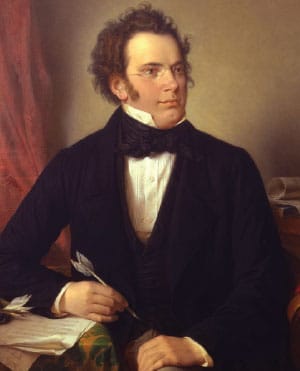
A quarter century after Beethoven’s first keyboard works, Schubert staked his name at age 18 with the song “Erlkönig.” Its dazzling piano accompaniment illustrates Goethe’s poem and was possible because advances in the instrument could handle the dramatic repeated notes in the right hand. Schubert was not a piano virtuoso himself—he supposedly could not play “Erlkönig” (and wrote a simplified version) nor the demanding Wanderer Fantasy, Opus 15. Unlike Mozart and Beethoven, he was clearly not pinning his career on being a performer. But even if Schubert was reluctant to perform in public, he was apparently happy to play for hours among friends at informal domestic gatherings known as Schubertiades. The piano figured in the vast majority of his compositions, beginning with the earliest surviving ones that he wrote around age 13. Schubert completed nearly a dozen piano sonatas (and left an equal number incomplete). Three of them were published, which spread his name more widely than did any of his other instrumental works.
Legend has it that Schubert visited Beethoven a few days before the master died on March 26, 1827, at age 56. That visit is probably fake news, but it is firmly documented that Schubert participated as a torchbearer at Beethoven’s funeral three days later. He then went on to compose an astonishing number of masterpieces in the mere 20 months before his own death the following year. This included the song cycles Winterreise and Schwanengesang, the Piano Trio in E-flat major, the Mass in E-flat major, the Fantasy in F minor for piano duet, the String Quintet in C major, and the last three piano sonatas, as well as brief sacred works, smaller keyboard pieces, dances, partsongs, lieder, and even sketches for an opera and a last symphony. One is hard-pressed to think of another composer who produced such quantity and quality of music during such a brief period.
Because Schubert had already enjoyed some success publishing piano sonatas, it made sense for him to write three more during the summer of 1828. They are dated “September,” although surviving drafts suggest a somewhat longer genesis. Schubert intended to dedicate the set to the composer Johann Nepomuk Hummel (1778–1837), who had been Mozart’s student and was a much esteemed figure at the time. Schubert’s death delayed their publication by a decade, and by the time the publisher Anton Diabelli released them, Hummel had died and the set carried a dedication to Robert Schumann, who wrote of them: “Whether they were written from his sickbed or not, I have been unable to determine. The music would suggest that they were. And yet it is possible that one imagines things when the portentous designation ‘last works’ crowds one’s fantasy with thoughts of impending death.”
Just as Beethoven had planned his last three sonatas as a set, Schubert likewise devised a trilogy and there are fascinating interrelations among them. These four-movement sonatas show a remarkable range of moods, and each one projects a different character. The Sonata in C minor, D.958, is the most explicitly Beethovenian, close to some of the earlier composer’s works in the same key. The Sonata in A major, D.959, uses the finale of Beethoven’s Sonata in G major, Opus 31, no.1, as a structural model for the last movement, even as Schubert recycles his own melody, a theme he had used earlier for the slow movement of his Sonata in A minor, D.537.
Schubert’s more serene final Sonata in B-flat major, D.960, that we hear tonight, also seems to reference Beethoven in the opening Molto moderato, which is similar to the Archduke Trio, Opus 97, also in B-flat. Schubert’s beautiful, lyrical, almost holy opening is soon disturbed by a brief G-flat trill sounding in the bass. Trills, as we saw, play a significant role in Beethoven’s last sonata, but he sounds them continuously for long stretches, prominent and structural, not as an ornamental decoration. Schubert’s uncanny trill is also not decorative, but it does not last long as it growls at the depths of the instrument. The first movement is long, one of the most expansive Schubert ever composed, especially if the exposition repeat is observed which includes the trill played fortissimo.
Time seems to be suspended in the outer sections of the second movement (Andante sostenuto), which is in A-B-A form. The middle part, in A major, has the character of a lied. The following Scherzo: Allegro vivace con delicatezza is an unusual marking for Schubert. Although Schubert’s fame was most connected with song, he also wrote hundreds of dances that were widely published and admired—the trio of the movement displays these gifts. Schubert ends the sonata with a seemingly more genial last movement (Allegro, ma non troppo—Presto) that breathes the same air as the finale of Beethoven’s String Quartet in B-flat, Opus 130, the last music Beethoven composed and that also opens in the “wrong” key. (Beethoven composed this movement as the substitute ending for the original finale that was published as the “Great Fugue,” Opus 133.)
Over the course of his brief career, Schubert often drew upon his own lieder for instrumental works, directly quoting passages in which the now absent words might give clues to meaning. The late piano sonatas are not nearly so explicit, although some moments convey a mood or texture similar to those found in his songs, especially those eventually published in the collection Schwanengesang (Swan Song). While elements of these sonatas are specifically modeled on Beethoven, the more important similarity is the shared value of Romantic subjectivity evident in deeply personal works. The chance to hear these two last testaments of great contemporaries, however different, is a privilege.
—Christopher H. Gibbs
About the Artists
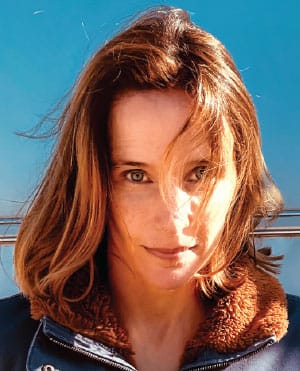
Hélène Grimaud
Hélène Grimaud is not just a deeply passionate and committed musical artist, but also a wildlife conservationist, a human rights activist, and a writer. She has been an exclusive Deutsche Grammophon artist since 2002. Her recordings have been awarded numerous accolades, including the Cannes Classical Recording of the Year, Choc du Monde de la Musique, Diapason d’Or, Grand Prix du Disque, Record Academy Prize (Tokyo), Midem Classic Award, and Echo Klassik Award. Her contributions have been recognized by the French government, which admitted her to the Ordre National de la Légion d’Honneur at the rank of Chevalier.
Recent projects include For Clara, focused on the ties that bound both Robert Schumann and his protégé Brahms to the pianist-composer Clara Schumann. Concert highlights include appearances with the London Philharmonic, Luxembourg Philharmonic as part of a residency at the Luxembourg Philhar-monie, the Philadelphia Orchestra, and Camerata Salzburg.
Grimaud was born in Aix-en-Provence, was accepted into the Paris Conservatory at 13, and won first prize in piano performance three years later. She continued to study with György Sándor and Leon Fleisher until she gave her debut recital in Tokyo in 1987. That same year, Daniel Barenboim invited her to perform with the Orchestre de Paris. She made her San Francisco Symphony debut as a Shenson Young Artist in February 1993.