In This Program
The Concert
Sunday, May 31, 2026 at 2:00pm
Gunn Theater
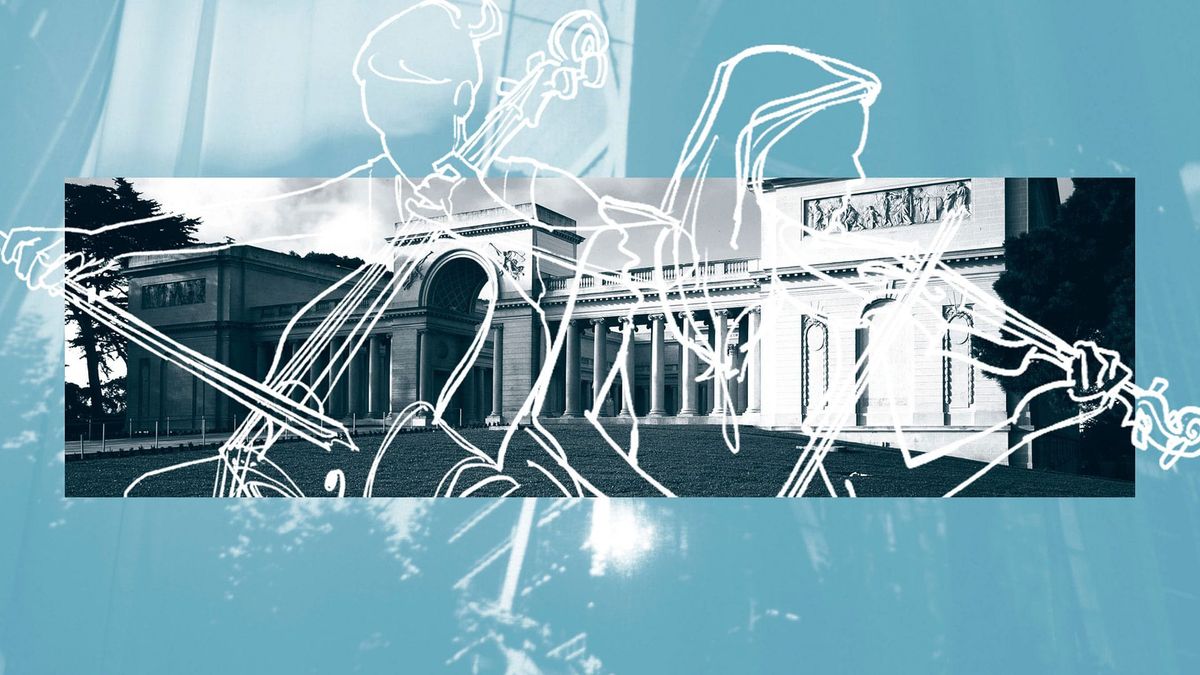
California Palace of the Legion of Honor
Alexander Barantschik violin
Peter Wyrick cello
Anton Nel piano
Wolfgang Amadeus Mozart
Piano Trio in E major, K.542 (1788)
Allegro
Andante grazioso
Allegro
Johannes Brahms
Sonata No. 1 in E minor for Cello and Piano, Opus 38 (1865)
Allegro non troppo
Allegretto quasi menuetto
Allegro
Intermission
Robert Schumann
Piano Trio No. 1 in D minor, Opus 63 (1847)
Mit Energie und Leidenschaft
Lebhaft, doch nicht zu rasch
Langsam, mit inniger Empfindung
Mit Feuer
This series showcases the 1742 Guarneri del Gesù violin on loan to Alexander Barantschik and the San Francisco Symphony from the Fine Arts Museums of San Francisco.
Program Notes
Piano Trio in E major, K.542
Wolfgang Amadeus Mozart
Born: January 27, 1756, in Salzburg
Died: December 5, 1791, in Vienna
Work Composed: 1788
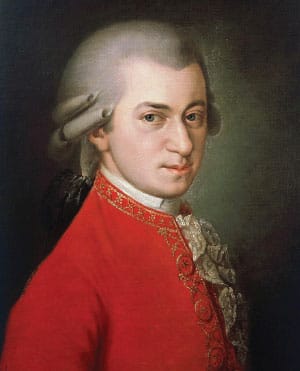
Some composers write their greatest music under extreme duress. Perhaps financial pressure forces productivity or composition serves as an outlet for emotional turmoil. Mozart was such a composer, somehow able to transform his personal tragedy into great art. His summer of 1788 serves as an example.
Don Giovanni had just had a disastrous premiere in Vienna, shocking after its unequivocal success in Prague a few months prior. He found himself in dire financial straits, reduced to begging friends for support. Most tragically, Mozart and his wife Constanze endured the pain of yet another child’s death, six-month-old Theresia, their third child to die before the age of one. In a letter to his friend Michael Puchberg, Mozart begged for a loan, then concluded with a P.S. about the E-major trio: “When are we to have a little musical party at your house again? I have just composed a new trio!”
Mozart had remarkable confidence in the piece: he wrote to his sister Nannerl asking her to play the trio for Joseph Haydn’s brother, Michael Haydn, saying “he cannot possibly dislike this trio.” He also played it in his audition for an appointment at the court of Dresden. Musicians over the centuries have shared his enthusiasm for the piece and it has become a favorite. Perhaps most famously, Frédéric Chopin played it in 1848 at his last public concert in Paris.
K.542 is the only multi-movement piece that Mozart ever wrote in the key of E major. This singularity is only one of its surprising and unusual qualities. The work begins with a curious solo melody in the piano. It is hard to nail down the character of this opening—is it wistful, bright and cheery, tender? It seems to be all these things at once. Rather than transition directly into the second theme, Mozart introduces a new carefree theme in E major and then halts the proceedings with a shocking B sharp at the top of a piano scale. Everything stops, and when the music resumes, we hear the second theme, properly in the dominant key of B major, as if nothing odd had occurred.
After some more exploration and a straight-forward ending, we are treated to a delightful second movement, marked grazioso (graceful). Its middle section gives us a taste of melancholy with an extended foray into a minor key and beautiful but fleeting harmonies.
Mozart had some difficulty writing the third movement. He disposed of his first attempt, eschewing a fugue and opting for something much simpler. The piano alternates between tinkling music in the high register and playful interjections of low octaves. The effect creates a childlike character, as Mozart biographer Alfred Einstein described it. Even the mournful episode towards the middle of the movement seems to express an innocent sadness. Before the end of the piece, the violin and piano both have showy moments with virtuosic cadenzas. The cello is not invited to their party, but as a consolation prize, it gets the final word with a solo cadence that closes the book on this children’s tale.
Sonata No. 1 in E minor for Cello and Piano, Opus 38
Johannes Brahms
Born: May 7, 1833, in Hamburg
Died: April 3, 1897, in Vienna
Work Composed: 1862–65
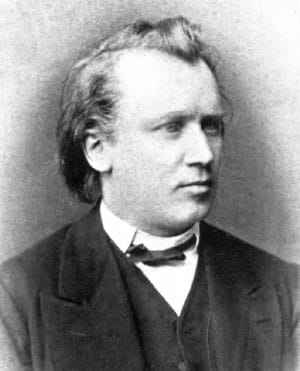
In 1862, Johannes Brahms’s friend Adolf Schubring wrote these prophetic words in the Neue Zeitschrift für Musik: “[Brahms] understands how to be Classic and Romantic, ideal and real—and after all, I believe he is appointed to blend both these eternal oppositions in art.”
Shortly after this career-defining article, Brahms began work on his E-minor cello sonata: his first published duo sonata. In June 1862, he rented a house with his composer friend Albert Dietrich just below the Ebernburg castle in a picturesque part of Germany. It was no coincidence they chose a location near the vacation spot of the virtuoso pianist and composer Clara Schumann, Brahms’s love and muse. Dietrich and Brahms spent the summer months composing, hiking in the nearby countryside, and visiting with Clara who regularly played for them in the evenings.
Brahms dedicated the sonata to his friend and colleague Josef Gänsbacher, a singing coach, administrator of the Singakademie in Vienna, and an amateur cellist. It was at Gänsbacher’s recommendation that Brahms received an invitation to direct the Singakademie, a position that became Brahms’s portal into the Viennese music world. The story goes that when Brahms and Gänsbacher played the sonata for a group of friends, Gänsbacher complained that he could not hear himself because of Brahms’s vigorous piano playing. Brahms responded: “lucky you.” It is likely an apocryphal anecdote, but not wholly unbelievable given Brahms’s cantankerous humor.
In this story, Brahms and Gänsbacher would have been performing the first version of the E-minor sonata, a three-movement piece with an Adagio as the central movement. Brahms submitted it twice to the publisher Simrock and was rejected. After three years, he revisited the piece while on another bucolic retreat near Clara Schumann. He did away with the Adagio middle movement, writing a fugal finale to replace it. The revision gave the piece a strange shape—a massive first movement in sonata form followed by a little dance marked Allegretto quasi Menuetto and finished off with the tumultuous Allegro. There is no slow movement in the entire piece. Finally in 1866, Simrock accepted this version and published it.
As if to answer Schubring’s critical essay, Brahms blends Romanticism and Classicism in novel ways in the E-minor sonata. Rich, singing melodies and moments of Sturm und Drang are couched in old musical structures. The first movement of the sonata is like an aural depiction of chiaroscuro. It opens with a decidedly scuro melody in the cello, dark and resonant, encouraged by offbeat chords in the piano. The scholar Karl Geiringer remarked on the resemblance of the first theme to the Contrapunctus III from Bach’s Art of Fugue. We pass through several keys with plenty of harmonic surprises until a new group of themes emerges, first a fiery one in B minor, furiously exchanged in tight counterpoint between the piano and the cello, then a theme in B major that floats peacefully in the wake of turmoil. The development reaches an energetic peak through unlikely means—the simple descending fifth that accompanied the peaceful B-major theme becomes a source of incredible power. After letting go into a quiet return of the B-major melody, the piece follows standard sonata form with a recap of the material from the exposition. The movement ends in the chiaro mood with a pastorale fantasy on the B-major theme.
The second movement, Allegretto quasi menuetto, is playful in a slightly sinister way, filled with the poised dance rhythms and graceful ornaments of the French Baroque. A sinuous waltz in the movement’s central trio section sees Brahms at his cleverest, expanding the first four notes of the minuet’s main theme until we return to the movement’s opening material. The third movement grabs us immediately. Though mostly in sonata form, it contains large fugal sections with a subject again inspired by Bach’s Art of Fugue. Brahms uses his command of classical forms to dramatic effect. The thundering piano part caused Brahms biographer Daniel Mason to write: “When you set a single cello to competing like this with the two hands of an able-bodied pianist, the odds are certainly on the pianist.” But the interweaving of the cello and the pianist’s two hands also makes for fascinating sonorities and thrilling virtuosity. A cascade of notes in both instruments brings the piece to a crashing close.
Piano Trio No. 1 in D minor, Opus 63
Robert Schumann
Born: June 8, 1810, in Zwickau, Saxony
Died: July 29, 1856, in Endenich, near Bonn
Work Composed: 1847
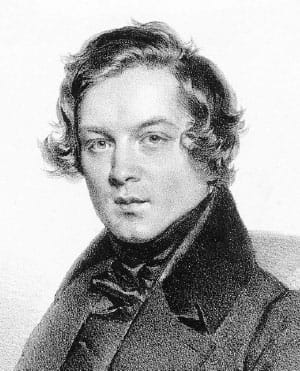
Robert Schumann wrote his D-minor trio in 1847, a tragic time in an often tragic life. In 1844, he had suffered from serious depression and one of his “nervous episodes,” marked by tremors, auditory hallucinations, and severe phobias. By 1847 he had mostly recovered, but the constant threat of ill health remained. Bookending the summer of 1847 were the untimely deaths of composers Fanny Mendelssohn Hensel and Felix Mendelssohn, the sibling duo whom Robert and his wife Clara counted among their closest friends. Most tragically, Robert and Clara’s first son Emil died at 16 months old on June 22, less than a week after Schumann had completed the sketch of the trio.
After Schumann’s “nervous episode” in 1844, his doctor prescribed total rest and forbade composition. Schumann could not bear this and discovered a workaround by learning to compose in his mind. He wrote later in life: “I used to write most, practically all of my shorter pieces in the heat of inspiration; many compositions were completed with unbelievable swiftness.... Only from the year 1845 on, when I began to invent and work out everything in my head, did a completely new manner of composing begin to develop.”
In addition to developing a more deliberate compositional method, Schumann dedicated the entire year of 1845 to the study of counterpoint, calling it his Fugenpassion (fugue fever). With his wife Clara, one of the great concert pianists and herself a formidable composer, he undertook a deep study of J.S. Bach’s Art of Fugue and Well-Tempered Clavier. In the D-minor trio we can clearly hear his recent obsession with counterpoint and the intricacy of the music also points to his slower compositional process.
Schumann’s D-minor trio is clearly inspired by three other trios written by his contemporaries: Fanny Mendelssohn Hensel’s D-minor trio and Felix Mendelssohn’s D-minor trio, which he called “the master trio of our time.” The third, and strongest, influence belongs to Clara, who wrote her G-minor trio as a seventh wedding anniversary present to Robert in 1846. In response, Robert presented her with this D-minor trio for her 28th birthday the following year.
Right from the start, we hear the influence of Schumann’s fugenpassion. The violin spins a dark, chromatic melody that the bass of the piano echoes in counterpoint, building to a forceful dotted rhythm played by all three instruments. The music transforms quickly in mood and then hangs on a high note for a moment, questioning, before introducing the uplifting second theme in the piano. Here too Schumann treats the theme as contrapuntal material, giving the cello pieces of it with which to urge on first the piano and then the violin when it takes the theme. The development gives us a particularly extraordinary new theme—distant, with an otherworldliness created through tinkling chime-like chords in the upper register of the piano combined with ponticello strings (bowed near the bridge of the instrument). In the recapitulation, all proceeds almost as usual with the return of themes in sonata-form style, but the ending of the movement throws off predictability, giving us a brief memory of the mystical theme from the development and ending uncertainly.
The scherzo chortles nervously with dotted rhythms until the trio section in the middle smooths everything over with a glassy surface. Again we see the study of counterpoint reflected in Schumann’s use of canon, increasing the urgency and excited agitation that is prevalent throughout the movement. In the tempo marking of the third movement, the heart of the piece, Schumann writes “mit inniger Empfindung” (with utmost feeling). Unsurpassed tenderness intermingles with winding chromatic lines. We are swept away for some time in the middle section with moving chords in the piano, and then return to thoughtful introspection until Schumann once again poses a question. The answer this time is the finale, marked “Mit Feuer” (with fire). Its central melody has a celebratory and open-hearted quality though it is constantly disturbed by aching melodic interjections, agitated murmurings, and other contradictory ideas. The interplay between the instruments builds at last to a bubbling up of D major and the dark clouds, for now, are vanquished.
—Allegra Chapman
About the Artists
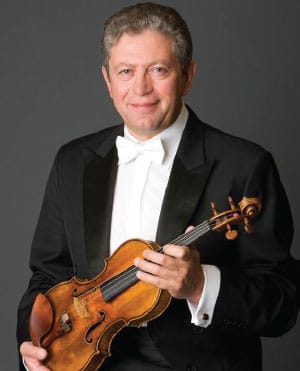
Alexander Barantschik
Alexander Barantschik began his tenure as the San Francisco Symphony’s Concertmaster in September 2001 and holds the Naoum Blinder Chair. He was previously concertmaster of the Bamberg Symphony Orchestra, London Symphony Orchestra, and Netherlands Radio Philharmonic, and has been an active soloist and chamber musician throughout Europe. He has collaborated in chamber music with André Previn, Antonio Pappano, and Mstislav Rostropovich. As leader of the LSO, Barantschik toured Europe, Japan, and the United States, performed as soloist, and served as concertmaster for major symphonic cycles with Michael Tilson Thomas, Rostropovich, and Bernard Haitink. He was also concertmaster for Pierre Boulez’s year-long, three-continent 75th birthday celebration.
Born in Russia, Barantschik attended the Saint Petersburg Conservatory and went on to perform with the major Russian orchestras including the Saint Petersburg Philharmonic. His awards include first prize in the International Violin Competition in Sion, Switzerland, and in the Russian National Violin Competition. Since joining the SF Symphony, Barantschik has led the Orchestra in several programs and appeared as soloist in concertos and other works by Bach, Mozart, Mendelssohn, Brahms, Beethoven, Prokofiev, Shostakovich, Walton, Piazzolla, and Schnittke, among others. Barantschik is a member of the faculty at the San Francisco Conservatory of Music, where he teaches graduate students from around the world in a special concertmaster program. Through an arrangement with the Fine Arts Museums of San Francisco, Barantschik has the exclusive use of the 1742 Guarneri del Gesù violin once owned by the virtuoso Ferdinand David, who is believed to have played it in the world premiere of the Mendelssohn E-minor Violin Concerto in 1845. It was also the favorite instrument of the legendary Jascha Heifetz, who acquired it in 1922 and who bequeathed it to the Fine Arts Museums, with the stipulation that it be played only by artists worthy of the instrument and its legacy.
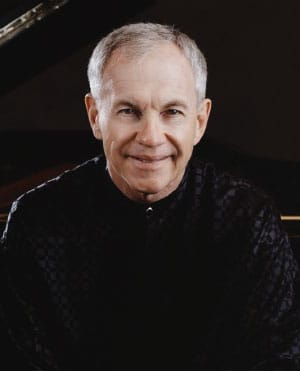
Anton Nel
Winner of the 1987 Naumburg International Piano Competition, Anton Nel tours as a recitalist, concerto soloist, chamber musician, and teacher. Highlights in the United States include performances with the Cleveland Orchestra, Chicago Symphony, Dallas Symphony, and Seattle Symphony, as well as recitals from coast to coast. He has appeared internationally at Wigmore Hall, the Concertgebouw, Suntory Hall, and major venues in China, Korea, and South Africa.
Nel holds the Joe R. and Teresa Lozano Long Endowed Chair at the University of Texas at Austin, and in the summers is on the faculties of the Aspen Music Festival and School and the Steans Institute at the Ravinia Festival. Born in Johannesburg, Nel is also an avid harpsichordist and fortepianist, and is a graduate of the University of the Witwatersrand, where he studied with Adolph Hallis, and the University of Cincinnati, where he worked with Béla Síki and Frank Weinstock. He made his San Francisco Symphony debut in 1994.
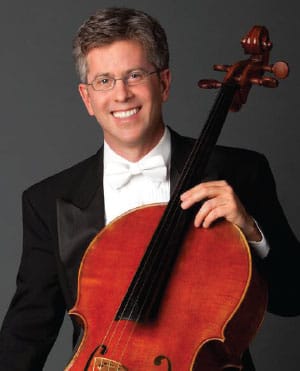
Peter Wyrick
Peter Wyrick was a member of the San Francisco Symphony cello section from 1986–89, rejoined the Symphony as Associate Principal Cello from 1999–2023, and retired from the Orchestra at the end of the 2023–24 season. He was previously principal cello of the Mostly Mozart Orchestra and associate principal cello of the New York City Opera. He has appeared as soloist with the SF Symphony in works including C.P.E. Bach’s Cello Concerto in A major, Bernstein’s Meditation No. 1 from Mass, Haydn’s Sinfonia concertante in B-flat major, and music from Tan Dun’s Crouching Tiger, Hidden Dragon Concerto.
In chamber music, Wyrick has collaborated with Yo-Yo Ma, Joshua Bell, Jean-Yves Thibaudet, Yefim Bronfman, Lynn Harrell, Jeremy Denk, Julia Fischer, and Edgar Meyer, among others. As a member of the Ridge String Quartet, Wyrick recorded Dvořák’s piano quintets with pianist Rudolf Firkušný on an RCA recording that received the Diapason d’Or and a Grammy nomination. He has also recorded Fauré’s cello sonatas with pianist Earl Wild for dell’Arte records. Born in New York to a musical family, he began studies at the Juilliard School at age eight and made his solo debut at age 12.