In This Program
The Concert
Friday, May 22, 2026, at 7:30pm
Saturday, May 23, 2026, at 7:30pm
Sunday, May 24, 2026, at 2:00pm
Cristian Măcelaru conducting
Tyler Taylor
Embers (2026)
San Francisco Symphony Commission and World Premiere
Commissioned as part of the Emerging Black Composers Project
Sergei Rachmaninoff
Piano Concerto No. 1 in F-sharp minor, Opus 1 (1891/1917)
Vivace
Andante
Allegro vivace
Simon Trpčeski piano
Intermission
Antonín Dvořák
Symphony No. 9 in E minor, Opus 95, From the New World (1893)
Adagio–Allegro molto
Largo
Scherzo: Molto vivace
Allegro con fuoco
The May 22 concert is presented in partnership with

The Emerging Black Composers Project is underwritten by Michèle and Laurence Corash.
These concerts are generously sponsored by the Athena T. Blackburn Endowed Fund for Russian Music.
Program Notes
At a Glance
In between is Sergei Rachmaninoff’s Piano Concerto No. 1 with Macedonian pianist Simon Trpčeski. It was made for Rachmaninoff’s solo debut as a pianist and composer, completed when he was just 18. He revised it 26 years later as he fled the Russian Revolution.
Embers
Tyler Taylor
Born: November 18, 1992, in Louisville, Kentucky
Work Composed: 2026
SF Symphony Commission and World Premiere
Instrumentation: 3 flutes (2nd doubling alto flute and 3rd doubling piccolo), 2 oboes, English horn, 2 clarinets, bass clarinet, 2 bassoons, contrabassoon, tenor saxophone, 4 horns, 3 trumpets (3rd doubling flugelhorn), 3 trombones, tuba, timpani, percussion (triangle, crotales, suspended cymbal, tam-tam, tambourine, snare drum, tom-toms, bass drum, whip, marimba, vibraphone, and tubular bells), harp, piano, and strings
Duration: About 16 minutes
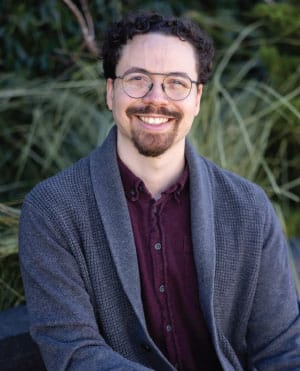
Tyler Taylor is the 2024 winner of the Michael Morgan Prize from the Emerging Black Composers Project, an initiative launched by the San Francisco Symphony and San Francisco Conservatory of Music in 2020.
Born and raised in Louisville, Kentucky, where he currently resides, Taylor is also a horn player and teacher of composition and horn. He earned degrees in both fields from the University of Louisville, a master’s degree from the Eastman School of Music, and a doctorate from Indiana University. In 2025, he was awarded the Cleveland Orchestra’s Daniel R. Lewis Fellowship, a three-year composer residency with the orchestra.
Taylor describes his music as “creating abstract musical analogies for social-political happenings both present and past.” In previous orchestral pieces, he has used the saxophone to represent othered voices and questioned orchestral hierarchy by reconfiguring the orchestra into smaller ensembles. In Embers, his new piece for the San Francisco Symphony, we follow a voice fighting to be heard, and the musical analogies take both abstract and concrete forms.
The Music
Embers begins with the first violins playing an expressive melody while stifled by heavy practice mutes—a visible, visceral effect. The first five minutes of the piece, dominated by this suppressed voice, evoke melancholy and difficult memories. Taylor says, “when you spend too much time dwelling in the past, there are consequences.” We quickly hear those consequences when the orchestra explodes in a torrent of sound that resets the scene. In the aftermath of this event, the theme from the muted violins appears in various guises. Taylor describes how the theme works its way through every part of the orchestra and serves as the foundation of all of the musical materials heard in the piece. Each time it is heard, it tries asserting itself in new ways: “the responses to these assertions vary from sharp cuts to long waves of sympathetic spinnings-out.”
The theme takes on many different characters throughout the piece: sometimes persistent and rebellious, sometimes mocking (when played by the trombones), sometimes peaceful. An optimistic group of trumpets breaks through briefly, but is cut off aggressively by the rest of the orchestra. Toward the end of the piece, at its climax, the trumpets return, reimagined in the context of the darker sound world that the piece inhabits, “not as bright and radiant, but still very, very powerful.” In his own program note, Taylor writes:
The word “embers” may evoke a number of associations. The aftermath of a fire—dim, flickering, glowing, ashes that can be stoked back into something powerful and energized. Distant memories echoing into the present.
In a broader sense, Embers reflects on what we are experiencing together as a larger community—united by a need to be heard, the pursuit of peace, and a desire for progress. Neither the piece nor I pretend to provide answers, but it certainly makes room for reflecting on where we stand and what we stand for.
—Allegra Chapman
Piano Concerto No. 1 in F-sharp minor, Opus 1
Sergei Rachmaninoff
Born: April 1, 1873, in Semyonovo, Staraya Russa, Russia
Died: March 28, 1943, in Beverly Hills, California
Work Composed: 1891 (rev. 1917)
SF Symphony Performances: First—February 1941. Pierre Monteux conducted with Sergei Rachmaninoff as soloist. Most recent—March 2008. Gustavo Dudamel conducted with Kirill Gerstein as soloist.
Instrumentation: solo piano, 2 flutes, 2 oboes, 2 clarinets, 2 bassoons, 4 horns, 2 trumpets, 3 trombones, timpani, percussion (triangle and cymbals), and strings
Duration: About 25 minutes
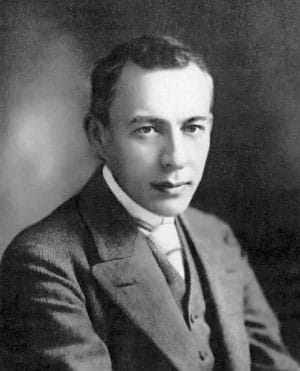
“Everything around me makes it impossible for me to work and I am frightened of becoming completely apathetic.” So wrote Sergei Rachmaninoff to his lifelong mentor Alexander Siloti in the fall of 1917 as revolution shook Russia. Guns fired in the streets outside his Moscow apartment and Rachmaninoff found himself incapable of creating new music. A long-planned revision of his Opus 1, his first piano concerto, became a welcome distraction from his inescapable circumstances and one we can be grateful for as it gave us the piece we know today (and the one we hear on this concert). On December 22, 1917, Rachmaninoff boarded a train with his family for Stockholm and never returned to Russia. The Piano Concerto No. 1 is therefore both his first large-scale work and the last one he touched before leaving his homeland, offering a fascinating window into his development as a composer.
When Rachmaninoff initially wrote the concerto as a teenager between 1890–91, he enjoyed a youthful confidence, blithely composing the piece in his head and writing it down only after several months’ delay, then angering the Moscow Conservatory’s new director, Vasily Safanov, by publicly rejecting his feedback on the piece. Rachmaninoff had good reason to be a bit cocky: he was just embarking on what would become a stunningly successful international career as a pianist and composer. He had the support of Russia’s leading composers of the day: Anton Arensky and Sergei Taneyev, with whom he studied composition at the Moscow Conservatory, and Tchaikovsky, who commissioned arrangements from him and championed his early work. But his self-confidence would not last. A tepid review of the first movement’s premiere stated “there was not yet of course any individuality.” Rachmaninoff judged the piece even more harshly later in his career, writing “its orchestration is worse than its music.” He named the first concerto as one of “three pieces that frighten me,” alongside his disastrous First Symphony of 1897 which resulted in a three-year creative block.
By the time Rachmaninoff returned to revise the concerto, he had lived through nearly 26 years of wild successes and crushing depression, and he was at the end of his most prolific period as a composer. He never revised his ill-fated First Symphony, but he was quite pleased with the First Piano Concerto’s revision and disappointed that audiences did not respond in kind. He bemoaned, “I have rewritten my First Concerto; it is really good now. All of the youthful freshness is there, and yet it plays itself so much more easily. And nobody pays any attention.” Late in life, he performed it himself on a 1941 concert with the San Francisco Symphony and Pierre Monteux at the War Memorial Opera House. While it is still not played as often as his second or third concertos (the SF Symphony would not program it again until 1980), Rachmaninoff would be pleased to see that many of today’s leading pianists do cherish it.
The Music
Rachmaninoff has long been snubbed as a hopeless Romantic, behind the times of his innovative era, though the soaring melodies and dramatic climaxes that some critics deride have made him beloved by audiences and musicians. In a posthumously published letter written in 1939, he lamented: “I feel like a ghost wandering in a world grown alien. I cannot cast out the old way of writing, and I cannot acquire the new. I have made intense effort to feel the musical manner of today, but it will not come to me.” However, by comparing the 1891 and 1917 versions of the First Concerto, we can clearly see that Rachmaninoff’s harmonic language shifted away from that of his Romantic idols and mentors as his unique voice developed. The 1891 version of the piece sounds like it belongs squarely in the 19th century, alongside Arensky and Tchaikovsky. The 1917 revision sounds like something else: certainly not ground-breaking like his contemporary Stravinsky, but reflecting turn-of-the-century culture. Rachmaninoff’s Romanticism is his own and could no more have existed in the 19th century than the music of his more experimental contemporaries.
The piece begins with the horns, clarinets, and bassoons intoning a fanfare of impending doom, perhaps invoking the “fate” motif from Tchaikovsky’s Symphony No. 4. The piano responds with cascading octaves and chords from the top of the keyboard down to the bottom, echoing the opening of Edvard Grieg and Robert Schumann’s seminal Romantic-era piano concertos. The piano fights with the orchestra until the orchestra finally gives us relief in the form of the melancholy, sweeping central theme of the movement. Playful passages abound with fantastically virtuosic writing in the piano and we hear the fateful opening motif and the main theme transformed in various ways. Rachmaninoff wraps up the movement with a gargantuan cadenza in the piano, impressive in both its length and emotional scope, followed by a return to the foreboding music of the opening and one final descending torrent of chords in the piano.
The second movement opens with a plaintive rising line in the winds. It wanders uncertainly, questioning, until the piano takes over and creates an improvisational wonder from the material. The climax is a study in delayed gratification. In a 2025 video for the Chicago Symphony, soloist Simon Trpčeski describes the evocative music as a scene, imagining Rachmaninoff improvising in a smoky bar, or admiring the Russian countryside from his Ivanovka estate.
The third movement offers childlike excitement, bubbling bravura piano writing, and a luscious E-flat major middle section. It ends with a triumphant answer to the concerto’s opening, an explosion of major chords bubbling up from the bottom of the keyboard to the top where the piano and orchestra join together in an emphatic final cadence.
—A.C.
Symphony No. 9 in E minor, Opus 95, From the New World
Antonín Dvořák
Born: September 8, 1841, in Nelahozeves, Bohemia
Died: May 1, 1904, in Prague
Work Composed: 1892–93
SF Symphony Performances: First—October 1912. Henry Hadley conducted. Most recent—March 2025. Edwin Outwater conducted.
Instrumentation: 2 flutes (2nd doubling piccolo), 2 oboes, English horn, 2 clarinets, 2 bassoons, 4 horns, 2 trumpets, 3 trombones, tuba, timpani, percussion (triangle and cymbals), and strings
Duration: About 40 minutes
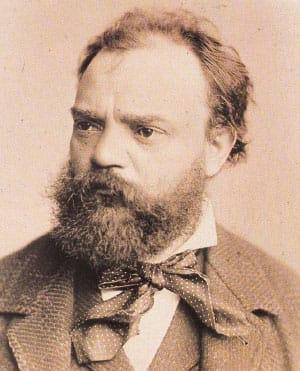
The rise of musical nationalism in the 19th century was based on the idea that each nation has folksongs that are inherently their own, and the job of a composer was to discover, develop, and refine these songs into a national classical music. This was especially relevant to Czech composers, as an ongoing National Revival was redrawing cultural distinctions between themselves and their Austrian neighbors after centuries of Habsburg rule.
Americans, too, began to wonder if they should have classical music of their own. In 1885 the New York philanthropist Jeannette Thurber founded the National Conservatory of Music and in 1892 recruited Antonín Dvořák to be its director. She hoped he would educate local musicians and advance a national style much like he had in his homeland of Bohemia. In the words of H. L. Mencken, he was hired to “introduce Americans to their own music.”
One of the students at the National Conservatory was Harry T. Burleigh, a Black Pennsylvanian composer and singer who showed Dvořák a variety of American folk styles. While recognizing the ethnic and cultural diversity of Americans, Dvořák concluded that American classical music should draw primarily from African American spirituals as well as the music of American Indians. He wrote: “These can be the foundation of a serious and original school of composition, to be developed in the United States. These beautiful and varied themes are the product of the soil. They are the folk songs of America and your composers must turn to them.”
And so he wrote the New World Symphony and American String Quartet as models, loosely integrating elements of African American and Native American musical traditions. The Symphony was premiered by the New York Philharmonic at Carnegie Hall on December 16, 1893, conducted by Anton Seidl, and was immediately met with acclaim. But the Panic of 1893 had left the National Conservatory’s finances—and Dvořák’s expensive salary—in jeopardy. He returned to Bohemia in April 1895, penning a bitter goodbye in Harper’s Magazine lamenting the paltry support for concert music in America:
The great American republic alone, in its national government as well as in the several governments of the States, suffers art and music to go without encouragement…
Not long ago a young man came to me and showed me his compositions. His talent seemed so promising that I at once offered him a scholarship in our school, but he sorrowfully confessed that he could not afford to become my pupil because he had to earn his living by keeping books in Brooklyn. Even if he came just two afternoons in the week, or on Saturday afternoon only, he said, he would lose his employment, on which he and others had to depend. I urged him to arrange the matter with his employer, but he only received the answer: “If you want to play, you can’t keep books. You will have to drop one or the other.” He dropped his music.
In any other country, the State would have made some provision for such a deserving scholar, so that he could have pursued his natural calling without having to starve..... Such an attitude of the State towards deserving artists is not only kind but wise. For it cannot be emphasized too strongly that art, as such, does not “pay,” to use an American expression—at least, not in the beginning—and that the art that has to pay its own way is apt to become vitiated and cheap.
The subsequent development of American classical music did not for the most part end up following Dvořák’s path. In fact, he would probably be disappointed to learn that more than a century later, his own “American” Symphony remains far more popular than any orchestral work by an actual American composer. In that sense, the New World Symphony was a failure. The 20th-century rise of jazz, however, shows prescience in his view that African American traditions should be central to American art music—just not in a way that a Romantic-era Czech composer could have imagined.
The Music
There are no genuine American folk tunes in the New World Symphony—just elements of what Dvořák thought made them distinctive: pentatonic (five-note) scales, drumming patterns, and syncopated rhythms. The middle movements were partly inspired by Henry Wadsworth Longfellow’s The Song of Hiawatha, a romanticized epic poem about Native Americans. And Dvořák’s own Czech style still shines through the piece, even as he tried to overlay it with American elements.
The first movement begins with an Adagio introduction that paints a hazy scene. Then the faster Allegro molto section introduces a bold call-and-response pattern, first heard between the horns and woodwinds. A second theme appears with the flute and oboe playing quietly together in a pentatonic scale. The last theme to be introduced is a lyrical flute solo reminiscent of the spiritual “Swing Low, Sweet Chariot,” which Burleigh taught to Dvořák. All these elements are mixed together and recur throughout the movement.
The slow movement, Largo, begins with seven mysterious chords that connect into a famous English horn solo. This, too, resembles a traditional spiritual or hymn, but the melody is entirely by Dvořák. (In 1922, one of his students added lyrics, creating the popular song “Goin’ Home,” sometimes mistaken as the original source.) Much of the movement develops the tune, including a striking passage where it’s accompanied by a pizzicato walking bass line. After a contrasting section that brings back the opening theme of the first movement, the English horn melody returns and grows warmer with strings.
The third movement, Vivace, begins with a clipped falling pattern suspiciously similar to the second movement of Beethoven’s Ninth Symphony. The music here is dancelike, inspired by Hiawatha’s wedding feast in the Longfellow poem.
The finale, Allegro con fuoco, opens with a tense rising half-step pattern in the strings, building to a powerful brass fanfare, and then a second theme in the clarinet. The movement brings back earlier melodies—including “Goin’ Home”—before arriving at a coda and a blaring E-major ending. But in a final touch evoking America’s open landscapes, Dvořák adds an echo that fades into silence.
—Benjamin Pesetsky
About the Artists
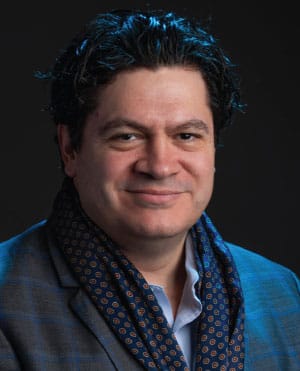
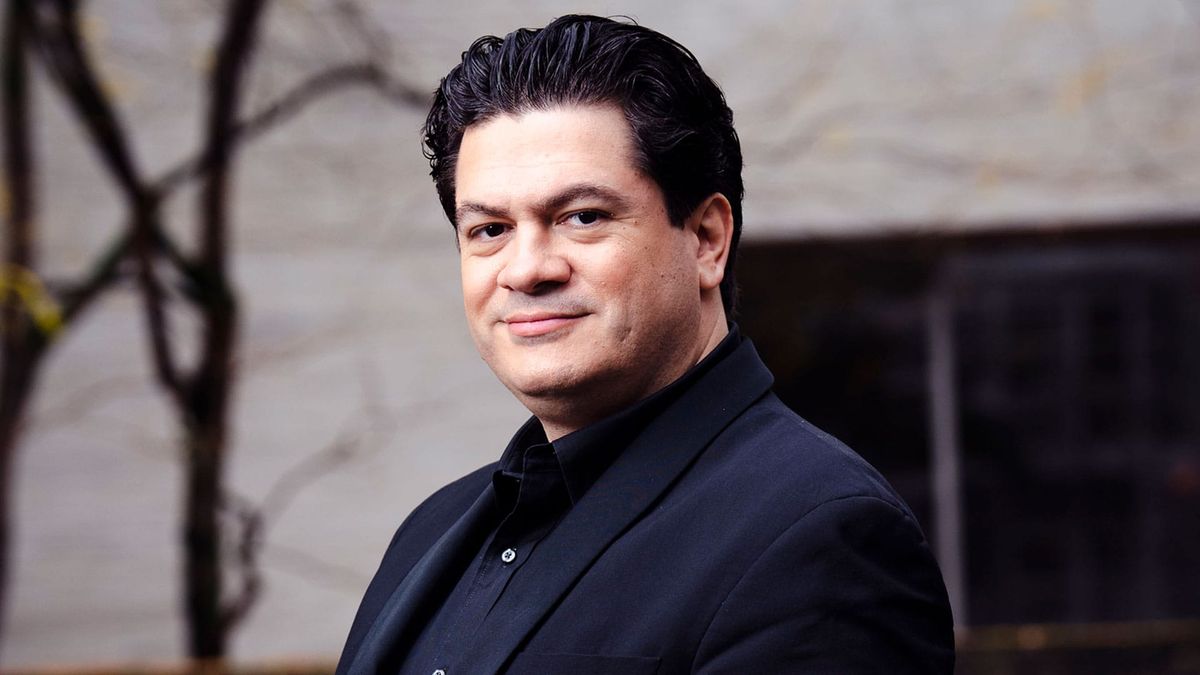
Cristian Măcelaru
Cristian Măcelaru is music director of the Cincinnati Symphony and Orchestre National de France, artistic director of the George Enescu Festival and Competition, artistic director and principal conductor of Interlochen’s World Youth Symphony Orchestra, and music director and conductor of the Cabrillo Festival of Contemporary Music. He also serves as a distinguished visiting artist at Rice University’s Shepherd School of Music and as artistic partner of the WDR Symphony in Cologne, where he previously served as chief conductor.
Măcelaru has appeared with the New York Philharmonic, Boston Symphony, Chicago Symphony, Cleveland Orchestra, Philadelphia Orchestra, Los Angeles Philharmonic, Royal Concertgebouw Orchestra, Staatskapelle Berlin, Dresden Staatskapelle, Leipzig Gewandhaus Orchestra, Bavarian Radio Orchestra, London Philharmonic, and NDR Elbphilharmonie, among other orchestras. Across his titled roles, Măcelaru has consistently elevated artistic standards while expanding audience engagement. He led Orchestre National de France at the opening ceremony of the 2024 Paris Olympic Games, before a global audience estimated at 1.5 billion people.
Măcelaru received a Grammy Award for his Decca Classics recording of Wynton Marsalis’s Violin Concerto with Nicola Benedetti and the Philadelphia Orchestra. His discography includes critically acclaimed recordings on Deutsche Grammophon, Warner Classics, Naïve Records, Linn Records, and other leading labels.
Born in Timișoara, Romania, Măcelaru moved to the United States at age 17 to attend Interlochen. He studied at the University of Miami and Rice University, and further refined his craft at the Tanglewood Music Center and Aspen Music Festival. He is a recipient of both the Solti Emerging Conductor Award and the Solti Conducting Award. He made his San Francisco Symphony debut in October 2018.
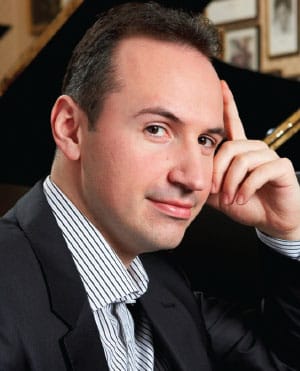
Simon Trpčeski
Simon Trpčeski opened the 2025–26 season with the Prague Philharmonia and Seattle Symphony, and he also appears this season with the Vancouver Symphony, Royal Philharmonic, Tonhalle Orchestra Zurich, Israel Philharmonic, Hong Kong Philharmonic, and Singapore Symphony. He debuts with the Orchestra di Santa Cecilia and Bilbao Symphony, and gives recitals at Wigmore Hall and the Amsterdam Concertgebouw.
Trpčeski began his career as a BBC New Generation Artist, and has gone on to collaborate with the Los Angeles Philharmonic, New York Philharmonic, Cleveland Orchestra, Philadelphia Orchestra, Chicago Symphony, London Symphony, Philharmonia Orchestra, Orchestre National de France, and Royal Concertgebouw Orchestra, among many others. He made his San Francisco Symphony debut in November 2004.
Trpčeski has recorded the complete Rachmaninoff, Tchaikovsky, and Prokofiev concertos with Vasily Petrenko. With Cristian Măcelaru, he recorded the Shostakovich and Brahms concertos. His recent recital album Variations was an Editor’s Choice in Gramophone and won the Choc de Classica and Amadeus D’oro awards. Beyond the concert stage, Trpčeski is committed to celebrating and sharing the rich musical traditions of his native Macedonia. His chamber music project Makedonissimo blends traditional folk music with virtuosic, jazz-inflected textures, and has toured across Europe, North America, and Asia. In recognition of his artistic achievements, Trpčeski received the Presidential Order of Merit for Macedonia in 2009, and in 2011 became the country’s first-ever National Artist. This season marks the 25th anniversary of his career, celebrated with a gala concert at the National Arena in Skopje, featuring the Macedonian Opera and Ballet Orchestra and longtime artistic collaborators.