In This Program
The Concert
Sunday, May 3, 2026, at 2:00pm
Musicians of the San Francisco Symphony
Harry T. Burleigh
(arr. Apollo Chamber Players)
From Plantation Melodies Old and New (1901/2016)
Negro Lullaby
An Ante-Bellum Sermon
Kelly Leon-Pearce violin
John Chisholm violin
Gina Cooper viola
Barbara Bogatin cello
Carl Nielsen
Serenata in vano (1914)
Allegro non troppo ma brioso–
Un poco adagio–
Tempo di marcia
Yuhsin Galaxy Su clarinet
Joshua Elmore bassoon
Jesse Clevenger horn
Anne Richardson cello
Daniel G. Smith bass
Wolfgang Amadeus Mozart
Divertimento in B-flat major, K.Anh.229 (ca. 1783)
Adagio
Menuetto-Trio
Adagio
Romanze Andante
Polonaise
Matthew Griffith basset horn
Yuhsin Galaxy Su basset horn
Jerome Simas basset horn
Sergei Prokofiev
Quintet in G minor, Opus 39 (1924)
Moderato
Andante energico
Allegro sostenuto, ma con brio
Adagio pesante
Allegro precipitato, ma non troppo presto
Andantino
James Button oboe
Yuhsin Galaxy Su clarinet
Florin Parvulescu violin
Katarzyna Bryla viola
Bowen Ha bass
This program is performed without intermission.
Program Notes
From Plantation Melodies Old and New
Harry T. Burleigh
(arr. Apollo Chamber Players)
Born: December 2, 1866, in Erie, Pennsylvania
Died: September 12, 1949, in Stamford, Connecticut
Work Composed: 1901 (arr. 2016)
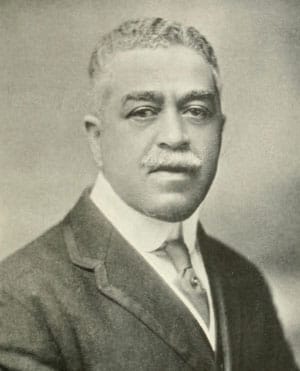
We have Harry Thacker Burleigh to thank for Antonín Dvořák’s interest in spirituals. As a student at New York’s National Conservatory of Music in the 1890s, Burleigh became Dvořák’s friend and assistant. Sometimes he would sing the “sorrow songs” he had learned from his grandfather for the eminent Czech composer, who encouraged him to notate and arrange the old songs. Dvořák was quite taken with Burleigh’s spirituals and channeled their overall style, if not the actual melodies themselves, into some of his late concert works—such as his New World Symphony.
Burleigh’s earliest collection of spirituals is Plantation Melodies Old and New. Published in 1901, it includes a “Negro Lullaby” with words by Edwin Campbell that typically ends each phrase with a change of meter from the regular 6/8 to 4/4—probably reflecting the way the song had been sung. The collection ends with “An Ante-Bellum Sermon” to words by Paul Laurence Dunbar; it’s the rousing favorite “Joshua Fit the Battle of Jericho” with its six stanzas telling stories from the Old Testament.
The Apollo Chamber Players have created (and recorded) arrangements of those two melodies for string quartet, sporting a bevy of enhancements but largely staying true to Burleigh’s voice-and-piano originals. They have dedicated the settings to “the memory and lasting influence of Henry T. Burleigh.”
Serenata in vano
Carl Nielsen
Born: June 9, 1865, in Sortelung, Denmark
Died: October 3, 1931, in Copenhagen
Work Composed: 1914
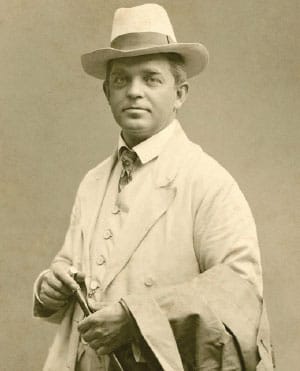
When one thinks of Carl Nielsen, big-boned and dramatic symphonies come first to mind, with their sweep and power, their innovative harmonic language, their clear intelligence, their reserved attitude toward nationalist elements, and their psychological depth. The operant word here is serious. This was a determined and intently focused composer.
And then along comes the Serenata in vano, an utterly atypical Nielsen composition that’s a deliberately light trifle, filled with humor, and apparently tossed off in about a week. He wrote it for a 1914 tour by members of the Royal Danish Orchestra; it wasn’t all that well received by audiences, given its placement on a program including a Mozart divertimento and Beethoven’s Opus 20 Septet. “The Serenata in vano is actually an amusing effort,” wrote one critic. “But it cannot be denied that yesterday evening it gave a slightly heavy and restrained impression.” Later performances in Copenhagen were considerably more successful and even warranted encores.
Nielsen’s idea was to conjure up a wordless scena about a group of wannabe troubadours attempting to serenade a fair lady. “First the gentlemen play in a somewhat chivalric and showy manner to lure the fair one out onto the balcony, but she does not appear,” he explained. “Then they play in a slightly languorous strain (Poco adagio), but that hasn’t any effect either. Since they have played in vain (in vano), they don’t care a straw and shuffle off home to the strains of the little final march, which they play for their own amusement.”
The serenade is unlikely to show up on many recital programs, but it’s really quite charming. It partakes of that slightly grumpy charm that is so characteristic of Nielsen, expressive but not maudlin, lean but not ascetic. The first of the three sections acts as a kind of prelude that leads to a yearning love song, the whole ending with a silly miniaturized march as the rejected troubadours slink away, frustrated and defeated.
Divertimento in B-flat major, K.Anh.229
Wolfgang Amadeus Mozart
Born: January 27, 1756, in Salzburg
Died: December 5, 1791, in Vienna
Work Composed: ca. 1783–85
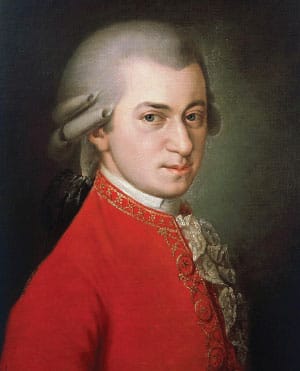
Sweet water from a foul well. Was there ever a more unattractive musician than Anton Stadler? There isn’t all that much documentation out there about him, but what there is points to a conniver, a crook, an adulterer, a swindler, and in general just a thoroughly reprehensible chap. One of a pair of brothers who specialized in the then-new clarinet and basset horn, Stadler made friends with Mozart around 1781, who seems to have been willing to overlook Stadler’s many character flaws in his admiration for Stadler’s glorious clarinet playing. “I have never heard the like of what you contrived with your instrument,” Mozart wrote to Stadler in 1785. “Never should I have thought that a clarinet could be capable of imitating the human voice as it was imitated by you.” Admiration aside, Mozart gave Stadler an amusing, if revealing, nickname: notschibinitschibi, a baby-talk putdown that can be loosely translated as dumbitybumbity.
In addition to such imperishable masterpieces as the Clarinet Concerto and Clarinet Quintet, Mozart also wrote a set of five lightweight divertimentos around 1783–85 for three basset horns, intended for the Stadler brothers plus one extra. The divertimentos languished unknown until 1800, when Mozart’s widow Constanze alerted a publisher that they were in Stadler’s possession. Since then, intrepid performers have often come up with workable alternatives for those three basset horns—they’ve always been in pretty short supply—such as for clarinets and bassoon, or for string trio.
The basset horn has a cylindrical bore and single reed like the clarinet, but it’s larger and has a bend between the mouthpiece and the upper joint. It has a lower range than the clarinet, and its overall tonal quality is somewhat darker, rather like an alto clarinet.
This piece is more Baroque suite than divertimento, and as such begins with a somber Adagio that resembles a trio sonata movement, with two melodic instruments over a supportive bass line. That’s followed by an intriguing little Menuetto that spices up the minuet’s typical blandness with unexpectedly long phrases. Its trio, on the other hand, hews closely to theory-book punctilio with its primly regular four-measure phrases.
Another Adagio interweaves the three instruments, each allotted its share of the lyrical proceedings. In fourth place comes a Romanze in a gentle gavotte rhythm; from time to time it’s given to some gentle display for the two upper instruments. It all ends with a Polonaise, a bouncy dance in triple meter, concluding this little suite in good cheer.
Anton Stadler, however, never cleaned up his act. Eventually his many trespasses caught up with him, and he died in 1812 from starvation.
Quintet in G minor, Opus 39
Sergei Prokofiev
Born: April 23, 1891, in Sontsovka, Ukraine
Died: March 5, 1953, in Moscow
Work Composed: 1924
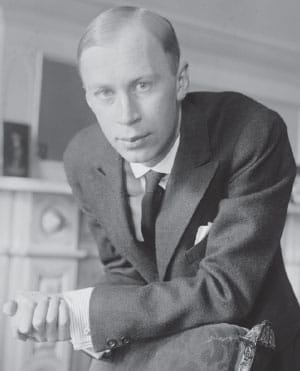
When Prokofiev returned to the Soviet Union in 1935 after having lived in America, France, and Germany for almost two decades, it was the general consensus that he had some explaining to do. Not about having moved back to the USSR—that seemed like a good idea at the time—but about certain of his past compositions that didn’t jibe with Soviet notions of what was proper music and what was hopelessly corrupted by Western decadence.
One piece under the microscope was Prokofiev’s thorny 1924 quintet. He blamed it all on Paris, where he was living at the time. He had succumbed to the siren song of dissonant complexity, he explained, then all the rage in the French capital. He was a new father, he needed to make a living, and those sophisticated, Stravinsky-soaked French audiences weren’t as easy to shock as had been his conservative Russian compatriots or those ingenuous Americans.
If he failed to jolt them it wasn’t for a lack of trying. Prokofiev spent his Parisian years pushing hard against musical propriety: the Second Symphony, the opera The Fiery Angel, the ballet Le pas d’acier, all brilliantly modernistic and often shatteringly dissonant. In such company, the Quintet seems downright mild-mannered; heard from the vantage point of a century later, it manifests as a surly dialect of French Neoclassicism, Stravinsky gone dissolute, perhaps. But only a little bit.
The opening movement presents a walking-tempo theme with two variations, the first of which treats a slowed-down version of the melody imitatively amongst the instruments. The next variation sounds for all the world like a flock of twittering birds set into near-panic by some rude shock or another. Fortunately for the birds, the original theme returns to set things right.
Grotesquerie rules the roost in the Andante energico second movement, its deliberately plodding bass rhythms offset by slithering chromatic moves above. The third-place Allegro sostenuto, ma con brio outdoes Stravinsky and Bartók in the jagged rhythm department. It’s acerbic to be sure, but also weirdly funny; it would be quite the toe-tapper if listeners could just manage to figure out where the beats are.
The ghostly Adagio pesante dwells in suspended time, its deliberately regular melodies placed above hypnotic pulsations. A nightmare chase follows in the Allegro precipitato, ma non troppo presto, its lightning pizzicato lower strings punctuated by outbursts played sul ponticello, i.e., on the bridge. The finale is an Andantino in stately triple meter that soon gives way to a deliriously warped gigue. After a brief respite, the quintet concludes in a barrage of yelps.
—Scott Foglesong
About the Artists
Kelly Leon-Pearce joined the San Francisco Symphony second violin section in 1990 and previously served as a substitute with the New York Philharmonic and associate concertmaster of the Aspel Festival Orchestra. As a founding member of the Persichetti Quartet, she played the cycle of Persichetti quartets at Kennedy Center and a Bartók cycle at the Museum of Modern Art in New York. She holds degrees from the Juilliard School.
Learn more about Kelly Leon-Pearce in our May edition of Meet the SF Symphony Musicians.
John Chisholm joined the San Francisco Symphony in 2002 and was previously associate concertmaster of the Louisville Orchestra, a member of the Rochester Philharmonic, and assistant concertmaster of the Sunriver Music Festival. He earned his bachelor’s degree, master’s degree, and a performance certificate from the Eastman School of Music.
Gina Cooper joined the San Francisco Symphony viola section in 1992, having served previously as a member of the Buffalo Philharmonic. A native of Ardsley, New York, she began her musical studies on piano and holds a master’s degree from the Yale School of Music.
Barbara Bogatin joined the San Francisco Symphony cello section in 1994 and was previously principal cello with the Milwaukee Symphony and New Jersey Symphony. She studied cello in the preparatory division of the San Francisco Conservatory, and received bachelor’s and master’s degrees from the Juilliard School.
Yuhsin Galaxy Su joined the San Francisco Symphony as Second Clarinet at the beginning of the 2024–25 season, and is also an accomplished pianist. She completed a master’s degree at the Colburn School and studied at the Curtis Institute of Music. She made her solo clarinet debut with the SF Symphony at this year’s Lunar New Year concert.
Joshua Elmore joined the San Francisco Symphony as Principal Bassoon in March 2025. He previously served as principal of the Fort Worth Symphony and has also performed with the Boston Symphony, New York Philharmonic, and Chineke! Orchestra. He is a graduate of the Juilliard School and also holds a professional studies certificate from the Colburn School.
Jesse Clevenger appears regularly as a guest performer with major orchestras including the Chicago Symphony, Dallas Symphony, and Hong Kong Philharmonic. He has served as Acting Third Horn and Acting Assistant Principal Horn for the San Francisco Symphony, and was the Houston Symphony’s interim assistant principal horn for seven seasons. He teaches at Stanford University and studied at Indiana University and Rice University’s Shepherd School of Music.
Anne Richardson joined the San Francisco Symphony as Associate Principal Cello in 2024 and holds the Peter & Jacqueline Hoefer Chair. She was previously an academy fellow with the Bavarian Radio Symphony, and studied at the Juilliard School and University of Michigan.
Daniel G. Smith was appointed Associate Principal Bass of the San Francisco Symphony in 2017. He was previously a member of the San Diego Symphony and principal bass of the Santa Barbara Symphony. He is a graduate of Rice University’s Shepherd School of Music.
Matthew Griffith joined the San Francisco Symphony as Associate Principal and E-flat Clarinet at the beginning of the 2022–23 season. He previously served as acting assistant principal clarinet with the North Carolina Symphony and the Nashville Symphony and was a member of TŌN (The Orchestra Now), a graduate-level training orchestra based at Bard College. He has performed as guest soloist with the Boston Pops, Milwaukee Symphony, Ocean City Pops, Eastern Connecticut Symphony, United States Army Field Band, and “The President’s Own” United States Marine Band.
Jerome Simas joined the San Francisco Symphony as bass clarinet in 2012. Prior to that, he was principal clarinet with the California Symphony, Oakland Symphony, Modesto Symphony, Monterey Symphony, and IRIS Orchestra. He is a member of the Left Coast Chamber Ensemble, among other groups, and is chair of woodwinds at San Francisco Conservatory of Music. He studied at the Cleveland Institute of Music.
James Button was appointed Associate Principal Oboe of the San Francisco Symphony in September 2017. A native of Australia, he was previously a member of the Nashville Symphony, Santa Fe Opera Orchestra, New World Symphony, and has appeared as guest principal with the Chicago Symphony, Philadelphia Orchestra, Los Angeles Philharmonic, and Melbourne Symphony. His live recording of Jennifer Higdon’s Oboe Concerto with the Nashville Symphony won a Grammy Award in 2018.
Florin Parvulescu joined the San Francisco Symphony first violins in 1998. A native of Romania, he was previously a member of the St. Louis Symphony and Baltimore Symphony, won the 1993 Marbury Competition at the Peabody Conservatory, and was a prizewinner in the 1994 Yale Gordon Concerto Competition. He also attended the American Academy of Conducting at the Aspen Music Festival.
Katarzyna Bryla joined the San Francisco Symphony viola section beginning with the 2022–23 season and holds the Joanne E. Harrington & Lorry I. Lokey Second Century Chair. She was born into a family of musicians and has earned more than two dozen awards in the United States, France, and her native Poland. In 2019 she became a coprincipal violist of Orchestra of St. Luke’s and has also been a member of the New York City Ballet Orchestra and the New York Pops.
Bowen Ha joined the San Francisco Symphony bass section at the beginning of the 2024–25 season and holds the Lawrence Metcalf Second Century Chair. He was previously a substitute musician with the New York Philharmonic, Philadelphia Orchestra, and Indianapolis Symphony. He studied at the Middle School Affiliated to Shanghai Conservatory, Interlochen Arts Academy, and the Juilliard School.