In This Program
The Concert
Sunday, May 17, 2026, at 7:30pm
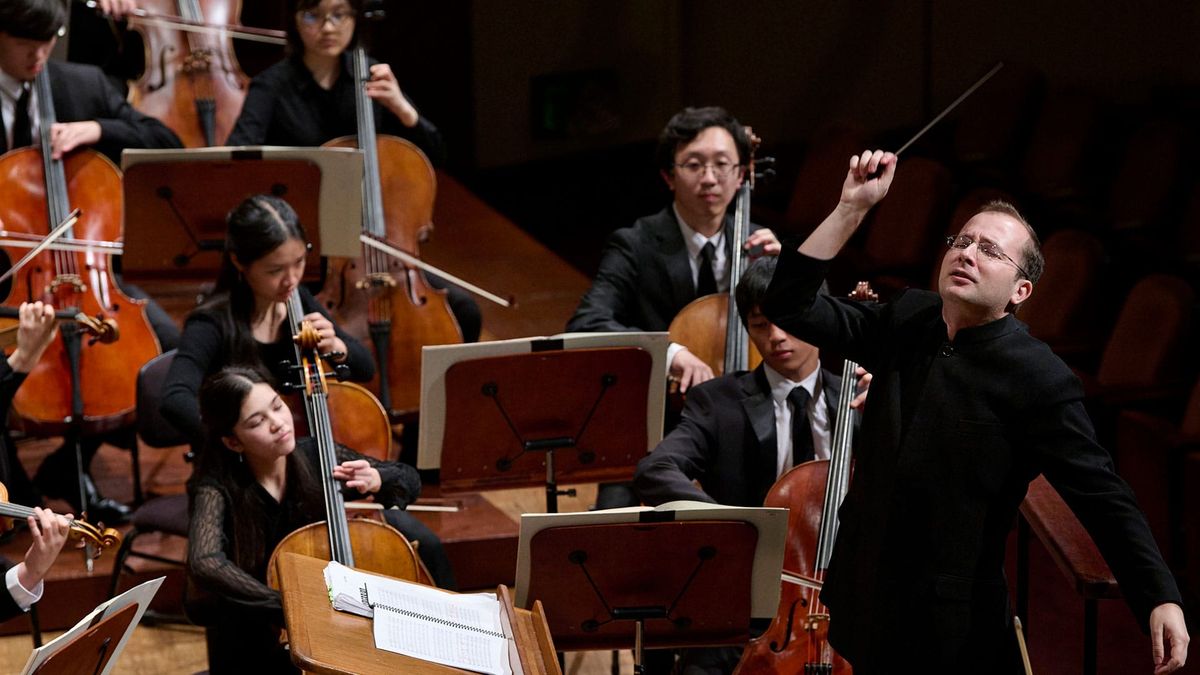
Radu Paponiu conducting
Wattis Foundation Music Director
Dylan Hall
Scherzo for Orchestra (2024)
Ludwig van Beethoven
Symphony No. 1 in C major, Opus 21 (1800)
Adagio molto–Allegro con brio
Andante cantabile con moto
Menuetto: Allegro molto e vivace
Finale: Adagio–Allegro molto e vivace
Intermission
Dmitri Shostakovich
Symphony No. 5 in D minor, Opus 47 (1937)
Moderato
Allegretto
Largo
Allegro non troppo
Program Notes
Scherzo for Orchestra
Dylan Hall
Born: December 10, 2007, in Minneapolis
Work Composed: 2024
Instrumentation: 2 flutes (2nd doubling piccolo), 2 oboes, 2 clarinets, 2 bassoons, 4 horns, 2 trumpets, 2 trombones, tuba, timpani, percussion (bass drum, cymbals, snare drum, triangle, whip, tambourine, wood block, and xylophone), and strings
Duration: About 5 minutes
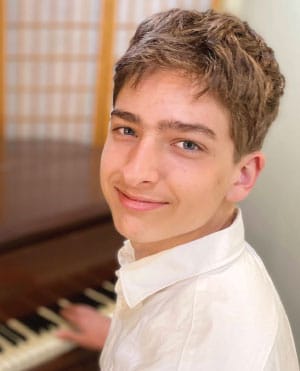
Composer, pianist, and SFSYO member Dylan Hall began work on his Scherzo for Orchestra when he was 15 years old. It started as an improvisation that he later expanded into a full-scale orchestral work. Hall submitted the work to the National Young Composers Challenge, through which it was premiered by the Orlando Philharmonic in 2024, and performed again by them in 2025. Hall is a student at Albany High School and also enrolled at the San Francisco Conservatory of Music Pre-College Division, where he studies composition with Arkadi Serper. He has attended summer programs including the Boston University Tanglewood Institute and Yellow Barn Young Artists Program.
Scherzo for Orchestra is a running joke, an apt nod to its title (the Italian word for “joke”). The composer plays with audience expectations from the very beginning. Whereas scherzos are most often in 3/4 meter, Hall’s is in four. It opens with the low strings playing a pizzicato oom-pah figure, albeit starting one note higher than expected. The cellos and basses right themselves by the middle of each bar to the expected note. No such luck for the horns, on the other hand. The horn section is stuck in a state of perpetual dissonance for the first 14 bars, playing half steps apart from each other. Hall plays a joke on the horn players, writing as if at least one of them is cracking each of the notes. The bassoon plays a jocular melody above the fray, with the clarinets and snare drum playing a marching echo. The action suddenly screeches to a halt as the horn plays a cheeky nasal stopped note. Then it is back to the races as the jokes continue, with the timpani playing offbeats that turn the phrases on their sides to sound unsteady on their feet. The battery of percussion interrupt and cajole the rest of the orchestra throughout, interjecting here and there to set the phrase akimbo.
Hall utilizes one of the silliest of techniques available to orchestras: the trombone glissando. The trombones slide around throughout the piece, but Hall seems to draw from perhaps the most famous glissando in the orchestra repertoire, the Interrupted Intermezzo from Béla Bartók’s Concerto for Orchestra. As with the Bartók, in Hall’s Scherzo, two trombones exchange glissandos in the middle of the piece, as if attempting to one-up each other. But once again, nothing can keep this scherzo from skipping on, not even a short-lived trombone duel.
This piece shares several similarities to the other pieces on the program. As Beethoven’s Symphony No. 1 was Beethoven’s introduction to the orchestral world of Vienna, Hall’s Scherzo is his first orchestral piece, an introduction to the San Francisco Symphony Youth Orchestra audience. Hall was studying Shostakovich’s and Prokofiev’s music while working on the Scherzo, and his piece bears resemblances to the humor and wittiness of those two Russian composers’ works. Hall alludes to other works while maintaining his own voice.
Symphony No. 1 in C major, Opus 21
Ludwig van Beethoven
Baptized: December 17, 1770, in Bonn
Died: March 26, 1827, in Vienna
Work Composed: 1800
Instrumentation: 2 flutes, 2 oboes, 2 clarinets, 2 bassoons, 2 horns, 2 trumpets, timpani, and strings
Duration: About 27 minutes
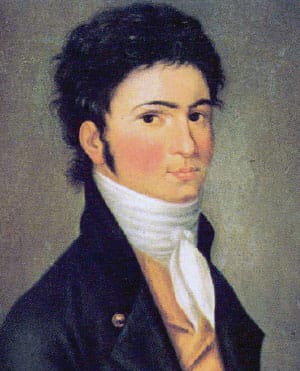
What is a young composer to do when one’s immediate predecessors of the symphonic repertoire put the genre on the map? How does one follow in the footsteps of Haydn and Mozart? For the young Ludwig van Beethoven, who was about to make his symphonic debut in Vienna in April 1800, this surely would have been on his mind as he was composing his first symphony.
Beethoven knew it represented more than just a symphony; it would serve as his introduction to the musical public in the musical capital of Europe. This would be his first contribution to the symphonic repertoire. Beethoven was keenly aware of his place in history. The idea of the canon, of the pieces that are today considered the most central pieces of the repertoire, did not really exist before Beethoven. Composers would write music for a performance, and it would not often be performed again. Beethoven was the person who changed this. After his lifetime, his music occupied a privileged place in the repertoire.
Beethoven also knew that he needed to say something new. He wanted to challenge norms and perceptions and chart a new path for music in his time. As we all now well know, Beethoven did exactly that over the course of his career. Not only did he change the symphonic genre, but his music was held as the lofty ideal of what a symphony should be well past his lifetime, and in some ways to this very day. Beethoven’s symphonies are still lauded as some of the best in the repertoire and are programmed heavily by orchestras around the world.
Beethoven continually and unabashedly plays with the listeners’ expectations in the introduction to the first movement. He begins his very first symphony with a wildly unstable chord. Whereas Mozart and Haydn so often begin with an introductory chord that places the audience firmly in the home key, Beethoven’s opening chord must resolve to another. In fact, he continues these unstable-resolution chord progressions in a sequence, each leading away from the home key of C major. It is not until the orchestra lands on the Allegro that the piece arrives in C major. Why does Beethoven do this? One can only surmise, but he had an impressive understanding of form and function in music, and knew how to play with expectations in a way that enraptured his audiences.
The fourth movement is as cheeky as it gets. The opening draws out a scale, adding one note at a time, each addition with more panache. What might sound like an aggravating thumb of the nose from any other composer becomes a delightful unfolding of a simple and yet somehow compelling theme in the young Beethoven’s musical vernacular. After the introduction, the strings rip through the same scale throughout the movement. It is a good reminder as to why all young musicians learn their scales.
The First Symphony is arguably the funniest of Beethoven’s symphonies. This might not be saying much for one of the most serious composers in the repertoire, but perhaps it is a nod to the sense of humor of his erstwhile teacher, Haydn, and the teacher he never got the chance to study with, Mozart. Inside jokes, subversiveness, and humor are a theme in this program: composers’ efforts to bring moments of levity to serious musical endeavors.
Symphony No. 5 in D minor, Opus 47
Dmitri Shostakovich
Born: September 25, 1906, in Saint Petersburg
Died: August 9, 1975, in Moscow
Work Composed: 1937
Instrumentation: 2 flutes, piccolo, 2 oboes, 2 clarinets, E-flat clarinet, 2 bassoons, contrabassoon, 4 horns, 3 trumpets, 3 trombones, tuba, timpani, percussion (triangle, cymbals, tam-tam, orchestra bells, snare drum, bass drum, and xylophone), 2 harps, piano (doubling celesta), and strings
Duration: About 48 minutes
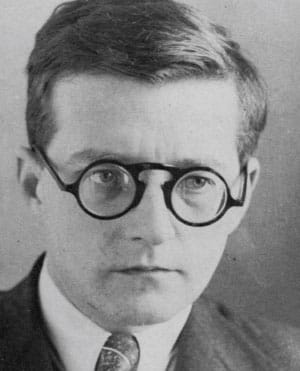
There is perhaps no piece in the symphonic repertoire that is more closely associated with political persecution and redemption than Dmitri Shostakovich’s Symphony No. 5. Since its composition in 1937, the work has continually been described in terms of Stalin’s iron grip on the creation and control of art and music in Soviet Russia, and remains to this day a symbol not only of the effects of government control over the arts, but also the shifting interpretations of Shostakovich’s works after his death.
Regardless of its extra-musical history within larger geopolitics of the time, the Fifth Symphony is one of the great symphonic works of the 20th century, and a trenchant reminder of the ability of the arts to express the enormous breadth of human emotion through sound. The first movement opens powerfully, with the strings playing angular, dotted rhythms, which sets the tone for the rest of the movement. The winds and brass do not enter until several minutes into the first movement. Shostakovich shows his restraint at times, by using only part of the orchestra available to him as in the beginning, and at other times displays his ability to unleash the raw power of the full orchestra, as in the finale.
The second movement scherzo has a sort of grotesque humor. Shostakovich’s version follows in the lineage of Gustav Mahler, with elements of folk-like music combined with sarcastic humor. The slow third movement omits the brass but makes up for the lack of these instruments by including a heavy division of the strings. There are three sections of violins rather than the normal two, two sections of violas and cellos, and the harp and celesta are given important roles. The movement is otherworldly; not only sonically but visually compelling. This is because the strings are often divided so that the opening voices are as far apart onstage as possible.
Of all the movements of the symphony, the finale is the most politicized. This politicization did not happen, though, until after Shostakovich’s death, with the publication of Testimony, a disputed autobiography that alleges to tell Shostakovich’s unvarnished opinions, compiled by the musicologist Solomon Volkov shortly before the composer’s death in 1975. On one hand, the end of the finale can sound like a triumphant march extolling Stalin’s famous saying that “things are always getting better.” Shostakovich said publicly, “the theme of my symphony is the making of a man. I saw man with all his experiences at the center of the composition… in the finale, the tragically tense impulses of the earlier movements are resolved in optimism and the joy of living.” On the other hand, Testimony tells another story: “The rejoicing is forced, created under threat… It’s as if someone were beating you with a stick and saying, ‘your business is rejoicing, your business is rejoicing,’ and you rise, shaky, and go marching off, muttering, ‘our business is rejoicing, our business is rejoicing’…What kind of apotheosis is that?” Although people close to Shostakovich disputed whether he said these exact words, they generally agreed that the sentiments were not far off. Shostakovich had a family to take care of, and to say anything against Stalin’s regime surely would not have ended well for him or his family.
Shostakovich was thankfully able to avoid prison or worse during his life, but this is not to say he was fully able to avoid the Soviet version of being “cancelled.” There were two important run-ins during his life when Shostakovich was singled out by the Soviet Party for being subversive, for writing music that was considered anathema to the Soviet ideals. He was accused of writing “formalistic” music, as opposed to the Soviet-sanctioned “socialist realism” that was the only acceptable music. In reality, what this meant was murky at best. Essentially, if Stalin or Andrei Zhdanov (who was later in charge of policing the arts and was responsible for Shostakovich’s second run-in with the Soviet regime) did not like the music, that was what made it formalist music.
While it goes without saying that any artist’s life influences their work, the infatuation with Shostakovich’s brushes with the Communist Party raises the question: What does a composer “owe” the listener, beyond the score? Should we have access to as many extra-musical details as possible, or is it truly any of our business? At the same time, the way Shostakovich shifted his musical output specifically to redeem himself in the eyes of the party is worth paying attention to. It might also encourage us to contemplate the effects of government control over and influence on the arts, which remains relevant today.
—Alicia Mastromonaco
About the Artists
Radu Paponiu
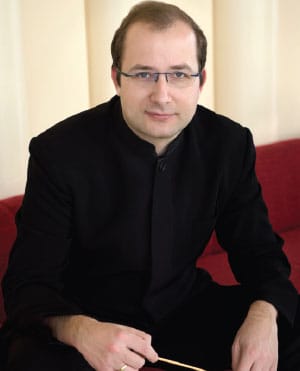
Radu Paponiu was appointed Wattis Foundation Music Director of the San Francisco Symphony Youth Orchestra in fall 2024, and recently extended his contract through the 2028–29 season. He was previously associate conductor of the Naples (Florida) Philharmonic and music director of the Naples Philharmonic Youth Orchestra. He has also served as music director of the Southwest Florida Symphony, assistant conductor of the Naples Philharmonic, and as a member of the conducting faculty of the Juilliard Pre-College.
As a guest conductor, Paponiu has appeared with the Romanian National Radio Symphony, Teatro Comunale di Bologna Orchestra, Transylvania State Philharmonic, Banatul Philharmonic, Louisiana Philharmonic, Rockford Symphony, Colorado Music Festival Orchestra, North Carolina Symphony, California Young Artists Symphony, and National Repertory Orchestra. He has collaborated with soloists such as Evgeny Kissin, Yefim Bronfman, Emanuel Ax, Gil Shaham, Midori, Vladimir Feltsman, Robert Levin, Charles Yang, Nancy Zhou, Stella Chen, and the Ébène Quartet.
Born in Romania, Paponiu began his musical studies on the violin at age seven, came to the United States at the invitation of the Perlman Music Program, and later completed two degrees in violin performance at the Colburn School. He went on to earn a master's degree in orchestral conducting at New England Conservatory, where he studied with Hugh Wolff.
San Francisco Symphony Youth Orchestra
The San Francisco Symphony Youth Orchestra is recognized internationally as one of the finest youth orchestras in the world. Founded by the San Francisco Symphony in 1981, the SFSYO’s musicians are chosen from more than 200 applicants in annual auditions. The SFSYO’s purpose is to provide an orchestral experience of preprofessional caliber, tuition-free, to talented young musicians. The more than 100 musicians, ranging in age from 12 to 21, represent communities from throughout the Bay Area. The SFSYO rehearses and performs at Davies Symphony Hall under the direction of Radu Paponiu, who joined the San Francisco Symphony as Wattis Foundation Music Director of the San Francisco Symphony Youth Orchestra in the 2024–25 season. Jahja Ling served as the SFSYO’s first Music Director, followed by David Milnes, Leif Bjaland, Alasdair Neale, Edwin Outwater, Benjamin Shwartz, Donato Cabrera, Christian Reif, and Daniel Stewart.
As part of the SFSYO’s innovative training program, musi-cians from the San Francisco Symphony coach the young play-ers each Saturday afternoon in sectional rehearsals, followed by full orchestra rehearsals with Radu Paponiu. Youth Orchestra members regularly meet and work with world-renowned artists: Esa-Pekka Salonen, Michael Tilson Thomas, Herbert Blomstedt, Kurt Masur, John Adams, Yo-Yo Ma, Valery Gergiev, Isaac Stern, Yehudi Menuhin, Wynton Marsalis, Midori, Joshua Bell, Mstislav Rostropovich, Simon Rattle, and many others have worked with the Youth Orchestra. Of equal importance, Youth Orchestra members are able to speak with these prominent musicians about their professional and personal experiences, and about music. The ensemble has toured Europe and Asia, given sold-out concerts in such legendary halls as Berlin’s Philharmonie, Vienna’s Musikverein, Saint Petersburg’s Mariinsky Theater, and Amsterdam’s Concertgebouw, and won first prize in Vienna’s International Youth and Music Festival.
San Francisco Symphony Youth Orchestra
First Violins
Euisun Hong, Co-Concertmaster
Lawrence V. Metcalf Chair
Aaron Ma, Co-Concertmaster
Lawrence V. Metcalf Chair
Andrew Zhang, Co-Concertmaster
Lawrence V. Metcalf Chair
Ethan Chang
Christina Hong
Hyesun Hong
Maximilian Huang
Kayla Hwang
Constance Kuan
Sydney Li-Jenkins
Magdalena Masur
Henry Miller
Carolyn Ren
Yujin Shin
Calliope Smith
Jenna Son
Henry Stroud
Kate Vo
Lucas Wang
Lucy Wang
Second Violins
Asher Cupp, Co-Principal
Lisa Saito, Co-Principal
Léopoldine Bréard
Maggie Cai
Janet Chan
Dylan Chua
Udo Funke
Brandon Gao
Evelyn Holmes
Katherine Jang
Sarah Kumayama
William Liang
Veronica Qiu
Serena She
Oliver Spivey
Braden Wang
Yihe Wang
Junnosuke Yanagisawa
Katherine Yoo
Riona Zhu
Violas
Bryan Im, Co-Principal
Yufei Shen, Co-Principal
Rebekah Sung, Co-Principal
Harper Berry
Colin Breshears
Jamie Cheung
Timothy Cheung
Onyx Haddick
Jaydon Li
Haoching Liu
Olivia Park
Galen Russell
Rohan Sangani
Laurelin Stroh
Nicole Targosz
Cellos
Melissa Lam, Co-Principal
Ethan Lee, Co-Principal
Claire Topper, Co-Principal
Ya-Ching Chan
Timothy Huang
Anthony Jung
Donghu Kim
Blanche Li
Lukas Masur
Yoonsa Park
Cara Wang
Bass
Rouyan Lechner Co-Principal
Allison Prakalapakorn, Co-Principal
Alec Blair
Haku Homma
Hani Khayatei Houssaini
Yoav Konig
Rudie Sheehy
Raiden Tan
Eric Zhang
Flutes
Esther Kim
Cadence Liu
Emilie Yoo
Oboes
Gabriel Chodos
Jesse Spain
Liam Ta
Asher Wong
Clarinets
Ryan Beiter
Subin Kim
Hanting Liu
Adam Thyr
Bassoons
Matthew Chan
Adam Erlebacher
Stuthi Jaladanki
Aya Watanabe
Horns
Daniel Cooper
Elinor Cooper
Owen Ellis
Violet MacAvoy
Owen Sheridan
Trumpets
Marcus Chu
Julian Moran
Brady Phan
Ivan Sokolenko
Trombones
Harvy Chang
Ethan Moran
Lenel Elison Gomintong, Bass Trombone
Tuba
Cameron Strahs
Percussion & Timpani
Garrett Guo
Jeffrey Lee
Derick Shu
Alexander Xie
Aeneas Yu
Harps
Jessica Cheung
Camille Chu
Keyboard
Dylan Hall
Radu Paponiu, Wattis Foundation Music Director
Coaching Faculty
David Chernyavsky, Violin
In Sun Jang, Violin
Chen Zhao, Violin
Adam Smyla, Viola
Jill Brindel, Cello
David Goldblatt, Cello
Stephen Tramontozzi, Bass
Catherine Payne, Flute
Russ de Luna, Oboe
Brooks Fisher, Oboe
Matthew Griffith, Clarinet
Jerome Simas, Clarinet
Justin Cummings, Bassoon
Jack Bryant, Horn
Jeff Biancalana, Trumpet
Jonathan Seiberlich, Trombone & Tuba
Jacob Nissly, Percussion & Timpani
Marty Thenell, Percussion & Timpani
Katherine Siochi, Harp
Marc Shapiro, Keyboard
Youth Orchestra Administration
Daniel Hallett, Director, Youth Orchestra Program
Katie Lee, Youth Orchestra Administrative Apprentice
Hung-Yu Lin, Youth Orchestra Administrative Apprentice
Lily Wang, Youth Orchestra Library Apprentice