In This Program
The Concert
Sunday, November 1, 2026, at 2:00pm
Musicians of the San Francisco Symphony
Bernard Andrès
Chants d’arrière-saison (1995)
Andantino
Allegro
Larghetto
Adagietto
Andante
Allegretto
Moderato
Katherine Siochi harp
Joshua Elmore bassoon
Richard Strauss
(arr. Rudolf Leopold)
Metamorphosen (1945)
Jessie Fellows violin
Jane (Hyeon Jin) Cho violin
Katarzyna Bryla viola
Leonid Plashinov-Johnson viola
Starla Breshears cello
Davis You cello
Daniel G. Smith bass
Intermission
Johannes Brahms
Clarinet Trio in A minor, Opus 114 (1891)
Allegro
Adagio
Andantino grazioso
Allegro
Carey Bell clarinet
Amos Yang cello
John Wilson piano
Program Notes
Chants d’arrière-saison
Bernard Andrès
Born: December 24, 1941, in Belfort, France
Died: July 14, 2026, in Saizy, France
Work Composed: 1995
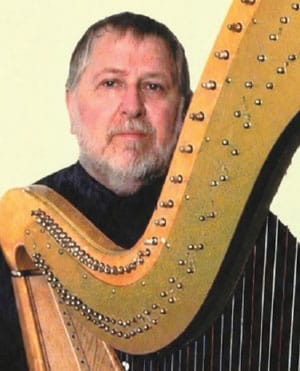
The dominant mood of Chants d’arrière-saison (Songs of Seasons Past) is, as the title implies, nostalgic remembrance. It’s the work of a French harpist and composer who was born in Belfort, south near the Swiss border. Bernard Andrès studied piano from an early age—the entire family was musical—and then he discovered the joys of the harp in his late teens. By his 20s he was a student at the Paris Conservatory, where he won the first prize for harp in 1966.
Songs of Seasons Past may be played by horn, cello, or bassoon with harp accompaniment. The songs making up the set are notable for their modal quality—that is, they are written in scales other than major and minor, once common in Western music and employed in Roman Catholic plainchant (aka Gregorian chant) as well as music from the Middle Ages through the Renaissance. Even though they became obsolete starting in the Baroque era, the modes retain a capacity for evoking certain times and cultures—such as the Aeolian mode’s associations with English folk music or the Iberian quality of the Phrygian mode. Thus in writing modal melodies, Andrès is not indulging in technical trickery: he’s seeking specific colors and resonances without resorting to descriptive titles or extra-musical associations.
Each of the eight songs is constructed with disarming simplicity; typically they offer a melody supported by imaginative and sometimes slightly piquant harmonies. Extremes of tempo are studiously avoided—only one song is marked Allegro (fast) while the others hover closely to tempo midranges, characterized by the Italian diminutives -ino and -etto, thus Andantino, Larghetto, Adagietto, Allegretto. Perhaps the final tempo marking sums up the entire set: Moderato. Gentle, wistful, winsome, softspoken, and happily devoid of even the slightest neurotic character, these little remembrances are morceaux to treasure.
Metamorphosen
Richard Strauss
(arr. Rudolf Leopold)
Born: June 11, 1864, in Munich
Died: September 8, 1949, in Garmisch-Partenkirchen, West Germany
Work Composed: 1945
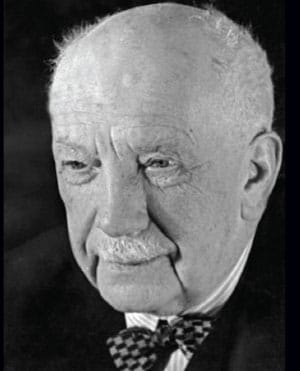
In early May 1945, Richard Strauss wrote in his diary: “On 1 May ended the most terrible period of mankind: 12 years during which the fruits of Germany’s 2,000-year-long cultural development were condemned to extinction and irreplaceable buildings and works of art were destroyed by a criminal rabble of soldiers. A curse on technology!” Among those “irreplaceable buildings” was the Munich National Theater, bombed to rubble in October 1943, which he described to his biographers as “the place consecrated to the first Tristan and Meistersinger performances, where my good father sat for 49 years as first horn in the orchestra.” He added that the theater’s destruction “was the greatest catastrophe which has ever been brought into my life, for which there can be no consolation and, in my old age, no hope.”
A short Adagio for strings, originally titled “Lament for Munich,” was the seed for the larger-scale work that Strauss eventually dubbed Metamorphosen, in response to an August 1944 commission from the Swiss conductor Paul Sacher. Strauss never detailed his reasons for choosing that name, but it may reflect Goethe’s elegiac poems “Metamorphosis of the Plants” and “Metamorphosis of the Animals.” “Die and be reborn!” announces Goethe. “You are but a gloomy guest on the dismal Earth.”
Strauss could have just as well named the work In Memoriam or Elegy, for that’s precisely what it is: a lament for a ruined culture and a yearning evocation of past musical glories. Its frequent quotation of the funeral march movement from Beethoven’s Eroica Symphony is no coincidence: the work is an acknowledged peak of Western music, and the dotted-note rhythm and descending scale of its second movement combine to create a palpable sense of grief. Strauss also channels the four-note motive of Beethoven’s Fifth Symphony, especially as stated in the darkly tinged third movement. Veiled allusions to Wagner via Tristan und Isolde can be heard, as well as hints of Mozart and Bach. Towards the end, as the Eroica funeral march is stated clearly in the lower strings, Strauss wrote In Memoriam! below the score. Thus it’s far more than a mere composition for string orchestra: it’s a requiem for a lost world.
Strauss completed Metamorphosen on April 12, 1945. Eighteen days later Adolf Hitler committed suicide amid the shattered ruins of a Third Reich that had afflicted humanity with inconceivable suffering over the dozen years of its existence. Slightly more than four years later, Strauss passed away at age 85 in his villa in Garmisch.
The short score of Metamorphosen, discovered in Switzerland in 1990, was edited by cellist Rudolf Leopold into a version for string septet, first performed in 1994. By removing the numerous doublings in Strauss’s published version for 23 string instruments, Leopold was able to create a chamber version that remains close to the original.
Clarinet Trio in A minor, Opus 114
Johannes Brahms
Born: May 7, 1833, in Hamburg
Died: April 3, 1897, in Vienna
Work Composed: 1891
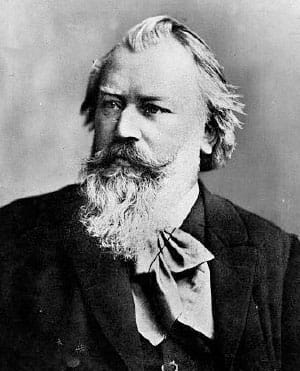
In 1890 Johannes Brahms declared that his composing days were over. “You can bid farewell to my music—since it is finally time to quit,” he wrote to publisher Fritz Simrock. He was only 57 as of May, but he looked and acted far older than his years. Bulky, bearded, and gruff, he bore few traces of the energetic and strikingly handsome youth who had so captivated the Schumanns and continued to manifest as young well into his 40s. Now he had draped himself in the mantle of a senior citizen. “I have worked enough,” he declared. “Now let the young folks take over.”
There exists a closely proximate universe in which Brahms actually carried out his intention to pack it all in. Fortunately, we don’t live in that one, so we have those transcendent post-1890 masterworks, among which are the character pieces for piano Opus 116 through Opus 119, the Four Serious Songs, and the four chamber works that were inspired by clarinetist Richard Mühlfeld of the Meiningen orchestra.
In March 1891 Brahms heard Mühlfeld at a private recital in Meiningen and followed up with a letter to Clara Schumann enthusing that “nobody can blow the clarinet more beautifully than Herr Mühlfeld of this place.” Mühlfeld’s playing—particularly its sincere musicianship and burnished tone—brought Brahms out of his self-imposed compositional retirement. A trio, a quintet, and two sonatas were the result, each spotlighting the clarinet but each with its own particular and ineffable vibe.
First up in the tetralogy is the trio for clarinet, piano, and cello, completed in July 1891. Mühlfeld, Brahms, and cellist Robert Hausmann played the November 1891 premiere at the Meiningen court; performances followed in Berlin and Vienna. Despite his penchant for uncompromising self-criticism, Brahms seems to have been proud of the trio and its companion quintet, both of which he described to Fritz Simrock as “two rather decent works.” Other voices weren’t quite as complimentary. Certain commentators suggested that the trio wasn’t altogether first-rate Brahms; Karl Geiringer described it as “not wholly free from a certain weariness” while others had bones to pick with the third movement, which Fuller Maitland dissed as approaching “very near to the border of the commonplace.” Fortunately, audiences tend to make up their own minds, and nowadays the trio holds a distinguished place among the crown jewels of late Romantic chamber music.
It’s worth mentioning that Brahms provided an alternate version of the trio with viola in place of the clarinet. Although that might have been partially a marketing ploy, there’s no question but that the viola’s mahogany timbre corresponds quite well with the work’s overall subdued demeanor. Nevertheless, it’s the original clarinet version that has prevailed with the listening public, and with good reason. Brahms’s skill in balancing the trio’s two strings with the clarinet inspired his close friend Eusebius Mandyczewski to marvel that “it is as though the instruments were in love with each other.”
The opening establishes a mood of melancholic regret that will permeate throughout the entire work. The cello outlines an upwards minor triad, then swiftly descends in steps back to its starting point. To quote Shakespeare’s lovesick Duke Orsino, it has a dying fall. That propensity for descent characterizes the first movement’s primary and secondary melodies and plays a critical role in establishing an overall sense of the autumnal, even in the luminous coda when the music’s downwards lean and minor mode gives way to gentle upwards surges in major.
An observation is in order regarding Brahms’s second-movement tempo indication. Ever the most precise of notators regarding Italian musical terminology, Brahms knew perfectly well that Adagio doesn’t mean “slow” per se: it means “relaxed” or “in repose.” Thus by “Adagio” Brahms directs the performers to relax into the music, but refrain from lingering or being overly deliberate about it all. In contrast to the first movement’s overall sense of regret, this is a sustained interlude of quiet contentment, a clear counterpart to those exquisite contemporaneous intermezzos for solo piano. A cellist once referred to it as the music of a sunny day in a beautiful meadow, alone and happy in one’s own thoughts. The primary theme is what is sometimes called a “plagal” melody—in other words, it tends to hover around the fifth scale degree rather than the first. A central section darkens things a bit; the harmonies grow more complex, the prevailing major mode becomes less clear. But the dappled serenity of the opening returns, and the movement ends in calm satisfaction.
Brahms had a well-earned reputation for being brusque to the point of churlishness, but within that crabby exterior lay a feather-soft heart. The music matches the man, and that oh-so Brahmsian rectitude can give way to sentimental Viennese gemütlichkeit at the drop of a hat. So it is with the third movement, an exquisite ländler-like affair, all soft curves, lilting rhythms, and passages so winsomely charming that they might have devolved into kitsch in the hands of a lesser composer. Brahms was clearly aware of the movement’s fragility; drawing on his precise knowledge of Italian, he indicated it to be played Andantino grazioso—at slightly less than a “walking” tempo, and graciously.
After those tender-hearted inner movements, the finale’s relatively stern demeanor comes as a bit of a shock, what with its forthright muscularity and Romani-infused dance rhythms that alternate 6/8 time with 2/4. Typical for a Brahms finale, it runs on the short side—half the length of the expansive opening movement, for example—and features what little virtuoso display is to be found in the work.
—Scott Foglesong
About the Artists
Katherine Siochi joined the San Francisco Symphony as Principal Harp beginning in the 2023–24 season and made her solo debut in September 2024. She was previously principal harp of the Minnesota Orchestra, Kansas City Symphony, and Sarasota Orchestra, and has appeared as a guest with the Chicago Symphony and New York Philharmonic. She was the gold medalist of the 2016 USA International Harp Competition and earned degrees from the Juilliard School as a student of Nancy Allen. In 2021 Siochi released her debut album, Nocturne, on Lyon & Healy Records. She serves on the faculty of San Francisco Conservatory of Music and the Aspen Music Festival and School.
Joshua Elmore joined the San Francisco Symphony as Principal Bassoon in March 2025 and made his solo debut last month with Weber’s Bassoon Concerto. He previously served as principal bassoon of the Fort Worth Symphony and has also performed with the Boston Symphony, New York Philharmonic, and Chineke! Orchestra. A graduate of the Juilliard School as a Kovner Fellow, Elmore also holds a Professional Studies Certificate from the Colburn School. He has been a fellow at Tanglewood Music Center and Music Academy of the West and contributed to a Grammy Award–nominated album with the National Orchestra Institute. He serves on the faculty of San Francisco Conservatory of Music and the Aspen Music Festival and School.
Jessie Fellows is Assistant Principal Second Violin with the San Francisco Symphony and holds the Audrey Avis Aasen-Hull Chair. Prior to her appointment, she performed frequently with both the Saint Louis Symphony and the New York Philharmonic. Her summer festival appearances include Bravo! Vail, Lakes Area Music Festival, Rome Chamber Music Festival, Amelia Island Chamber Music Festival, Spoleto USA, and the Aspen Music Festival. Fellows received her bachelor’s degree from the McDuffie Center for Strings at Mercer University and her master’s degree as a Jerome Greene Fellow at the Juilliard School under the tutelage of Ida Kavafian.
Jane (Hyeon Jin) Cho joined the San Francisco Symphony second violin section in the 2025–26 season. Born in South Korea, she began violin lessons at the age of six and studied at the Yehudi Menuhin School in the United Kingdom and the University of Music and Performing Arts in Graz, Austria. She earned her bachelor’s degree with first class honors from the Royal College of Music in London, a master of music at the Juilliard School, and an artist diploma from the Queen Elisabeth Music Chapel in Belgium. In 2022, she was a finalist in the 16th International Henryk Wieniawski Violin Competition. She performs on a Giuseppe Nadotti violin, made in Piacenza, Italy, ca. 1775.
Katarzyna Bryla joined the San Francisco Symphony viola section beginning with the 2022–23 season and is currently Acting Assistant Principal. She was born into a family of musicians and has earned more than two dozen prizes and awards in the United States, France, and her native Poland. In 2019 she became a co-principal violist of Orchestra of St. Luke’s and a member of St. Luke’s Chamber Ensemble. She has also been a member of the New York City Ballet Orchestra and the New York Pops. She has performed at Classical Tahoe, Napa Valley Music Festival, and Music@Menlo.
Leonid Plashinov-Johnson joined the San Francisco Symphony viola section at the beginning of the 2022–23 season. Previously a member of the St. Louis Symphony, he is a laureate of multiple competitions, most recently the Primrose International Viola Competition, and has participated in the Yellow Barn, Ravinia, and AIMS festivals. Born in Russia, he graduated from New England Conservatory, where he won the concerto competition.
Starla Breshears joined the San Francisco Symphony cello section at the beginning of this season and holds the Gary & Kathleen Heidenreich Chair. She was a prizewinner of the Irving M. Klein International String Competition, Stulberg International String Competition, Johansen International Competition, and the Shkolnikova Academy concerto competition, which led to a solo appearance with the Shkolnikova Academy String Orchestra in France. Breshears was a Kohl Scholar at the Colburn Music Academy, where she studied with Clive Greensmith, and before that was a Joseph Chan Scholarship recipient at the San Francisco Conservatory of Music Pre-College Academy, where she studied with Richard Aaron and Jean-Michel Fonteneau. She was previously principal cello of the San Francisco Symphony Youth Orchestra.
Davis You joined the San Francisco Symphony cello section at the beginning of the 2024–25 season and holds the Lyman & Carol Casey Second Century Chair. He earned his bachelor of music from New England Conservatory, where he studied with Laurence Lesser and Paul Katz, and regularly appeared as principal cello of the NEC Philharmonia. He was a member of Quartet Luminera, which won the silver medal at the Fischoff National Chamber Music Competition. A Bay Area native, You began his cello studies with Irene Sharp and Jonathan Koh. He has appeared on NPR’s From the Top, San Francisco International Piano Festival, Wellesley Chamber Players Series, Taos Chamber Music Festival, and Norfolk Chamber Music Festival.
Daniel G. Smith was appointed Associate Principal Bass of the San Francisco Symphony in 2017. He previously served as principal bass of the Santa Barbara Symphony, and he was a member of the San Diego Symphony. He has served as guest principal and associate principal bass with the Los Angeles Chamber Orchestra, and guest principal of the Lakes Area Music Festival in Brainerd, Minnesota. Smith received his bachelor of music from Rice University’s Shepherd School of Music under the tutelage of Timothy Pitts.
Carey Bell joined the San Francisco Symphony as Principal Clarinet in 2007 and holds the William R. & Gretchen B. Kimball Chair. He was previously principal clarinet of the San Francisco Opera Orchestra, acting principal of the San Francisco Ballet Orchestra, principal of the Syracuse Symphony, and a member of the Civic Orchestra of Chicago. Cultivating a career in the Bay Area for over two decades, Bell has soloed with the SF Symphony many times and performed with numerous local orchestras and chamber ensembles. He studied clarinet and composition at the University of Michigan.
Amos Yang joined the San Francisco Symphony in 2007 as Assistant Principal Cello and holds the Karel & Lida Urbanek Chair. He was previously a member of the Seattle Symphony and a member of the Maia String Quartet. Born and raised in San Francisco, he was a member of the SF Symphony Youth Orchestra and San Francisco Boys Choir, and earned bachelor’s and master’s degrees from the Juilliard School.
John Wilson frequently performs as pianist with the San Francisco Symphony and San Diego Symphony and serves as principal keyboard for the Marin Symphony. In 2026–27 he gives the Bay Area premiere of Caroline Shaw’s piano concerto Watermark and appears as soloist in Rachmaninoff’s Piano Concerto No. 2 with the San Francisco Philharmonic. He has performed Philip Glass’s Piano Concerto No. 1 with the Chamber Orchestra of New York at Carnegie Hall and Beethoven’s Triple Concerto at the Sun Valley Music Festival, and has toured with the San Francisco Symphony under Michael Tilson Thomas and Esa-Pekka Salonen. Wilson performed on the Grammy-winning San Francisco Symphony recordings Meditations on Rilke and Adriana Mater. His Avie Records debut featured the world premiere of Michael Tilson Thomas’s Upon Further Reflection; he also appears on Pentatone’s Grace: The Music of Michael Tilson Thomas. He has premiered works by MTT, John Adams, Steve Reich, Timo Andres, and Gabriela Lena Frank. Wilson is a Steinway Artist.