In This Program
The Concert
Sunday, November 1, 2026, at 2:00pm
Gunn Theater
California Palace of the Legion of Honor
Alexander Barantschik violin
Peter Wyrick cello
Anton Nel piano
Wolfgang Amadeus Mozart
Piano Trio in G major, K.496 (1786)
Allegro
Andante
Allegretto: Theme and Variations
Frank Bridge
Cello Sonata in D minor (1917)
Allegro ben moderato
Adagio ma non troppo–Molto allegro agitato
Intermission
Camille Saint-Saëns
Piano Trio No. 1 in F major, Opus 18 (1864)
Allegro vivace
Andante
Scherzo: Presto
Allegro
This series showcases the 1742 Guarneri del Gesù violin on loan to Alexander Barantschik and the San Francisco Symphony from the Fine Arts Museums of San Francisco.
Program Notes
Piano Trio in G major, K.496
Wolfgang Amadeus Mozart
Born: January 27, 1756, in Salzburg
Died: December 5, 1791, in Vienna
Work Composed: 1786
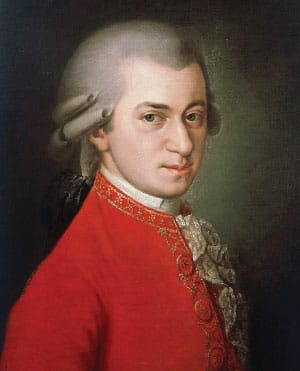
Mozart often composed in his head before notating his music, producing disconcertingly clean manuscripts. But he also had moments of frustration and writer’s block just like regular mortals. His Piano Trio in G major, K.496, was the product of discarded drafts, red ink slashes, and much rewriting. Innovation rarely happens smoothly and Mozart’s late trios, of which K.496 is the first, find him at his most innovative.
In the summer of 1786, Mozart was at the peak of his career. The Marriage of Figaro and two piano concertos, K.488 in A major and K.491 in C minor, had just achieved enormous success and his reputation could not have been better. From this triumphant standpoint, he turned towards the problematic genre of piano-and-string chamber music.
Concerns with balance have always plagued these combinations. Prior to the arrival of the Viennese fortepiano, the fear was nearly always that the strings would drown out the keyboard. The violin and cello enriched the keyboard by doubling it, lending it the expressive possibilities of sustained notes and wide dynamic range. The keyboard had all of the musical material and so duos and trios were typically titled “sonata for piano with accompaniment” (as was this trio initially). Today, we contend with inverted balance issues: the powerful modern piano threatens to overwhelm the string instruments.
In the 1770s, Mozart acquired one of the new Viennese fortepianos made by J.A. Stein and Anton Walter. He was so impressed that he wrote to his father: “In whatever way I touch the keys, the tone is always even. It never jars, it is never weaker or entirely absent.” The capabilities of the Viennese pianos allowed Mozart to give more independence to the string instruments. His late trios point the way towards the future of the piano trio—a perfect marriage of ensemble playing and soloistic virtuosity.
The trio begins with a long piano solo introducing a florid, operatic first theme. The violin takes a turn and then the two instruments converse while the cello dutifully holds bass notes. The movement proceeds without surprises until the start of the development, when all three instruments restate the opening ascending scale together in minor, creating a stormy transformation. It is the cello’s first taste of prominence. It continues as an equal participant for some time, exchanging related scales in different keys with the violin and piano until the movement’s opening material returns and the cello recedes back to an accompanimental role.
The second movement also begins with a piano solo followed by a questioning violin. Before long, the cello takes the main theme and weaves independently in counterpoint between the violin and piano. Another shocking cello entrance takes us into the distant key of A-flat major. The music winds searchingly, landing on many moments of intense beauty, particularly the violin and cello duet towards the close of the movement.
The finale has received the most critical analysis and interest from scholars and musicians. It is a theme and variations on a gavotte: a poised Baroque dance. Mozart innocently plays with its jovial theme until the fourth variation, an arresting passacaglia in a minor key, so revolutionary in its textures and use of the instruments that Beethoven even copied out its complex counterpoint in an attempt to get at its inner workings. We can clearly see here Mozart’s intense study of J.S. Bach’s counterpoint begun four years earlier. The movement transitions back into major with an Adagio variation that closely resembles the main theme of the second movement. This thematic reminiscence was also quite unorthodox and hints at what Beethoven would do in his own piano trios. Finally in the sixth variation, the theme returns in its original form. It seems all is well until suddenly the minor variation with its strange violin drone and unsettling counterpoint returns—another moment of retrospection! Mozart climbs out of these darker environs with chords in joyous, life-affirming counterpoint, sidesteps with a return of the main theme, and then ends with a triumphant flourish.
—Allegra Chapman
Cello Sonata in D minor
Frank Bridge
Born: February 26, 1879, in Brighton, England
Died: January 10, 1941, in Eastbourne, England
Work Composed: 1913–17
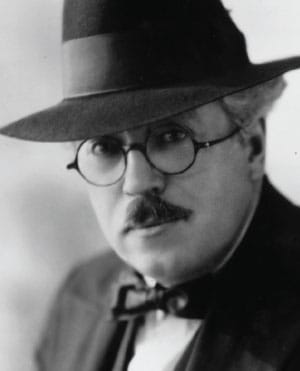
Frank Bridge spent the first quarter of his career primarily as a string player. His father was a working-class violinist and bandleader in Brighton, England, and Bridge went into the family business by the time he was a teenager. In 1899 he earned a scholarship to the Royal College of Music, an education that lifted him from seaside theater orchestras into London string quartets.
Bridge studied composition with the Irish composer Charles Villiers Stanford, part of the generation of Stanford students that included Ralph Vaughan Williams and Gustav Holst. By 1912, Bridge began limiting his playing to focus more on composition and conducting. Many different influences are apparent in his music: late Romanticism, modernism, touches of English Pastoralism and French Impressionism. But there is also something more: an individual voice with a compelling story to tell. Benjamin Britten recalled two of Bridge’s teaching principles. “One was that you should find yourself and be true to what you found. The other—obviously connected with the first—was his scrupulous attention to good technique, the business of saying clearly what was in one’s mind.”
Bridge wrote the Cello Sonata in D minor during the First World War—it was a slow, multi-year effort from 1913–17. Friends reported that he was in deep despair over the state of the world and suffering from insomnia. The piece was finally premiered in 1917 by cellist Felix Salmond and pianist Harold Samuel at Wigmore Hall. After Bridge died in 1941, his music was not often performed, but Britten strove to revive his old teacher’s works, recording the Cello Sonata with Mstislav Rostropovich in 1969.
Cast in two movements, the sonata takes off with a wondrously winding melody, immediately repeated higher, then extended to rise even further. The feeling of flexibility and offset between the instruments comes from an old Brahmsian rhythmic trick of three-against-two, creating a roiling slow-motion groove beneath this wild, exploratory music.
The second movement begins hazily, more spacious than the first. Slowly it moves forward into a muted passage, Andante con moto, where a mournful melody takes form. Then a surprise: the piano launches into fast music, Molto allegro e agitato. Another composer might have separated this into a third movement finale, but Bridge wanted it intermingled. The first movement melody returns in a coda, newly focused and emboldened.
—Benjamin Pesetsky
Piano Trio No. 1 in F major, Opus 18
Camille Saint-Saëns
Born: October 9, 1835, in Paris
Died: December 16, 1921, in Algiers
Work Composed: 1864
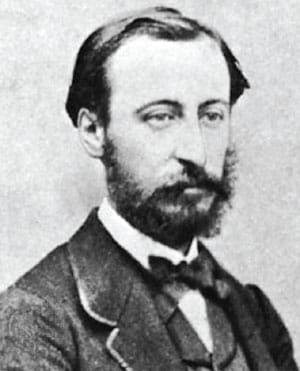
Over the course of his long life, Camille Saint-Saëns occupied many positions in French musical society: the astounding prodigy; the rebellious, forward-thinking artist; the revered composer embodying the national voice; and finally the stick-in-the-mud reactionary. He was often called the “French Mozart” due to his prodigious abilities at the piano and organ. Saint-Saëns self-identified as “a classicist, nourished on Mozart and Haydn from my tenderest infancy.” Claude Debussy called him “the musician of tradition.” But his interests ranged far and wide. He enthusiastically studied and wrote about a variety of subjects including archeology, Latin and ancient Greek, astronomy, and philosophy. His omnivorous musical appetite spanned the full range of music history, from medieval Gregorian chant to the new works of his German contemporaries who were generally rejected by the French musical elite. Saint-Saëns wrote: “I am an eclectic spirit. It may be a great defect, but I cannot change it: one cannot make over one’s personality.”
Early in his career, Saint-Saëns developed a love of instrumental genres, an eccentric focus at a time when the dramatic genres of grand opera and ballet dominated the French music scene. At the same time, he experimented with French folk idioms and textures. His search for a distinct French voice and his interest in instrumental forms would become the norm after 1871 when France suffered a crushing defeat in the Franco-Prussian War. As the nation faced a reckoning, patriotic sentiment swept through French culture. Saint-Saëns led the charge to develop and champion a modern French musical voice, co-founding the Société nationale de musique with the motto “ars gallica” (French art).
But when Saint-Saëns wrote his F-major trio in 1864 on a trip to Auvergne and the Pyrenees, all this was in the future. He premiered it at the Salle Pleyel, a 500-seat venue in Paris popular for premieres, joined by the Spanish violin sensation Pablo de Sarasate and an unknown cellist. It follows the typical piano trio forms of Viennese repertoire, but with a French twist, invoking folk instruments and ancient medieval Gallic music.
In the trio’s first movement, Allegro vivace, a sense of a French voice is already palpable. But what does it mean to “sound French”? We know it when we hear it, whether it be Édith Piaf or Claude Debussy. There is something about the lightness of this music, its delicate but vivacious textures, that creates the association. The movement follows traditional sonata form, introducing a first theme that bounces upwards with an almost naive gaiety immediately followed by a second theme that glides back down. The music flits through the old Viennese form, defying the weight of its history.
In the second movement, we are transported to an ancient realm, which later inspired Maurice Ravel in the slow movement of his own piano trio. The violin drone at the opening of the movement mimics the clavecin-vielle, a hurdy-gurdy-like instrument from the mountainous regions of France. The drone grows rhapsodic before a slightly faster section smooths over the dotted rhythms of the rustic opening music, all flowing water. The movement ends as it began. The Scherzo skips along with a pointillistic melody in the piano and plucking of strings, repeated notes chattering in a delighted mood. A return of the drone from the second movement gives us a heartfelt middle section.
The final movement begins simply, hiding a compositional sleight of hand. The bubbling piano accompaniment, seemingly unimportant, contains a melody which later becomes a chorale whispered in prayerful tones. This spiritual music suspends us for a blissful moment before we return to the effervescent material of the movement’s opening. The piece ends with a knowing wink.
—A.C.
About the Artists
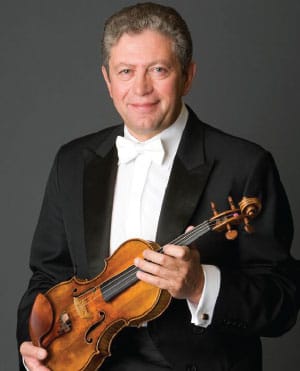
Alexander Barantschik
Alexander Barantschik was appointed Concertmaster of the San Francisco Symphony in September 2001 and holds the Naoum Blinder Chair. He previously served as concertmaster of the Bamberg Symphony, London Symphony, and Netherlands Radio Philharmonic, and has been active as a soloist and chamber musician throughout Europe.
Barantschik has led the SF Symphony in several programs and appeared as a soloist in works by Bach, Mozart, Mendelssohn, Brahms, Beethoven, Prokofiev, Shostakovich, Walton, Piazzolla, and Schnittke, among others. He also soloed and toured with the London Symphony, and served as concertmaster for symphonic cycles with Michael Tilson Thomas, Mstislav Rostropovich, and Bernard Haitink. As a chamber musician, Barantschik has collaborated with Yo-Yo Ma, André Previn, Antonio Pappano, and Rostropovich. In the new year, he will solo in Mozart’s Sinfonia concertante with Principal Viola Jonathan Vinocour and Music Director Designate Elim Chan (January 14–16).
Born in Russia, Barantschik attended the Saint Petersburg Conservatory and went on to perform with the major Russian orchestras, including the Saint Petersburg Philharmonic. His awards include first prizes in the International Violin Competition in Sion, Switzerland, and the Russian National Violin Competition.
Through an arrangement with the Fine Arts Museums of San Francisco, Barantschik has the exclusive use of the 1742 Guarneri del Gesù violin once owned by the virtuoso Ferdinand David, who is believed to have played it in the world premiere of the Mendelssohn E-minor Violin Concerto in 1845. It was also the favorite instrument of the legendary Jascha Heifetz, who acquired it in 1922 and who bequeathed it to the Fine Arts Museums, with the stipulation that it be played only by artists worthy of the instrument and its legacy.
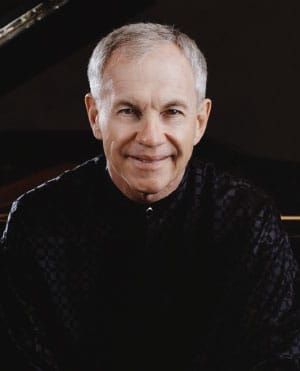
Anton Nel
Winner of the 1987 Naumburg International Piano Competition, Anton Nel tours as a recitalist, concerto soloist, chamber musician, and teacher. Highlights in the United States include performances with the Cleveland Orchestra, Chicago Symphony, Dallas Symphony, and Seattle Symphony, as well as recitals from coast to coast. He has appeared internationally at Wigmore Hall, the Concertgebouw, Suntory Hall, and major venues in China, Korea, and South Africa.
Nel holds the Joe R. and Teresa Lozano Long Endowed Chair at the University of Texas at Austin, and in the summers is on the faculties of the Aspen Music Festival and School and the Steans Institute at the Ravinia Festival. Born in Johannesburg, Nel is also an avid harpsichordist and fortepianist, and is a graduate of the University of the Witwatersrand, where he studied with Adolph Hallis, and the University of Cincinnati, where he worked with Béla Síki and Frank Weinstock. He made his San Francisco Symphony debut in 1994.
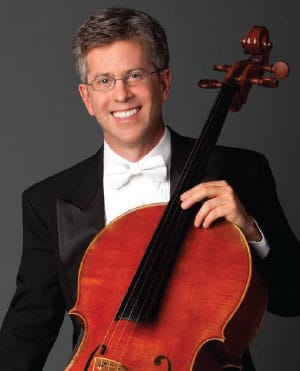
Peter Wyrick
Peter Wyrick was a member of the San Francisco Symphony cello section from 1986–89, rejoined the Symphony as Associate Principal Cello from 1999–2023, and retired from the Orchestra at the end of the 2023–24 season. He was previously principal cello of the Mostly Mozart Orchestra and associate principal cello of the New York City Opera. He has appeared as soloist with the SF Symphony in works including C.P.E. Bach’s Cello Concerto in A major, Bernstein’s Meditation No. 1 from Mass, Haydn’s Sinfonia concertante in B-flat major, and music from Tan Dun’s Crouching Tiger, Hidden Dragon Concerto.
In chamber music, Wyrick has collaborated with Yo-Yo Ma, Joshua Bell, Jean-Yves Thibaudet, Yefim Bronfman, Lynn Harrell, Jeremy Denk, Julia Fischer, and Edgar Meyer, among others. As a member of the Ridge String Quartet, Wyrick recorded Dvořák’s piano quintets with pianist Rudolf Firkušný on an RCA recording that received the Diapason d’Or and a Grammy nomination. He has also recorded Fauré’s cello sonatas with pianist Earl Wild for dell’Arte Records. Born in New York to a musical family, he began studies at the Juilliard School at age eight and made his solo debut at age 12.