In This Program
- The Concert
- At a Glance
- Program Notes
- Johannes Brahms: Nänie
- Arvo Pärt: Magnificat
- About the Artists
- About San Francisco Symphony
The Concert
Thursday, October 29, 2026, at 7:30pm
Friday, October 30, 2026, at 7:30pm
Saturday, October 31, 2026, at 7:30pm
Inside Music Talk with Elim Chan
in conversation with Benjamin Pesetsky
On stage at 6:30pm before each performance
Elim Chan conducting
Johannes Brahms
Nänie, Opus 82 (1881)
San Francisco Symphony Chorus
Jenny Wong director
Felix Mendelssohn
Violin Concerto in E minor, Opus 64 (1844)
Allegro molto appassionato
Andante–
Allegretto non troppo–Allegro molto vivace
Renaud Capuçon
Intermission
The second half of this program is performed without pause.
Please hold your applause until the end of the Adams.
Arvo Pärt
Magnificat (1989)
First San Francisco Symphony Chorus Performances
San Francisco Symphony Chorus
Jenny Wong director
John Adams
Doctor Atomic Symphony (2007)
The Laboratory
Panic
Trinity
First San Francisco Symphony Performances
Support for the San Francisco Symphony Chorus is provided through the San Francisco Symphony Chorus Endowment Fund, generously established by Peter G. Neumann.
Inside Music Talks are supported in memory of Horacio Rodriguez.
Program Notes
From Elim Chan
The standout element of this program is the chorus, which is a medium I’m eager to explore further in my upcoming projects. As I get to know the San Francisco Symphony, it feels only natural to broaden the ways in which we work together, including through the SF Symphony Chorus, whom I first had the opportunity to meet a few years ago in Gustav Holst’s The Planets.
Opening the program, Johannes Brahms’s Nänie is a beautiful funeral song that echoes many of the sentiments found in the Doctor Atomic Symphony. While John Adams’s work reflects on J. Robert Oppenheimer and humanity’s capacity for destruction, Brahms grapples with questions of mortality and grief. The famous line “Auch das Schöne muss sterben!” (Even the beautiful must die!) speaks to an idea that resonates deeply across both works. Nothing can escape death, and that theme runs through the outer pieces on this program. They are profound meditations on mortality.
This is the first time in many years that Renaud Capuçon has appeared with the San Francisco Symphony, and Felix Mendelssohn’s Violin Concerto is such a gem of the repertoire, making it the perfect piece for us to work on together.
After the intermission, Arvo Pärt’s deeply introspective and spiritual Magnificat provides a perfect transition, preparing the audience for the world of Adams’s Doctor Atomic Symphony. The Pärt is radiant and completely a cappella, which allows the chorus to truly showcase what it can do. Then Adams unleashes the full power of the orchestra to confront the subject of the atomic bomb and its consequences for humanity.
—Elim Chan
Nänie
Johannes Brahms
Born: May 7, 1833, in Hamburg
Died: April 3, 1897, in Vienna
Work Composed: 1881
SF Symphony Performances: First—September 1929. Hans Leschke conducted. Most recent—May 2022. Nathalie Stutzmann conducted.
Instrumentation: chorus, 2 flutes, 2 oboes, 2 clarinets, 2 bassoons, 2 horns, 3 trombones, timpani, harp, and strings
Duration: About 15 minutes
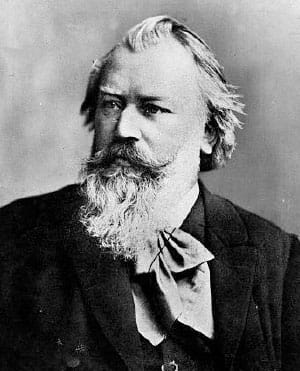
Nänie is the middle work of the “Brahms Elegies,” three choral-orchestral settings of legends of classical antiquity, vis-à-vis German idealist poetry. The elegiac works, which include Schicksalslied, Opus 54, and Gesang der Parzen, Opus 89, were vessels for Johannes Brahms to grapple with his philosophical queries surrounding nostalgia, memory, mourning, and loss. Nänie illuminates just how deeply ensconced Brahms was in the German intellectual milieu of his time, and how he interpreted philosophical, literary, and artistic movements through his own musical lens. The piece, written in memory of his friend, the German neoclassical painter Anselm Feuerbach, sets poetry by Friedrich Schiller.
Turn-of-the-19th-century German Romantics Schiller, Goethe, and Hölderlin espoused neoclassical forms as part of the German idealist movement, which proposed that all art should point the way to the ideal, and that one could find guidance in the works of classical antiquity. The poem’s title is from the Latin naenia, which means “funeral song” or “dirge.” The opening line, “Auch das Schöne muss sterben!” (Even the beautiful must die!), is a recognition of the defenselessness one feels in the wake of untimely death. The poem’s form is from earliest Greek lyrical poetry, and was used for elegies, laments, and epitaphs. Schiller uses three episodes in Greek mythology to describe that although beauty might fade with the passing of mortal souls, poetry remains immortal. From Orpheus trying to bring Eurydice home from the underworld, Aphrodite mourning the death of Adonis, to Thetis trying to save her son Achilles, there is beauty in grief and yearning among those who must keep on living.
Whereas Schiller looked toward classical antiquity for lessons in finding the ideal in art, Anselm Feuerbach’s classical inspiration was mediated through the Italian Renaissance. Feuerbach was part of a group of artists known as the Deutsch-Römer (German Romans) and spent the last several years of his life living and painting in Venice, where he died at 50 years old in 1880. Brahms shared many ideals with his friend Feuerbach: both men revered the masters of the past for their attention to form, line, and structure. Unlike Feuerbach, Brahms needed only to look a few decades into the past, toward Beethoven and Schumann.
Brahms’s interest in nostalgia and memory is apparent from the opening measures of Nänie. The first wind chorale is a clear allusion to Beethoven’s Piano Sonata No. 26 in E-flat major, Les Adieux. Brahms quotes the opening phrase, “Lebewohl,” with its horn calls, a nod toward pastoral innocence. Brahms uses the “Lebewohl” motto at the coda of the piece, and quotes Beethoven and himself in the middle of the work. By drawing musical allusions to earlier eras, Brahms not only connects with Schiller and Feuerbach’s neoclassicism and German idealism, but also draws attention to the turn-of-the-century disenchantment with current musical practice, and a yearning for a simpler time.
Even the beautiful must die. But there is beauty in the knowledge that art will endure. Brahms ends the piece not with the final phrase of the poem, but the penultimate: “auch ein Klaglied zu sein im Mund der Geliebten, ist herrlich” (Yet, it is splendid to be a lament on the lips of the beloved), repeating “herrlich” (splendid, marvelous) over again. It is a meditation on the perseverance of the beautiful in music. Despite what Brahms endured in his life, the shifting cultural ideals over the course of the long 19th century, the wars and socio-political upheavals, Brahms still chose to write a paean to musical beauty in Nänie.
—Alicia Mastromonaco
Violin Concerto in E minor, Opus 64
Felix Mendelssohn
Born: February 3, 1809, in Hamburg
Died: November 4, 1847, in Leipzig
Work Composed: 1838–44
SF Symphony Performances: First—February 1915. Henry Hadley conducted with Albert Spalding as soloist. Most recent—September 2026. Giancarlo Guerrero conducted with Hilary Hahn as soloist.
Instrumentation: solo violin, 2 flutes, 2 oboes, 2 clarinets, 2 bassoons, 2 horns, 2 trumpets, timpani, and strings
Duration: About 27 minutes
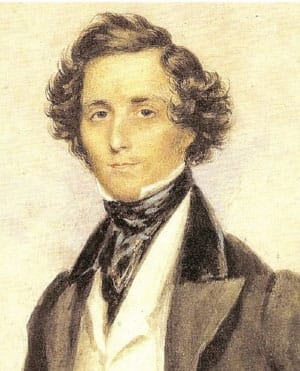
Felix Mendelssohn’s love of classical forms, his desire to write a serious piece of music for the violin, and his consideration for his place in the canon all helped lead him to compose his violin concerto. This contrasted with concertos by composer-performers such as Paganini or the young Chopin, who wrote flashy pieces full of virtuosic pyrotechnics and showmanship. Ferdinand David, the soloist who premiered Mendelssohn’s work, was one of the most important violinists of his time: he was the leader of a string quartet, concertmaster of the Leipzig Gewandhaus Orchestra (where Mendelssohn was music director), and a teacher at the Leipzig Conservatory (which Mendelssohn founded in 1843). Mendelssohn and David collaborated on the concerto, and it is likely that David helped with the writing of the cadenza.
Mendelssohn’s violin concerto was innovative in several ways that reflect shifts in concert culture and composition at the time. For European concertgoers before the mid-19th century, today’s expectations of silence in the concert hall would have been wholly unfamiliar. Multi-movement works were broken up into different parts of the program, with shorter pieces and lighter fare interspersed between. Audience members would chat during the performances and interact with the musicians as they were performing. Concerts were social events, places to see and be seen, just as much as they were musical events. Listeners would applaud after each movement, or even demand encores of a particularly spectacular one. Concert culture eventually began to change (particularly after Beethoven’s death in 1827), and audiences became more interested in hearing works in their entirety, as the “genius” composer would have conceived it.
Mendelssohn’s violin concerto is an interesting case study in these shifting mores. In order to create continuity, he does not allow a break between the movements, but rather continues directly from one into the next, with a sustained bassoon between the first and second movements and a transitional passage with the orchestra and soloist between the second and third. This was likely to prevent overeager audience members from applauding at inopportune times, and to encourage them to focus on the piece until the end, when the catharsis of applause would be even greater. This way Mendelssohn ensured that the premiere with his home orchestra at the Leipzig Gewandhaus would proceed the way he wanted it to.
Then in an effort to create a serious concerto that would not be meddled with by nefarious self-serving virtuosos, Mendelssohn wrote out the concerto’s cadenza. Typically, earlier composers would leave it to the soloist to improvise a cadenza, but in the 19th century it became more common for composers to provide one, which would later become the standard practice.
Mendelssohn’s violin concerto was a harbinger of how concertos would shift over the course of the 19th century, from the brilliant concerto to the symphonic concerto. The former was a showpiece, serving as a vessel for a composer-performer’s virtuosity and dazzling technique, while the latter was a serious piece of music that would be treated on par with other works in the concert hall. Mendelssohn deftly weaves this transition, gently shifting audiences’ expectations and behavior through the work alone.
—A.M.
Magnificat
Arvo Pärt
Born: September 11, 1935, in Paide, Estonia
Work Composed: 1989
First SF Symphony Chorus Performances
Instrumentation: chorus
Duration: About 7 minutes
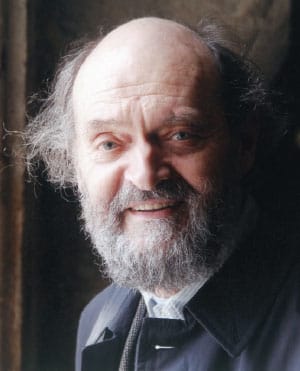
Now 91, Arvo Pärt remains creatively active, more than half a century after he began the prolonged search that led to the unmistakable musical language associated with his name. Born in the small Estonian town of Paide in 1935, five years before Estonia was occupied and annexed by the Soviet Union, Pärt showed an early attraction to music but later described himself as a slowly maturing composer: “I wasn’t in a position to find the path that might have led me toward what I was really looking for.”
Pärt’s search for his authentic voice transpired under the constraints of Soviet cultural policy. While studying in Tallinn, he became one of the first composers in postwar Estonia to experiment with 12-tone techniques, officially condemned as decadent and formalist. He later turned to collage, juxtaposing styles from radically different periods.
The most provocative result was Credo (1968), which stages a confrontation that is at once musical and spiritual: Bach’s C-major Prelude from The Well-Tempered Clavier is disrupted by dissonant clusters and percussive force, while the chorus openly proclaims “Credo in Jesum Christum.” The juxtaposition was aesthetically unsettling and politically incendiary in the Soviet context, where the explicit declaration of belief led to the work’s suppression.
Credo marked a crisis in Pärt’s early experimentation, pushing collage technique to a breaking point. Apart from his Third Symphony, he virtually stopped composing for much of the next eight years. Instead, he immersed himself in Gregorian chant and other early sacred music, seeking to relearn the foundations of melody. “When I began to sing and to play these melodies,” he later recalled, “I had the feeling that I was being given a blood transfusion.” It was during this period of searching, in 1972, that Pärt converted to the Russian Orthodox faith.
The breakthrough came in 1976 with the spare piano miniature Für Alina. Pärt had discovered the radically reduced method he called tintinnabuli (from the Latin for “little bells”), pointing to its bell-like sonorities. Rather than simply imitate the musical past, his study of early music procedures became a catalyst for a new beginning. As the Estonian musicologist Toomas Siitan explains, tintinnabuli combines a scalar melodic line with another drawn from the notes of a single triad; the two function not as melody and accompaniment but as an inseparable whole. Pärt later encapsulated the principle in the equation “1+1=1.”
This radical economy can make his music sound deceptively simple. Pärt’s enormous popularity has encouraged labels such as “holy minimalism,” but the term can obscure both the rigor of his technique and the concreteness of his spiritual outlook. “By spirituality I do not mean something mystic,” he has explained, “but something in fact quite concrete.” His Orthodox faith has remained central to his life, and sacred works occupy a major place in his catalogue.
The Music
The Magnificat is the Virgin Mary’s song of praise from the Gospel of Luke, sung during her visit to Elizabeth and beginning with the words “My soul magnifies the Lord.” It has been one of the central canticles of Christian worship for many centuries, inspiring countless musical settings.
Pärt composed his compact setting in 1989, on a commission from the Deutscher Musikrat. Written for unaccompanied mixed choir, with frequent divisi (one section dividing into multiple lines), Magnificat closely links the shape of its vocal lines to the Latin text.
The two soprano parts begin alone, one largely fixed on C while the other rings a melodic line around it. Pärt then transfers the interplay to the lower register, with divided tenors and basses. Similarly spare combinations alternate with fuller choral textures, including further divisions of the tenor and bass parts. The result is one of Pärt’s most serenely beautiful applications of tintinnabuli to sacred text.
—Thomas May
Doctor Atomic Symphony
John Adams
Born: February 15, 1947, in Worcester, Massachusetts
Work Composed: 2007
First SF Symphony Performances
Instrumentation: 2 flutes, piccolo, 3 oboes, English horn, 3 clarinets (2nd doubling E-flat clarinet and 3rd doubling bass clarinet), 3 bassoons (3rd doubling contrabassoon), 4 horns, 3 trumpets, piccolo trumpet, 3 trombones, tuba, timpani, percussion (crotales, chimes, snare drum, thunder sheet, glockenspiel, bass drum, 2 tam-tams, 2 suspended cymbals, and tuned gongs), harp, celesta, and strings
Duration: About 24 minutes
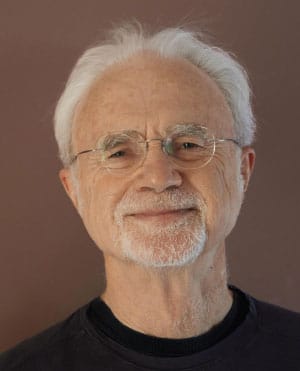
John Adams’s Doctor Atomic Symphony brings orchestral form to music that originated just across Grove Street from Davies Symphony Hall. San Francisco Opera gave the world premiere of Doctor Atomic in 2005. The two-act work centers on J. Robert Oppenheimer and the scientists of the Manhattan Project during the tense final hours leading to the first successful test of an atomic bomb at the Trinity site in the New Mexico desert in July 1945.
For Adams, the story was more than a historical episode. “The manipulation of the atom, the unleashing of that formerly inaccessible source of densely concentrated energy, was the great mythological tale of our time,” he has written. With the bomb’s successful explosion, “the relationship between humans and the planet they inhabit changed unalterably.”
Oppenheimer, the brilliant physicist who directed the Los Alamos project, becomes the opera’s central protagonist: an American Prometheus—to borrow the title of Kai Bird and Martin Sherwin’s famous biography. His interests extended far beyond science to poetry, music, and painting; he even learned Sanskrit to read the Bhagavad Gītā. That extraordinary intellectual and cultural breadth makes his role in creating a weapon of unprecedented destructive power all the more troubling.
Rather than work with a conventional operatic libretto, Adams set a collage of “found” texts arranged by longtime collaborator Peter Sellars ranging from government documents and eyewitness accounts to poetry. Oppenheimer’s literary passions come to the fore at one of the opera’s emotional high points, when he turns to John Donne’s Holy Sonnet “Batter my heart, three-person’d God”—the poem that prompted him to give the test site the name “Trinity.”
The bomb itself, known simply as the “Gadget,” becomes a kind of perverse holy grail around which the characters gather. But Doctor Atomic also sets the scientists’ drive to master nature against another worldview rooted in the desert landscape. Pasqualita, the Oppenheimers’ Tewa maid, invokes the Corn Dance and the traditions of the Indigenous people whose ancestral home surrounds the test site. Adams describes this perspective not as less rational but as fundamentally different: rather than act upon nature, “they are the observers,” attentive to secrets that the natural world itself might reveal.
Much of Doctor Atomic is, paradoxically, about waiting. As an electrical storm lashes the desert in the hours before the test, scientists and military officers argue over whether to proceed while the bomb hangs suspended for detonation. Like a Greek tragedy, we’re well aware of how the story will end, but Adams’s music restores its sense of present-tense anticipation.
When Adams returned to this material in 2007, he had no interest in merely assembling a suite of orchestral excerpts. The opera’s initial performances had made him aware that some musical ideas had necessarily been cut short or left underdeveloped because the demands of the stage had to take priority over what was happening in the pit. A commission from the St. Louis Symphony and conductor David Robertson, to whom Doctor Atomic Symphony is dedicated, gave him an opportunity to rethink those ideas in purely orchestral terms.
Adams elaborated, extended, and transformed ideas from the opera such that they follow a trajectory independent of the drama. The process of composing Doctor Atomic Symphony reinforced his conviction that “symphonic logic and operatic logic are two completely different species.”
Doctor Atomic Symphony unfolds in a single continuous movement articulated in three large sections. Adams has cited Sibelius’s Seventh Symphony as a precedent for this sustained architecture—a work he says has exerted “an immense effect on my compositional thinking.” The symphony follows its own musical course, but the moral and psychological tensions of the opera remain concentrated within it.
Elim Chan, who will conduct the complete Doctor Atomic as her first staged opera at the Zurich Opera House in February 2027, remembers being “completely gripped” when she first encountered Doctor Atomic at the Metropolitan Opera. She finds its dramatic intensity no less effective without the voices: “What I find so powerful is that when you take away the words and hear Doctor Atomic Symphony, [Adams] translates the opera into purely symphonic terms, but you still feel so much of the psychology of what he was trying to describe and underline in the original work.”
The Music
“The Laboratory” begins with music from the opera’s overture. Timpani hammer beneath splintered brass calls and dark, unstable harmonies, creating an ominous soundscape—a secular Day of Judgment superimposed on the desert. “Panic,” the longest of the Symphony’s three sections, ensues without pause. Frenzied rhythms and anxious pauses suggest the nervous waiting of those final hours as the electrical storm threatens the test.
Individual instruments retain traces of their operatic identities: a barking, gruffly insistent trombone suggests General Leslie Groves, the Manhattan Project’s military director, while music associated with Pasqualita brings back the contrasting perspective of the Tewa world.
The final section, “Trinity,” turns inward. A solo trumpet takes on Oppenheimer’s voice, drawing on the soliloquy that closes the opera’s first act, when he recites Donne’s “Batter my heart.” D minor comes into focus as the trumpet’s solemn, neo-Baroque lament is set against the obsessive rhythmic patterns that have driven the symphony. Adams does not end by reproducing the bomb’s detonation as a spectacular orchestral climax. Instead, the lyrical line and those insistent patterns remain at odds, and the music is pared down to a stark, unresolved close.
—T.M.
—John Adams
Johannes Brahms: Nänie
Auch das Schöne muss sterben!
Das Menschen und Götter bezwinget
Nicht die eherne Brust
rührt es des stygischen Zeus.
Einmal nur erweichte
die Liebe den Schattenbeherrscher,
Und an der Schwelle noch, streng,
rief er zurück sein Geschenk.
Nicht stillt Aphrodite
dem schönen Knaben die Wunde,
Die in den zierlichen Leib
grausam der Eber geritzt.
Nicht errettet den göttlichen Held
die unsterbliche Mutter,
Wann er, am skäischen Tor fallend,
sein Schicksal erfüllt.
Aber sie steigt aus dem Meer
mit allen Töchtern des Nereus,
Und die Klage hebt an
um den verherrlichten Sohn.
Siehe! Da weinen die Götter,
es weinen die Göttinnen alle,
Dass das Schöne vergeht,
dass das Vollkommene stirbt.
Auch ein Klaglied zu sein
im Mund der Geliebten, ist herrlich;
Denn das Gemeine geht
klanglos zum Orkus hinab.
Auch ein Klaglied zu sein
im Mund der Geliebten, ist herrlich.
—Friedrich Schiller
Even the beautiful must die!
What vanquishes mortals and gods
does not stir the hardened heart
of the Zeus of darkest Styx.
Only once did love
soften the ruler of shadows,
and yet on the threshold
he sternly called back his gift.
Aphrodite does not nurse
the handsome youth’s wound
so cruelly torn by the boar
into his delicate flesh.
Nor is the divine hero saved
by his immortal mother
when he falls at the Scaean Gate
fulfilling his destiny.
But she rises from the sea
with all the daughters of Nereus
and offers up a lament
for her exalted son.
Behold! See how the gods weep
and all goddesses weep
as beauty passes away
and perfection dies.
Yet, it is splendid to be a lament
on the lips of the beloved—
while the rabble descend in silence
to the underworld of Orcus below.
Yet, it is splendid to be a lament
on the lips of the beloved.
Translation: Noam Cook
Arvo Pärt: Magnificat
Magnificat anima mea Dominum.
Et exultavit spiritus meus in Deo salutari meo.
Quia respexit humilitatem ancillae suae.
Ecce enim ex hoc beatam me dicent
omnes generationes.
Quia fecit mihi magna,
qui potens est, et sanctum nomen eius.
Et misericordiae eius a progenie
in progenies, timentibus eum.
Fecit potentiam in brachio suo,
dispersit superbos mente cordis sui.
Deposuit potentes de sede
et exaltavit humiles.
Esurientes implevit bonis,
et divites dimisit inanes.
Suscepit Israel puerum suum,
recordatus misericordiae suae.
Sicut locutus est ad patres nostros,
Abraham et semini eius in saecula.
—Luke 1:46–55
My soul magnifies the Lord.
And my spirit rejoices in God my Savior.
For He has regarded the lowliness of His handmaiden.
Behold, from henceforth, all generations
shall call me blessed.
For the Mighty One has done
great things for me, and holy is His name.
His mercy is for those who fear Him
from generation to generation.
He has shown strength with His arm,
He has scattered the proud in the imagination of their hearts.
He has put down the mighty from their thrones
and exalted the lowly.
He has filled the hungry with good things,
and sent the rich away empty.
He has helped His servant Israel
in remembrance of His mercy.
As He spoke to our ancestors,
to Abraham and to His descendants forever.
About the Artists
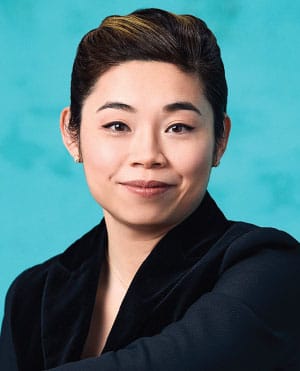
Elim Chan
Elim Chan embodies the spirit of contemporary orchestral leadership with her crystalline precision and expressive zeal. In May 2026 she was announced as the San Francisco Symphony’s next Music Director, a position she will begin in September 2027. She was recently appointed artistic partner with the Vienna Symphony for the 2026–27 and 2027–28 seasons, following her designation as portrait artist at the Musikverein in the 2022–23 season. Chan served as principal conductor of the Antwerp Symphony from 2019–24 and principal guest conductor of the Royal Scottish National Orchestra between 2018–23.
Chan made her San Francisco Symphony debut during the 2022–23 season in a program that included the world premiere of Elizabeth Ogonek’s Moondog, an SF Symphony commission. In June 2026, she made her first appearances as Music Director Designate, conducting two sold-out concerts featuring works by Wagner and Berlioz, and Debussy’s La Mer. She will return in January and June for further performances including the Orchestra’s first performances of Noriko Koide’s Swaddling Silk and Gossamer Rain and Augusta Read Thomas’s Sunlight Echoes. Her programs will also feature the San Francisco Symphony Chorus, Yefim Bronfman, Concertmaster Alexander Barantschik, and Principal Viola Jonathan Vinocour with works by Elgar, Prokofiev, Mozart, and Rachmaninoff.
Chan makes her Berlin Philharmonic debut this season, and also debuts with the Accademia Nazionale di Santa Cecilia in Rome, Leipzig Gewandhaus Orchestra, Royal Stockholm Philharmonic, NHK Symphony Orchestra, and Dallas Symphony. She conducts her first staged opera with John Adams’s Doctor Atomic at Zurich Opera House in a new production. In 2028, she will make her Vienna Philharmonic debut.
Recent debuts and upcoming re-invitations include the Boston Symphony, New York Philharmonic, Los Angeles Philharmonic, Cleveland Orchestra, Philadelphia Orchestra, Pittsburgh Symphony, Toronto Symphony, London Symphony, Royal Concertgebouw Orchestra, Staatskapelle Berlin, Dresden Staatskapelle, Munich Philharmonic, Bamberg Symphony, Orchestre de Paris, and Hong Kong Philharmonic.
Chan appeared at both the Lucerne and Salzburg festivals and conducted the First Night of the Proms with the BBC Symphony Orchestra in 2024 and returned in 2025 to conduct the Last Night of the Proms. With the Antwerp Symphony, she recorded All These Lighted Things for Alpha Classics, pairing the titular Elizabeth Ogonek work with pieces by Prokofiev and Ravel.
Born in Hong Kong, Chan studied at Smith College and the University of Michigan. In 2014, she became the first female winner of the Donatella Flick Conducting Competition and went on to spend her 2015–16 season as assistant conductor at the London Symphony. In the following season, Chan joined the Dudamel Fellowship program of the Los Angeles Philharmonic. She also owes much to the support and encouragement of Bernard Haitink, whose masterclasses she attended in Lucerne in 2015.
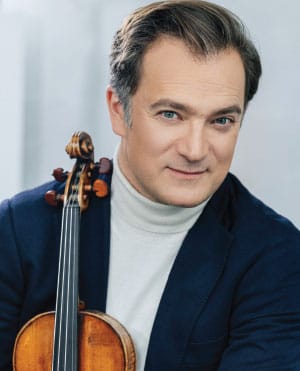
Renaud Capuçon
Renaud Capuçon solos this season with Orchestre Philharmonique de Radio France, the Royal Concertgebouw Orchestra, Boston Symphony, Leipzig Gewandhaus Orchestra, and Munich Philharmonic. As a conductor, Capuçon appears this season with the Toronto Symphony, where he is a spotlight artist, as well as with the Deutsches Symphonie-Orchester Berlin and Hungarian Radio Symphony.
Since 2021, Capuçon has been artistic director of the Orchestre de Chambre de Lausanne, where he both plays and conducts. This season, he leads the orchestra on a European tour with Martha Argerich and directs a Beethoven cycle marking the bicentenary of the composer’s death. He is also artistic director of Sommets Musicaux de Gstaad, the Easter Festival in Aix-en-Provence, and the Rencontres Musicales Festival in Evian. Since 2022, he has had a creative partnership recording for Deutsche Grammophon.
Capuçon regularly performs with the Berlin Philharmonic, Vienna Philharmonic, New York Philharmonic, Los Angeles Philharmonic, Filarmonica della Scala, London Symphony, Orchestre de Paris, Orchestre National de France, Budapest Festival Orchestra, and Yomiuri Nippon Symphony. He made his San Francisco Symphony debut in October 2011.
Born in Chambéry in 1976, Capuçon was appointed Chevalier de l’Ordre National du Mérite by the French government in 2011, and in 2016 was appointed Chevalier de la Légion d’honneur. He plays the Guarneri del Gesù “Panette” of 1737, which belonged to Isaac Stern.
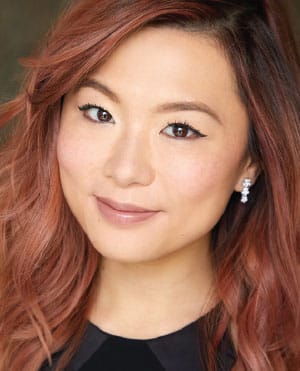
Jenny Wong
Jenny Wong is Chorus Director of the San Francisco Symphony and associate artistic director of the Los Angeles Master Chorale. Her conducting engagements have included the Los Angeles Philharmonic Green Umbrella Series, Los Angeles Opera Orchestra, Oregon Bach Festival, Long Beach Opera, Phoenix Chorale, and Gay Men’s Chorus of Los Angeles. In 2021, Wong was one of nine national recipients of Opera America’s inaugural Opera Grants for Women Stage Directors and Conductors.
As Chorus Director, Wong worked with Esa-Pekka Salonen and Michael Tilson Thomas, as well as numerous guest conductors. She has also prepared choruses for the Los Angeles Philharmonic and Chicago Symphony, working with conductors Gustavo Dudamel, Susanna Mälkki, Jonathan Cohen, and Osmo Vänskä, among many others. Wong led the SF Symphony Chorus for the Deutsche Grammophon recording of Kaija Saariaho’s Adriana Mater, which won the 2025 Grammy Award for Best Opera Recording, and helped prepare the Los Angeles Master Chorale for the Los Angeles Philharmonic’s recording of Mahler’s Symphony No. 8, which won the 2022 Grammy Award for Best Choral Performance. Together with Grant Gershon and the Los Angeles Master Chorale, Wong was also awarded the 2022 American Prize in Choral Performance.
Wong received her doctor of musical arts and master of music from the University of Southern California and an undergraduate degree in voice from the University of Illinois, Urbana-Champaign. She recently extended her contract as SF Symphony Chorus Director through the 2028–29 season.
San Francisco Symphony Chorus
The San Francisco Symphony Chorus was established in 1973 at the request of Seiji Ozawa, then the Symphony’s Music Director. The Chorus, numbering 32 professional and more than 120 volunteer members, now performs more than 26 concerts each season. Louis Magor served as the Chorus’s director during its first decade. In 1982 Margaret Hillis assumed the ensemble’s leadership, and the following year Vance George was named Chorus Director, serving through 2005–06. Ragnar Bohlin concluded his tenure as Chorus Director in 2021, a post he had held since 2007. Jenny Wong was named Chorus Director in September 2023.
The Chorus can be heard on many acclaimed San Francisco Symphony recordings and has received Grammy Awards for Best Performance of a Choral Work (for Orff’s Carmina burana, Brahms’s A German Requiem, and Mahler’s Symphony No. 8), Best Classical Album (for a Stravinsky collection and for Mahler’s Symphony No. 3 and Symphony No. 8), and most recently Best Opera Recording (for Saariaho’s Adriana Mater).
Lead support for the San Francisco Symphony Chorus this season was provided by Peter G. Neumann.
To learn more about supporting the San Francisco Symphony Chorus Fund, please contact Jay Auslander, Director of Legacy Giving, at 415.503.5404 or jauslander@sfsymphony.org.
Benjamin Pesetsky is Associate Director of Editorial and Inside Music Talks for the San Francisco Symphony. He has written program notes for the St. Louis Symphony, Philadelphia Orchestra, and Melbourne Symphony. He holds degrees in composition and philosophy from Bard College Conservatory and Bard College.
San Francisco Symphony Chorus
SOPRANOS
Elaine Abigail
Adeliz Araiza
Naheed Attari
Sylvia V. Baba
Morgan Balfour*
Arlene Boyd
Olivia T. Brown
Laura Canavan
Rebecca Capriulo
Sara Chalk
Phoebe Chee*
Tonia D’Amelio*
Andrea Drummond
Elizabeth Emigh
Camryn Finn*
Cara Gabrielson*
Susanna Gilbert
Julia Hall
Ashley Hecht
Axelle Heems
Hyun Suk Jang
Betsy Johnsmiller
Jocelyn Queen Lambert
Becky Lau
Ellen Leslie*
Caroline Meinhardt
Jennifer Mitchell*
Ria Patel
Bethany R. Procopio
Kelly Ryer
Rebecca Shipan
Elizabeth L. Susskind
Daphne Touchais*
Sigrid Van Bladel
Cristina Villalobos
ALTOS
Carolyn Alexander
Melissa Butcher
Marina Davis*
Shauna Fallihee*
Corty Fengler
Leah Finn*
Amy L. Hespenheide
Emily (Yixuan) Huang
Kelsey M. Ishimatsu Jacobson
Hilary Jenson
Cathleen Josaitis
Gretchen Klein
Joyce Lin-Conrad
Madi Lippmann
Margaret (Peg) Lisi*
Brielle Marina Neilson*
Kimberly J. Orbik
Lindsay Marie Rader
Celeste Riepe
Jeanne Schoch
Kathryn Schumacher
Sandy Sellin
Kyle S. Tingzon*
Mayo Tsuzuki
Makiko Ueda
Merilyn Telle Vaughn*
Heidi L. Waterman*
Hannah J. Wolf
Michelle Zheng
TENORS
Paul Angelo
Carl A. Boe
Alexander P. Bonner
Seth Brenzel*
Scott Dickerman
Thomas L. Ellison
Christian Emigh
Sam Faustine*
Patrick Fu
Kevin Gibbs*
Alec Jeong
Drew Kravin
James Lee
Benjamin Liupaogo*
Joachim Luis*
Andrew P. McIver
Mark Mueller*
Jack O’Reilly
David Kurtenbach Rivera*
Tetsuya Taura
David von Bargen
Nicholas Weininger
Jack Wilkins*
John Paul Young
Jakob Zwiener
BASSES
Matthew Ahn
Simon Barrad*
Sean Brooks
Phil Buonadonna
Robert Calvert
Sean Casey
Adam Cole*
Noam Cook
Malcolm Gaines
Vasco Hexel
Rob Lloyd Huber
Yitao Lin*
Roderick Lowe
Hugo Mendel
Clayton Moser*
Case Nafziger
Bradley C. Parese
Matthew C. Peterson*
Michael Prichard
Timothy Echavez Salaver
Chung-Wai Soong*
Storm K. Staley
Connor Tench
David Varnum*
Julia Vetter
Nick Volkert*
Elliot Yates
*Member of the American
Guild of Musical Artists
Jenny Wong,
Chorus Director
Keisuke Nakagoshi,
Rehearsal Accompanist
John Wilson,
Rehearsal Accompanist