In This Program
The Concert
Friday, September 18, 2026, at 7:30pm
Saturday, September 19, 2026, at 7:30pm
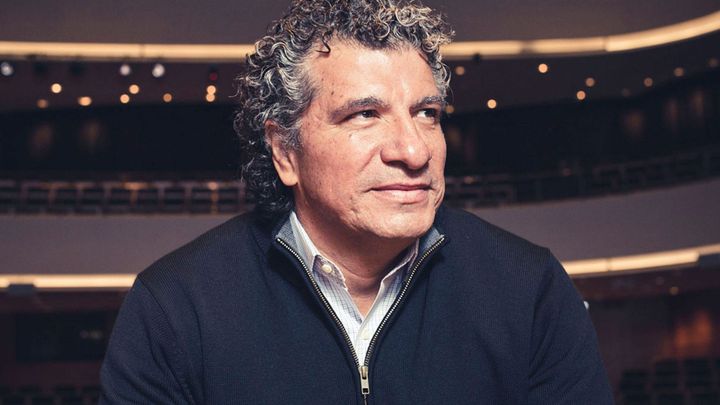
Inside Music Talk with Benjamin Pesetsky
On stage at 6:30pm before each performance
David Afkham conducting
Unsuk Chin
subito con forza (2020)
Robert Schumann
Symphony No. 4 in D minor, Opus 120 (1841/51)
Ziemlich langsam–Lebhaft (Fairly slow–Lively)
Romanze: Ziemlich langsam (Romance: Fairly slow)
Scherzo: Lebhaft (Scherzo: Lively)
Langsam–Lebhaft (Slow–Lively)
Intermission
Johannes Brahms
Piano Concerto No. 1 in D minor, Opus 15 (1858)
Maestoso
Adagio
Rondo: Allegro non troppo
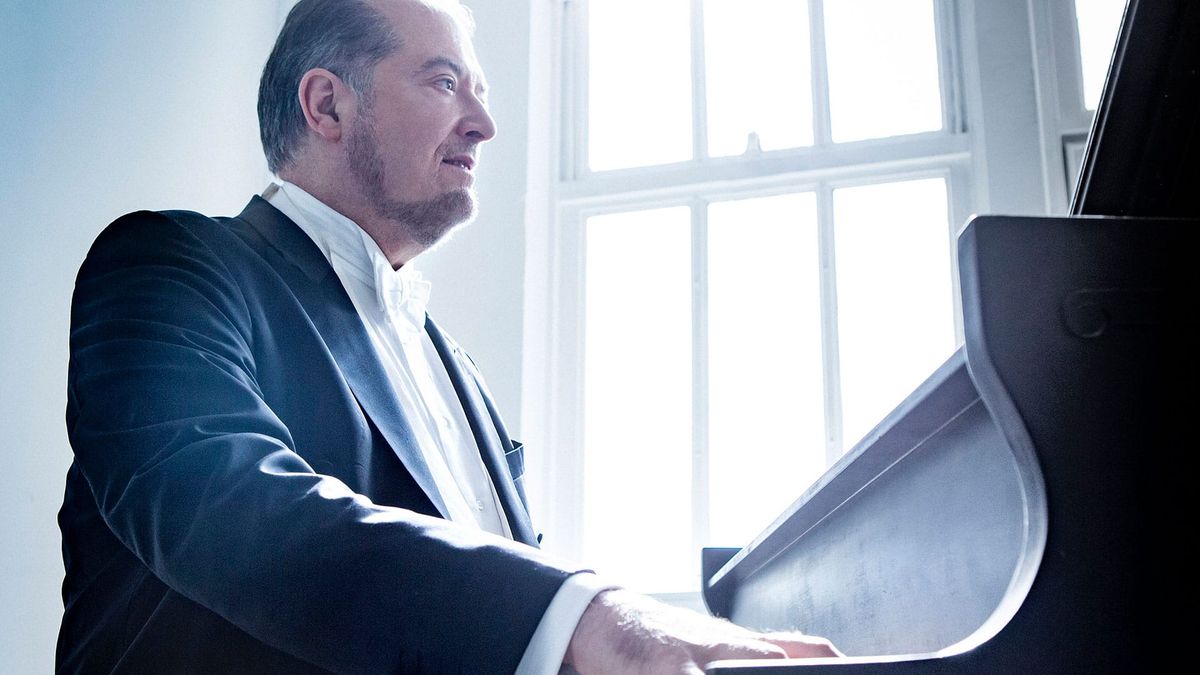
Garrick Ohlsson
Program Notes
subito con forza
Unsuk Chin
Born: July 14, 1961, in Seoul
Work Composed: 2020
SF Symphony Performances: First and only—November 2021. Gustavo Gimeno conducted.
Instrumentation: 2 flutes, 2 oboes, 2 clarinets, 2 bassoons, 2 horns, 2 trumpets, timpani, percussion (triangle, cymbals, tam-tam, tambourine, snare drums, whip, guiro, crotales, gongs, tubular bells, vibraphone, xylophone, marimba), piano, and strings
Duration: About 6 minutes

Ludwig van Beethoven was one of Unsuk Chin’s favorite composers when she began learning about classical music as a youngster in Seoul in the 1960s. The daughter of a minister, she taught herself piano. Her family had no money for records or music lessons. One reason Beethoven appealed to her, Chin has explained, is that “he was constantly looking for new directions” and “for original solutions, even if this meant breaking through existing forms.”
Chin studied composition at Seoul National University with Sukhi Kang. In 1985, her graduation work Spektra won first prize in the Gaudeamus competition in the Netherlands. That same year, she moved to Hamburg to study with György Ligeti. She went on to settle in Berlin, where she has lived ever since.
Chin emerged from the post-Ligeti generation as a fiercely independent voice. In her music, fantasy and imagination blend with an extraordinary sensitivity to timbral nuance and its psychological and theatrical ramifications. “My music is a reflection of my dreams,” she has said. She describes visions of “immense light” and “an incredible magnificence of colors,” forming what she calls “a fluid sound sculpture.” Its beauty may be “abstract and remote,” she adds, but it can still “address the emotions and . . . communicate joy and warmth.”
Chin returned to Beethoven in his fateful 250th anniversary year of 2020 with subito con forza, written on a joint commission from BBC Radio 3, the Kölner Philharmonie, and the Royal Concertgebouw Orchestra. Despite the pandemic restrictions that disrupted so many of the anniversary celebrations, the premiere went ahead in September at the Concertgebouw in Amsterdam, with Klaus Mäkelä conducting the orchestra before a small audience. It has since become Chin’s most frequently performed work.
Along with Beethoven’s music itself, Chin drew on the conversation books through which he communicated after his hearing had deteriorated. One cryptic entry caught her attention: “Major and minor. I am the winner.”
Subito con forza refers to a performance instruction Beethoven frequently used: literally, “suddenly with power.” The phrase suits a score that abounds in eruptions and contrasts. The scoring itself glances back toward Beethoven: Chin uses a Classical-era palette but expands it with piano and a large array of percussion.
As Chin explains, “Beethoven’s struggle to communicate and his hearing loss frequently resulted in an inner rage and frustration. What particularly appeals to me are the enormous contrasts: from volcanic eruptions to extreme serenity. It profoundly and poignantly speaks of something fundamental about the human condition.”
The opening gesture alludes to the stark, emphatically forceful chords that launch Beethoven’s Coriolan Overture from 1807. The piece then explodes into a parallel but unfamiliar universe of chiming percussion and extended techniques before quickly guttering into ghostly shivering in the strings.
Rich in texture and ideas, this piece explores the untapped possibilities in Beethoven’s raw material—multiple other paths not taken. These are subjected to the incandescent fire of Chin’s own orchestral technique and imagination.
—Thomas May
Symphony No. 4 in D minor, Opus 120
Robert Schumann
Born: June 8, 1810, in Zwickau, Saxony
Died: July 29, 1856, Endenich, near Bonn
Work Composed: 1841 (rev. 1851)
SF Symphony Performances: First—November 1917. Alfred Hertz conducted. Most recent—May 2016. Michael Tilson Thomas conducted.
Instrumentation: 2 flutes, 2 oboes, 2 clarinets, 2 bassoons, 4 horns, 2 trumpets, 3 trombones, timpani, and strings
Duration: About 28 minutes
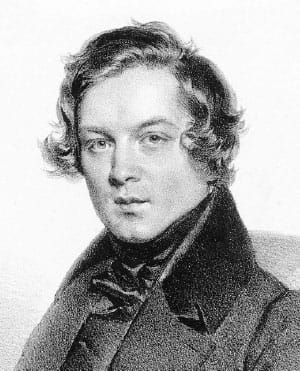
If 1840 was Robert Schumann’s Year of Song—the year he married Clara Wieck, after a long and nasty legal battle with her father, his former landlord and piano teacher—then Schumann would devote 1841 to orchestral music, at the explicit command of his brilliant young bride, a world-famous pianist, accomplished composer, and former child prodigy. By that point she had been urging him to write symphonies for years.
“His compositions are all orchestral in feeling,” she wrote in her diary toward the end of their protracted engagement. “My wish is that he should compose for orchestra—that is his field! May I succeed in bringing him to it.”
In 1841 he seemed well on his way. In January he wrote the first draft of his First Symphony (Spring) in a staggering four days. His friend Felix Mendelssohn led the Leipzig Gewandhaus Orchestra in the successful premiere a few months later. Then, during a single week in early June, Schumann put the finishing touches on a symphony in D minor. At the time, he had no reason not to think that this would be his second symphony, but he called it his “Clara Symphony” to honor his most essential musical ally. She recorded in a contemporaneous diary entry: “I have heard nothing of it as yet, but from seeing Robert’s doings, and from hearing a D minor echoing wildly in the distance, I know in advance that this will be another work that is emerging from the depths of his soul.”
Robert presented the symphony to his bride as a gift for her 22nd birthday in September. “My birthday was a day filled from morning to night with enjoyment and happiness,” she wrote.
Although his new symphony contained the conventional four movements, the lack of pauses made it harder to discern beginnings and endings, the minimal guideposts of symphonic form. By the time we realize that the Romanze has started, it’s too late to look back: the lullaby-like second movement has got us in its sway.
His goal was cyclical unity: an unbroken, continuous stream of music that coheres across wild shifts in mood and style. He achieved this by lavishing his attention on transitions and liminal spaces, the way each musical passage flows into the next.
He finished the orchestration in early October, and the Leipzig Gewandhaus Orchestra performed the premiere on December 6, 1841. Unfortunately, Mendelssohn was not available to conduct it, and the orchestra was under-rehearsed. Despite some positive reviews, Schumann’s publisher declined to release it. He set it aside for a decade and enjoyed moderate success with his next two symphonies. When he finally picked it up again, in 1852, he was barely holding on to what would be the last job of his life, directing a municipal orchestra in Düsseldorf.
While orchestrating an unfinished symphony in D minor by another composer, he was inspired to revisit his own D-minor symphony. By deepening its instrumental textures and reinforcing the transitions, especially the passage connecting the third movement to the finale, he readied the score for its re-début at the Lower Rhine Music Festival on May 15, 1853.
Although the original 1841 iteration has always had its champions, among them Johannes Brahms (who published the original score against Clara’s wishes), the 1853 revision is programmed today. Its premiere marked one of Schumann’s last professional triumphs.
The Music
Schumann’s Symphony No. 4 begins with a sinuous rising-and-falling figure, the “Clara” theme, first sung by the second violins and bassoons. Derived from one of Clara’s own compositions, Romance varié for solo piano (1833), the tune appears in various guises throughout the symphony.
The fantasia-like first movement is marked Ziemlich langsam–Lebhaft (Fairly slow–Lively). Murmured threats from the winds over rumbling timpani: a shock of petrichor. When the music brightens from D minor to F major, the obsessive “Clara” theme seems to expand and unwind, inviting more optimistic outcomes until a doomy trombone motif emerges. Woodwinds and violins riff on the pattern, creating pastoral overlays, and the movement resolves optimistically, in D major.
The second movement is marked Romanze: Ziemlich langsam (Romance: Fairly slow). The slow, songlike, triple-time interlude begins with a flickering A-minor chord, a tart contrast to the bold D major that capped off the first movement. Schumann simulates the dreamy, improvisatory quality of balcony-lurking troubadours. The movement begins with a shadowy duet for solo oboe and cello before morphing into a melancholy variation on the earlier “Clara” motif. Playing off an inversion of that idea, a solo violin erupts in an ecstatic aria, but soon enough the oboe and cello return for their bluesy refrain.
The third movement, marked Lebhaft (Lively), is a big, galumphing scherzo. In the contrasting central section—instead of the conventional trio section—Schumann resurrects the rhapsodic violin theme from the second movement, only this time it’s played by the entire string section. After an expansive development, a dotted-rhythm motif from the first movement spawns an ornate fugue as the theme ricochets among instrumental groups like a sunbeam in a cathedral of mirrors.
The finale, marked Langsam–Lebhaft (Slow–Lively), repurposes the format of the first movement, along with a few of its profuse melodies. It eludes the turmoil of the introduction and finds its bliss as the horns guide the “Clara” motif to its gleaming apotheosis. Schumann even proposes an entirely new melodic idea in the exuberant coda, as if to say that his best ideas were still to come. Sadly, they were not.
Piano Concerto No. 1 in D minor
Johannes Brahms
Born: May 7, 1833, in Hamburg
Died: April 3, 1897, in Vienna
Work Composed: 1854–58
SF Symphony Performances: First—March 1926. Alfred Hertz conducted with Harold Bauer as soloist. Most recent—November 2022. Michael Tilson Thomas conducted with Emanuel Ax as soloist.
Instrumentation: solo piano, 2 flutes, 2 oboes, 2 clarinets, 2 bassoons, 4 horns, 2 trumpets, timpani, and strings
Duration: About 28 minutes
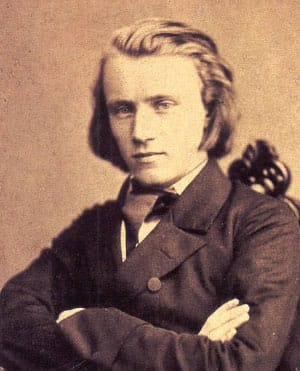
Johannes Brahms’s Piano Concerto No. 1 is a radical, turbulent work with a long and tortured gestation period. During the nearly five years that elapsed between the preliminary sketches and the final revisions, Brahms was living out a soap opera.
In winter 1854, his cherished mentor Robert Schumann threw himself into the Rhine and, by his own request, was sent to a sanatorium, where he would spend the rest of his life in virtual exile, deteriorating until he was nearly catatonic. Sadder still, his doctors prohibited visits from his wife, Clara, with whom he had seven children.
As soon as he heard about Robert’s suicide attempt, Brahms rushed to the family’s aid, living among them and helping out where he could. He and Clara became more than friends, if not quite lovers. Although she was nearly 14 years his senior, Brahms wrote her countless ardent letters. Yet when Robert died, in July 1856, Brahms did not ask her to marry him and made it clear that he never would. Clara remained his chief muse, collaborator, and confidante, but he craved freedom.
The Music
Before this music was a concerto, it was conceived as a sonata for two pianos and then a symphony. Brahms, an inexperienced orchestrator in his early 20s, became blocked and put the project aside for two years until Robert’s death compelled him to revisit it. He struggled with the score, now a piano concerto, for another three years, scrapping most of his preliminary efforts but retaining the tumultuous opening.
The first movement is in sonata form, but only to a point. There are wrenching breaks, themes shoving each other aside in the harmonic welter. The first measures are studded with “devilish” tritone intervals, shockingly dissonant to Brahms’s contemporaries and still unsettling today.
The serene and radiant Adagio originally bore a religious inscription, a benediction from the Latin mass. Devotional in tone, the second movement is both an elegy for Robert and a “tender portrait,” in Brahms’s own words, of Clara, whom he had once described as “going to the concert hall like a priestess to the altar.” The assertive, driving finale follows a traditional rondo form and seems particularly indebted to Beethoven’s Piano Concerto No. 3.
Even after all the angst surrounding the composition of the First Piano Concerto, Brahms was feeling hopeful about its first performances. He was the soloist, and rehearsals had gone smoothly. But after a coolly polite reception in Hanover, its official premiere at the Leipzig Gewandhaus was an unqualified disaster. He played well, but everyone, even the conductor, hated the music. Brahms tried to take it in stride, writing in a letter that “the failure has made no impression whatsoever on me. . . . After all, I’m only experimenting and feeling my way as yet. But the hissing was too much of a good thing, wasn’t it?”
Despite his attempt at humor, the failure rattled him. He continued to compose, in his painstaking way, but he waited nearly a decade before he offered the public a work of similar ambition.
—René Spencer Saller
About the Artists
David Afkham
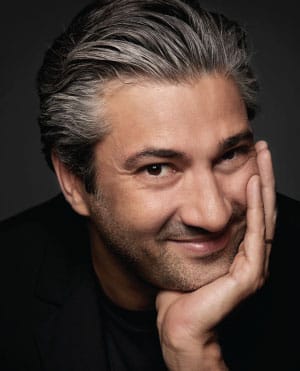
David Afkham recently concluded his tenure as chief conductor and artistic director of the Spanish National Orchestra, having first been appointed as principal conductor in 2014. In recognition of his leadership, he was awarded the Order of Alfonso X the Wise, one of Spain’s highest civilian distinctions in culture, education, and science.
In Europe, Afkham has appeared with the Royal Concertgebouw Orchestra, London Symphony, Philharmonia Orchestra, Bavarian Radio Orchestra, Munich Philharmonic, Berlin Staatskapelle, Deutsches Symphonie-Orchester Berlin, Vienna Symphony, Orchestre National de France, and Orchestra dell’Accademia Nazionale di Santa Cecilia. In the United States, he has led the Cleveland Orchestra, Chicago Symphony, Boston Symphony at Tanglewood, St. Louis Symphony, Los Angeles Philharmonic, Philadelphia Orchestra, Minnesota Orchestra, and Pittsburgh Symphony. In the opera sphere, he has conducted productions at Deutsche Oper Berlin, Seattle Opera, Dresden Semperoper, the Glyndebourne Festival, and Teatro Real Madrid, among other companies. He made his San Francisco Symphony debut in October 2025.
Highlights this season include Afkham’s debut at the BBC Proms with the Spanish National Orchestra. He also returns to the ensemble for two further projects, as well as to the St. Louis Symphony, the Seattle Symphony, and the Deutsches Symphonie-Orchester Berlin. He debuts with the Baltimore Symphony and leads two projects with the Hamburg Symphony.
Born in Freiburg, Germany, Afkham began piano and violin lessons at an early age. He was the first recipient of the Bernard Haitink Fund for Young Talent, won first prize at the Donatella Flick Conducting Competition in 2008, and was the inaugural recipient of the Nestlé and Salzburg Festival Young Conductors Award in 2010.
Garrick Ohlsson
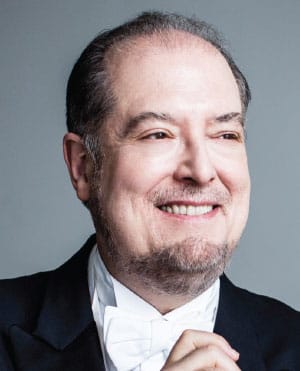
Since his triumph as winner of the 1970 Chopin International Piano Competition, Garrick Ohlsson has established himself as a musician of magisterial interpretive and technical prowess. Long regarded as one of the world’s leading exponents of the music of Frédéric Chopin, Ohlsson commands an enormous repertoire which ranges over the entire piano literature.
This season, Ohlsson will return as a guest soloist to the Denver Symphony, Baltimore Symphony, Montreal Symphony, Houston Symphony, and Madison Symphony, culminating in a spring appearance with Orpheus Chamber Orchestra at 92Y in New York, where he will play and direct both piano concertos of Chopin.
Ohlsson’s recording with the Takács Quartet of the Edward Elgar and Amy Beach piano quintets won Gramophone’s 2021 Classical Music Award for chamber music. His 10-disc set of the complete Beethoven sonatas has garnered critical acclaim, including a Grammy Award for Vol. 3. In November, Universal Music Group will re-release his 16-disc set of the complete works of Chopin.
Ohlsson studied at the Juilliard School and was awarded the Avery Fisher Prize in 1994 and the University Musical Society (University of Michigan) Distinguished Artist Award in 1998. He was the 2014 recipient of the Jean Gimbel Lane Prize in Piano Performance from Northwestern University, and in August 2018, the Polish government awarded him the Gloria Artis Gold Medal for Cultural Merit. He is a Steinway Artist and lives in San Francisco, where he serves on the piano faculty of the San Francisco Conservatory of Music. He made his San Francisco Symphony debut in May 1972.
Benjamin Pesetsky is Associate Director of Editorial and Inside Music Talks for the San Francisco Symphony. He has written program notes for the St. Louis Symphony, Philadelphia Orchestra, and Melbourne Symphony. He holds degrees in composition and philosophy from Bard College Conservatory and Bard College.