In This Program
- Welcome
- Welcoming New Musicians
- The Bridge: Alexander Barantschik
- Suddenly Now: Unsuk Chin
- Meet the Musicians
- Community Connections
- Print Edition
 San Francisco Symphony
 San Francisco Symphony
 San Francisco Symphony
 San Francisco Symphony
 San Francisco Symphony
 San Francisco Symphony
 San Francisco Symphony
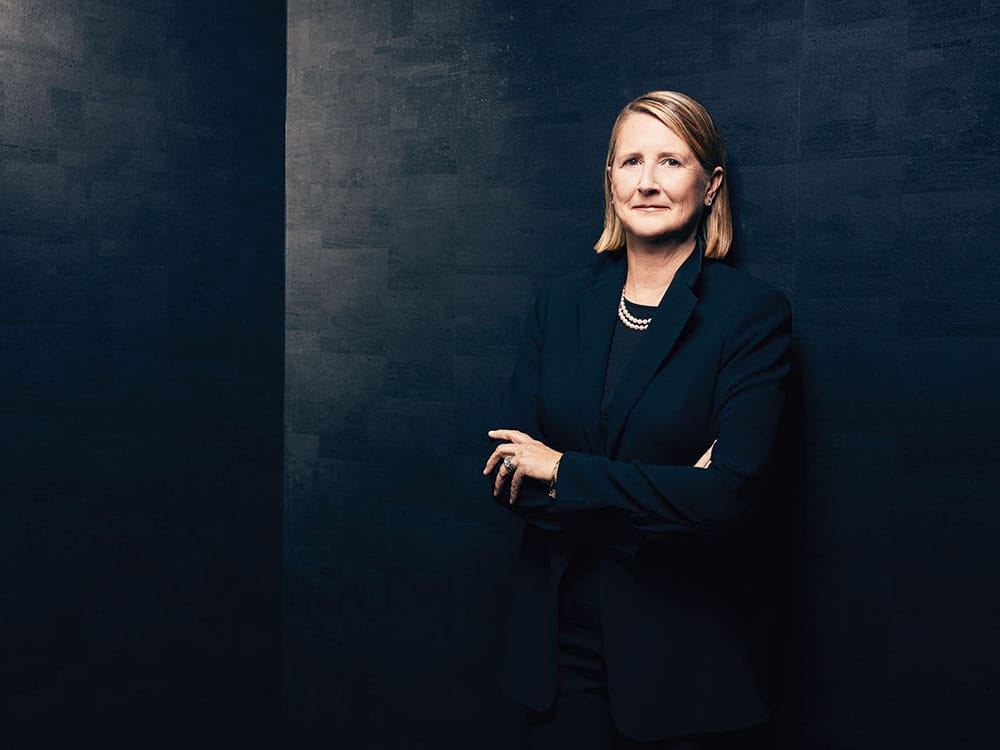
Welcome
Welcome to the 2026–27 season! This is an exciting period of artistic momentum for the San Francisco Symphony as we look ahead to a season that builds on the Symphony’s longstanding spirit of curiosity and innovation while offering a glimpse of the artistic direction taking shape in the years ahead.
That spirit is reflected throughout this season’s programming. We continue to expand the possibilities of the concert experience, bringing dance, puppetry, and visual storytelling into the concert hall though collaborations with Alonzo King LINES Ballet, director Janni Younge, and photographer and videographer Deborah O’Grady.
The Symphony thrives on partnerships that broaden the ways we engage with music and the world around us. We are thrilled to deepen our relationship with composer Gabriella Smith as our 2026-27 Creative Partner. Gabriella brings a passion for conservation and a desire to connect artists, audiences, and the community through experiences in and beyond the concert hall.
This season also showcases the artistic imagination Elim Chan will bring as our next Music Director. When she returns in October, she will lead the kind of richly devised program that hints at the exciting journey ahead.
The next chapter of the San Francisco Symphony is already underway. We look forward to experiencing it with you.
Priscilla B. Geeslin
Chair, San Francisco Symphony
Community Connections
Bringing Music to All San Francisco
The All San Francisco Concert, presented in partnership with the San Francisco Arts Commission, is a dedicated performance for Bay Area nonprofit, social services, and community organizations, in recognition and gratitude for the work these groups do for the citizens of our region. Created in 1980 by veteran philanthropist and San Francisco Symphony Life Governor Ellen Magnin Newman and led by an advisory committee of local nonprofit and community leaders, the concert is a pillar of the Symphony’s community programs. Visit sfsymphony.org/allsf for a listing of this year’s All San Francisco Committee.
The Ellen Magnin Newman Award is presented annually to a Bay Area community-based organization that strengthens our region’s cultural fabric and serves families and individuals to create a more just and equitable society for everyone who lives here.
This year, the All San Francisco Committee is proud to honor Cultura y Arte Nativa de las Americas (CANA), an organization that for more than 40 years has preserved and celebrated the many heritages of the Latino, Caribbean, and African diasporas in the San Francisco Bay Area through relevant dance, music, and art programming, and by creating spaces for community learning, advocacy, and human services. By producing events like Carnaval San Francisco, CANA stands as a beacon of hope for the stewardship of cultural traditions and the creation of a new, more inclusive American culture.
Learn more at canasf.org.
The San Francisco Symphony thrives on collaboration, and we’re proud to work with the most creative, innovative groups and individuals shaping the Bay Area today.
Welcoming New Musicians
News & Notes
The San Francisco Symphony welcomes four new musicians to the Orchestra’s roster in the 2026–27 season.
Jung-Eun Shin joins the Symphony as Associate Principal Second Violin. A native of South Korea, Shin has been based in Germany for much of her professional career, and most recently served as first concertmaster of the Augsburg Philharmonic.
Michael Stevens becomes the Symphony’s Associate Principal Horn, having served as acting principal horn and associate principal horn during the 2025–26 season. He was previously principal horn of the Rochester Philharmonic.
James Benoit joins the Symphony as Assistant Principal Timpani/Section Percussion. He previously served as principal timpani of the Pittsburgh Symphony and Seattle Symphony.
Section Cello Starla Breshears (Gary & Kathleen Heidenreich Second Century Campaign Chair), whose appointment was announced in March, also joins the Orchestra with the start of the 2026–27 season.
For more on the San Francisco Symphony musicians, visit sfsymphony.org/musicians.
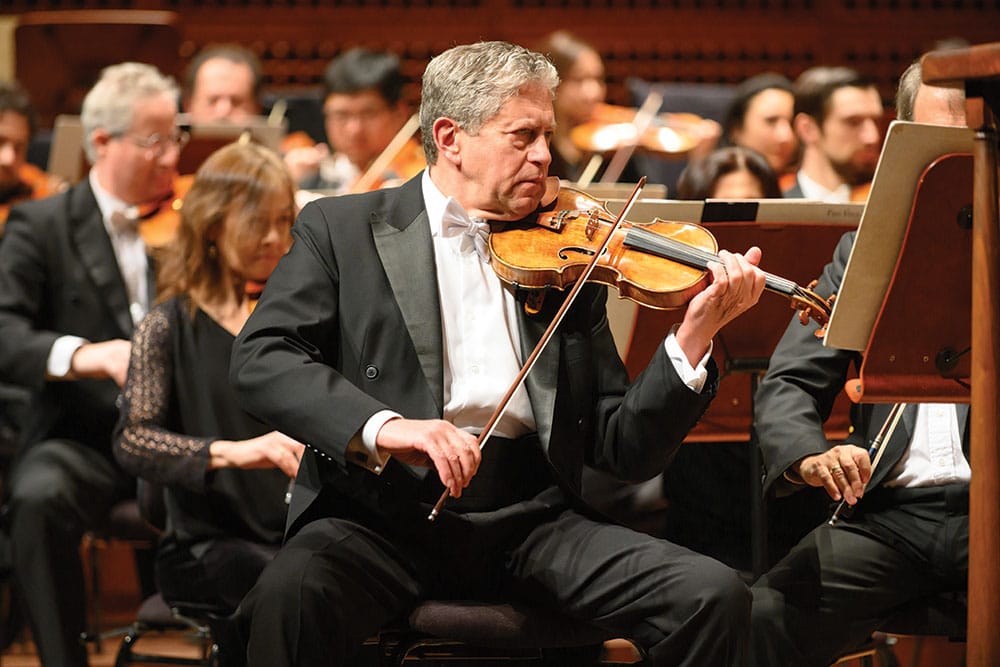
The Bridge
Alexander Barantschik on celebrating 25 years with the San Francisco Symphony, what it means to be a concertmaster, and creating musical miracles every performance. • By Steve Holt
OVER A QUARTER CENTURY in the San Francisco Symphony concertmaster’s chair, has the job changed very much?
Alexander Barantschik laughs. “It changes from concert to concert!”
The basics of the job are still very much the same as they were in 2001, when he came to San Francisco. There’s a great deal the audience never sees: going over the music, editing the bowings if necessary, especially if the piece is new (and the SF Symphony performs its share of new music). Onstage, the concertmaster plays the orchestral violin solos, frequently some of the most well-known and well-loved parts of the classical repertoire.
But Barantschik, known familiarly as Sasha, says his most important task is “to be a bridge from the conductor to the orchestra.” And that’s where the constant changes come in.
“Every conductor has his or her own tempi and wishes. So for us in the orchestra, flexibility is the key. We constantly need to adjust to the reality that not only is every conductor different, every conductor is different every night. Yes, we always sound like the San Francisco Symphony, but looking and listening, and constantly being on alert is the task of every musician in the orchestra, especially the concertmaster and the other section principal players.”
Barantschik says this level of focus is required even in repertoire standards like Beethoven’s Ninth Symphony, which the Symphony performed last June. “It’s one of the most complex pieces in the repertoire. There’s a big orchestra, a large chorus, and four soloists. You could almost say the concertmaster’s task is to read the minds of the conductor and the singers, and help communicate their needs to the players.”
He relishes the excitement and variability of live performance. “The audience is witnessing the creation of music, all the way from silence into emotions. It’s a pretty fascinating process. Musicians read those little black dots on the page as someone on the podium waves their hands, and the result is a deep range of emotions the listener feels. Isn’t that a miracle? I think it is.”
Another miracle is the one Sasha tucks under his chin for every performance: a 1742 Guarneri del Gesù violin, graciously on loan from the Fine Arts Museums of San Francisco.
“It is a blessing, a great privilege, and a great honor to play this violin, which at one time belonged to the legendary Jascha Heifetz. Before that, it was played in the premiere of the Mendelssohn Violin Concerto. The story goes that Heifetz owned two priceless instruments, this one, and a Stradivarius. An interviewer asked him why he preferred to perform with the Guarneri, and he said, ‘I get better reviews with it.’ I don’t know if that’s true, but it’s a good story!”
Barantschik’s story began in Leningrad (now St. Petersburg), where he attended the conservatory and performed with the symphony. After immigrating to the West, he became concertmaster with the Bamberg Symphony, the Netherlands Radio Philharmonic, and then the London Symphony Orchestra.
That was where he met Michael Tilson Thomas for the first time, beginning a long musical journey together. Tilson Thomas had just been named principal conductor of the LSO and the orchestra was set to record Strauss’s Ein Heldenleben. “We actually met in a recording studio. It was in the middle of a very cold season in London, and we both were wearing very warm, completely identical Irish cardigans. We looked at each other and said, ‘That’s a good start!’ It was a good start indeed. And the rest is history, of course.”
Tilson Thomas made his way to San Francisco and within a few years had brought on Barantschik as concertmaster. The two were close collaborators throughout MTT’s 25 years at the helm. “There are countless, unforgettable concerts with him that live vividly in my memory,” Barantschik says. “I cherish those memories.”
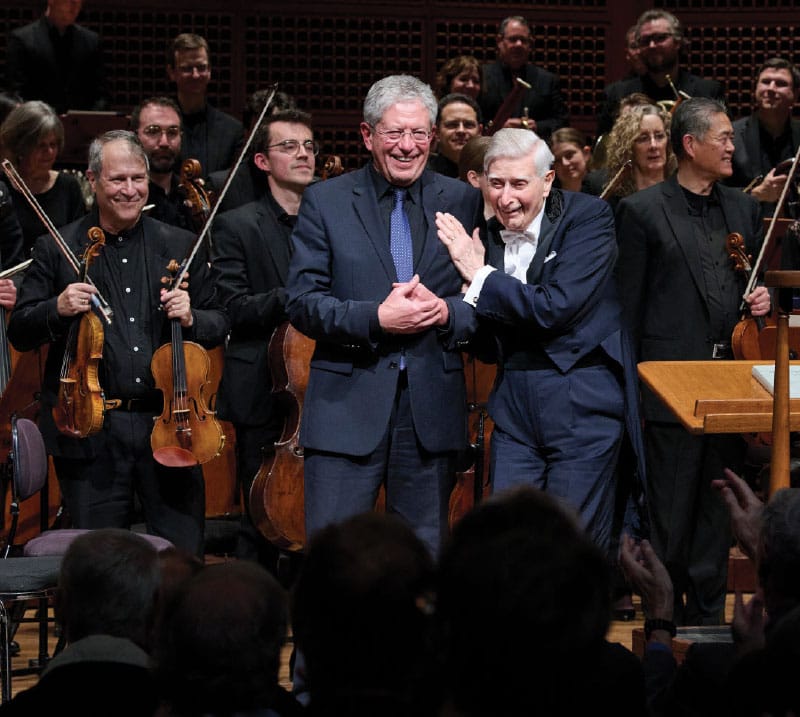
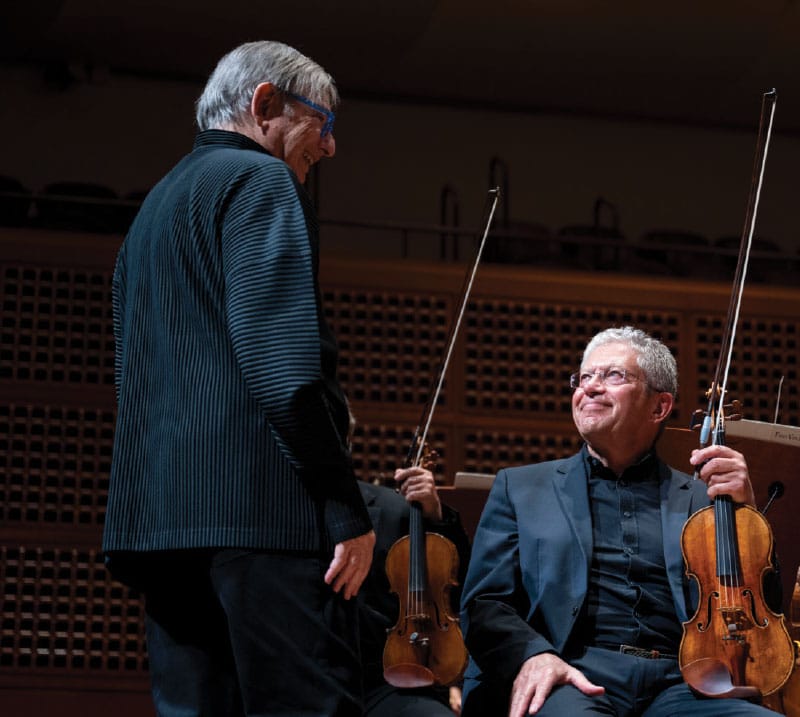
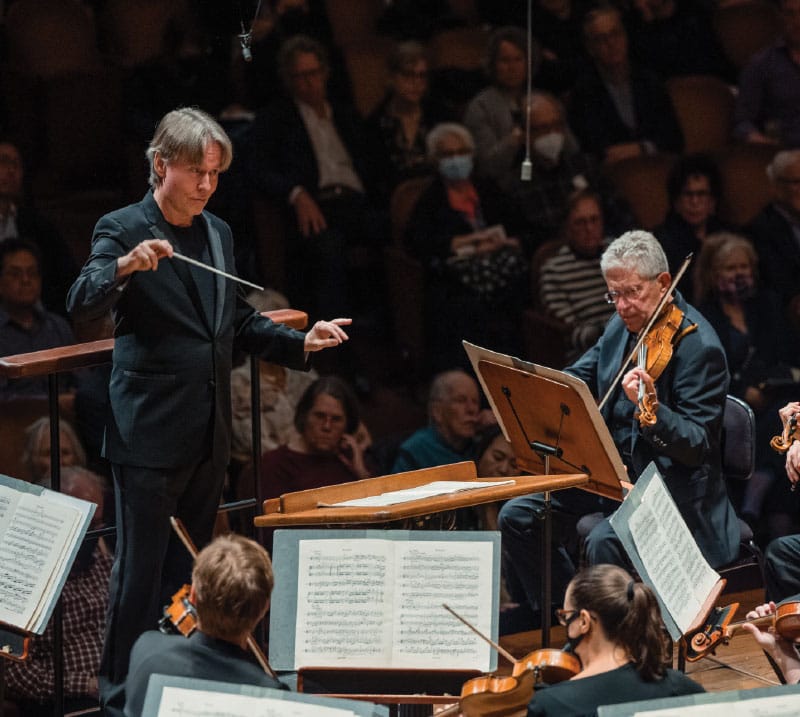
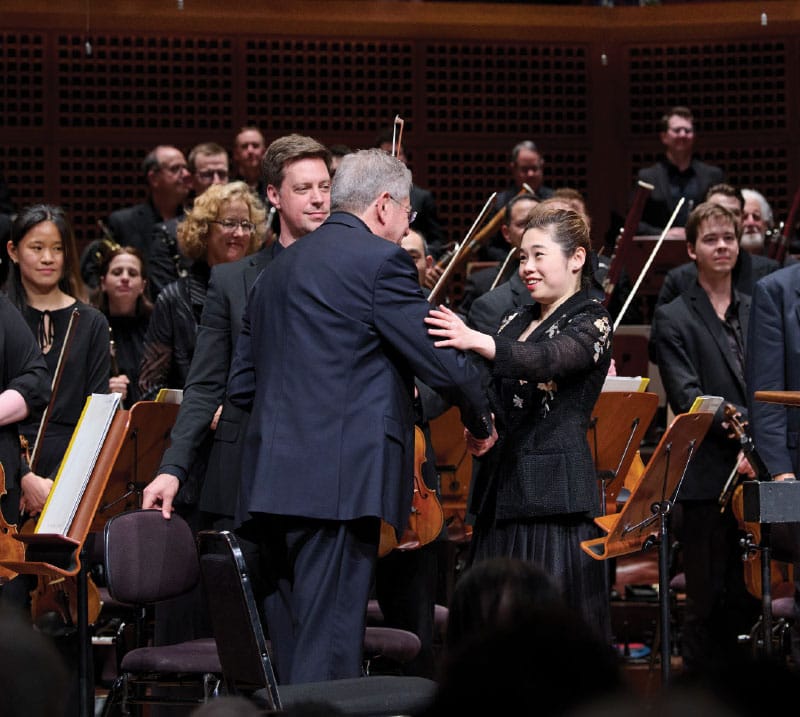
Alexander Barantschik with four San Francisco Symphony music directors. Clockwise from top left: Herbert Blomstedt, 2025. Photo: Stefan Cohen; Michael Tilson Thomas, 2023. Photo: Christopher M. Howard; Elim Chan, 2026. Photo: Stefan Cohen; Esa-Pekka Salonen, 2023. Photo: Brandon Patoc
In addition to MTT, Barantschik has performed with many of the other giants of the podium, from Leonard Bernstein to Georg Solti, Claudio Abbado to Seiji Ozawa, and Colin Davis to Herbert Blomstedt.
He is eager to work with the Symphony’s recently appointed music director, Elim Chan. “There is a lot of interest, curiosity, and enthusiasm about her appointment. She recently led us in La Mer by Debussy, and it was nothing short of phenomenal. Even before she started conducting, when she just came on stage, the whole atmosphere was electric!”
In addition to Chan’s concerts in October, Barantschik is also looking forward to an April 2027 program led by former SF Symphony Music Director Esa-Pekka Salonen featuring Berlioz’s Symphonie fantastique, which he calls “one of my favorite pieces.”
While acknowledging the challenges facing orchestras post-pandemic, Sasha is bullish on the future. “Things go up and down in culture, but after these difficult years, I feel a genuine interest in classical music in the Bay Area. I see a lot of young faces in the audience every night, which is, of course, encouraging. Elim is planning a very well-balanced combination of old, beautiful pieces that everyone knows, and new music. I know she is very capable of doing both.”
He’s also encouraged by the changing face of the Orchestra. “Recently, many players have decided to retire but we’ve been able to attract major talents from around the world. All the young people that we’ve hired are really incredible. The orchestra is in phenomenal shape. So Elim Chan is getting a perfect instrument. It’s like giving a violinist a Guarneri del Gesù: in a pair of skillful hands, the sky is the limit!”
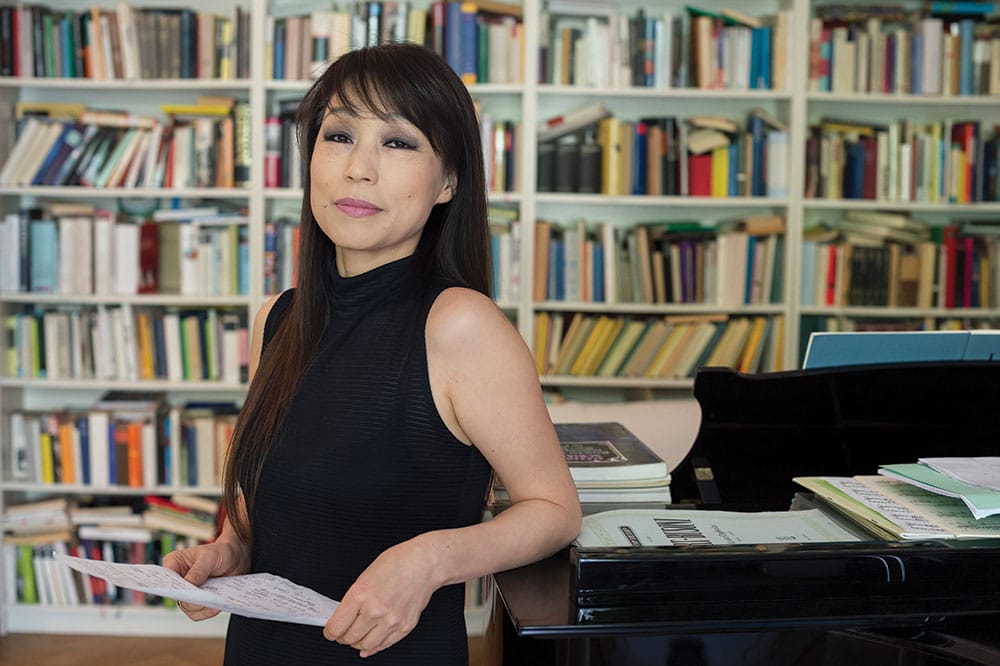
Suddenly Now
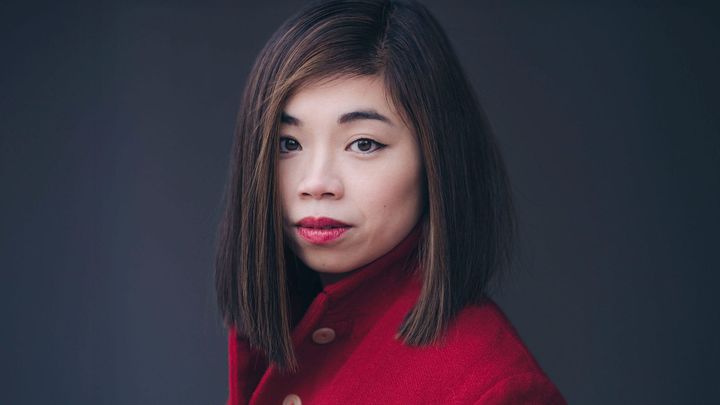
Unsuk Chin on collaboration, writer’s block, and evolving as a composer
What was your first experience with the San Francisco Symphony?
I know [the Symphony] from a range of excellent recordings, including Stravinsky and Ives recordings with MTT, discs with Edo de Waart as conductor and Zoltán Kocsis as a soloist, and several Blomstedt recordings—all of which testifies to an exceptionally committed and open-minded ensemble and institution where precious traditions and innovation go hand in hand.
You’ve worked on contemporary music series with the Philharmonia Orchestra and Seoul Philharmonic, among others. What were those experiences like and how is programming a concert series different for you than your work as a composer?
Curating and organizing festivals is a very welcome contrast to composing, which is very solitary work. In this, I can connect to the living musical creation of other people here and now. More recently, I’ve served as Artistic Director of the Tongyeong International Music Festival, an important festival in Korea, and the Weiwuying International Music Festival in Taiwan. Both include lots of contemporary music, but not solely.
How does working with individual performers or ensembles inspire you? How do you build those relationships?
Since many of my instrumental concertos have been written for particular performers in mind, their unique skills inspired me to take up a specific project. Once both sides have taken that decision, the next step is to find commissioning orchestras or promoters to realize the plans.
What is most challenging for you as a composer? What stimulates you?
Most challenging: the writer’s block, which is a fairly frequent experience. You can sit in front of the blank staff paper for days or even weeks and, right at the moment where you think you feel ready to jump out the window, the knot gets untied. It seems it is just not possible without a struggle. My remedy: practicing piano, which gives me a lot of energy through immediate physical contact with already existing music.
Do you think about composition differently now than you did earlier in your career?
Certainly. The most radical break happened in my mid-20s. When I was younger, I devoured all of the Western avant-garde music, as if with a time lapse, and wrote prize-winning works that were indebted to different modernist idols. However, when I studied with György Ligeti, he demanded that I find my own voice; it was a time when he had himself renounced the avant-garde to look for an alternative way beyond traditionalism, modernism, and post-modernism. As a result, I couldn’t compose for three years. [Chin studied with Ligeti in Hamburg from 1985–88 before moving to Berlin, where she currently lives.]
What would you still like to do as a composer that you haven’t had an opportunity to do?
I always want to explore new things, so I set new goals for myself with every piece; I won’t decide to go for a new project if I can’t discover something new.
Meet the Musicians
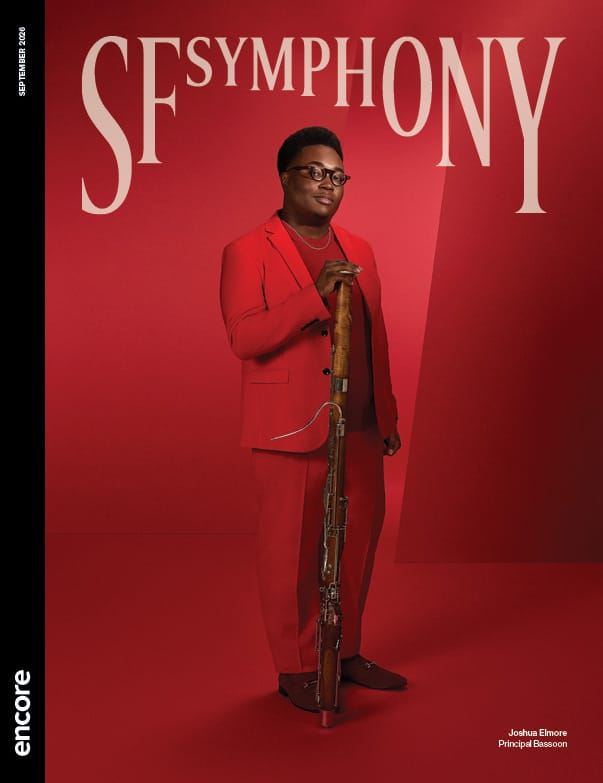
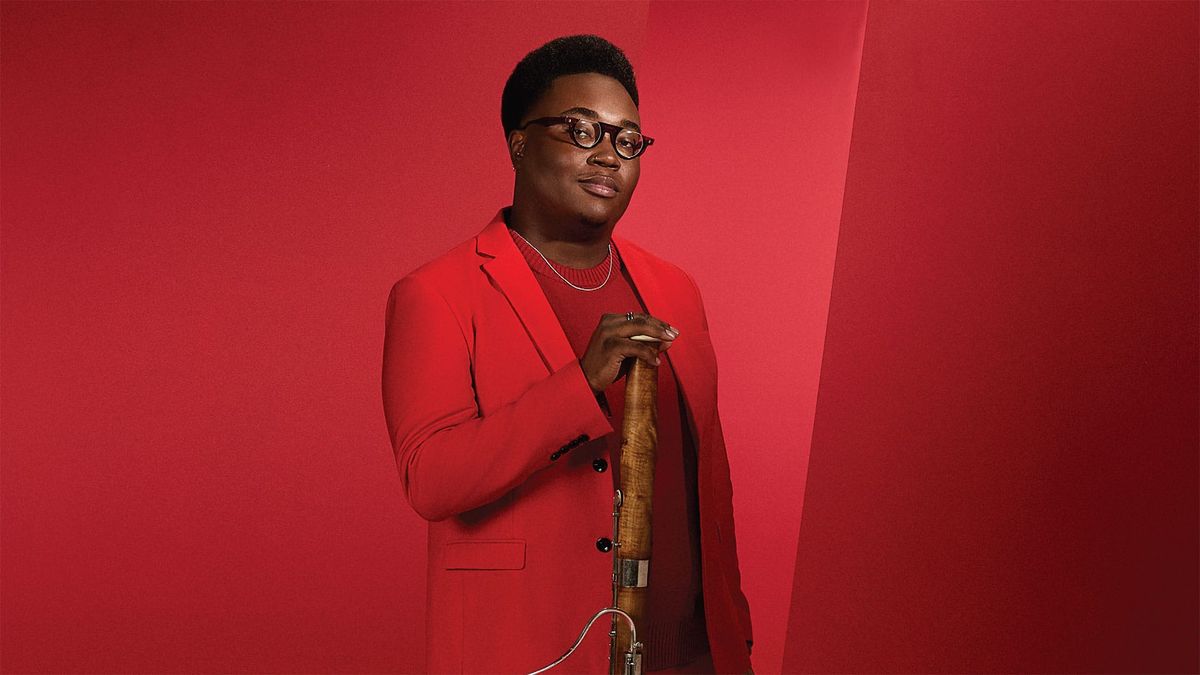
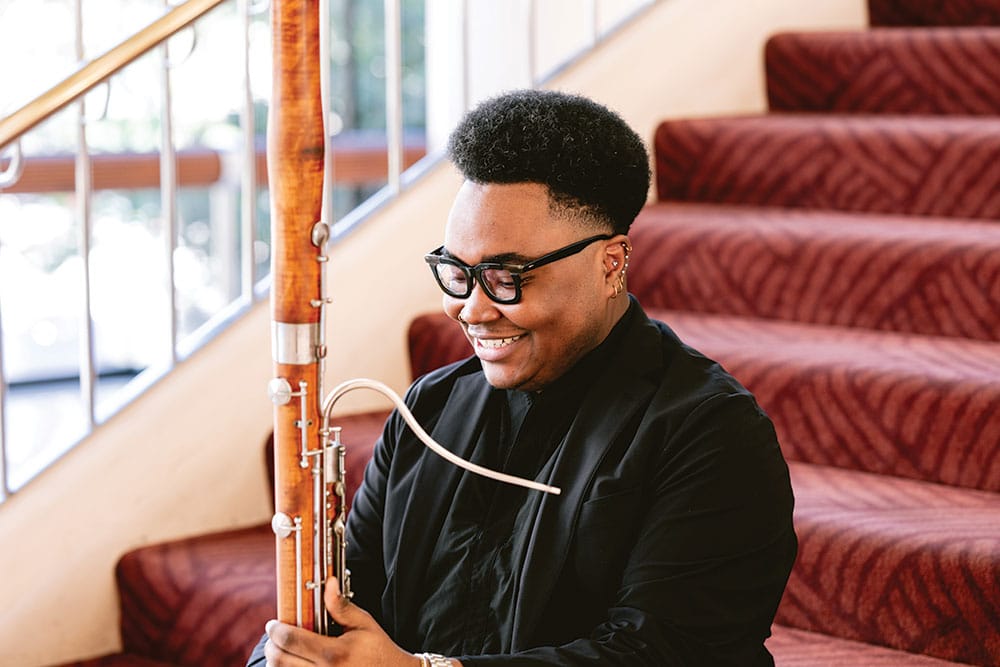
Joshua Elmore • Principal Bassoon
Joshua Elmore joined the San Francisco Symphony as Principal Bassoon in 2024. He makes his Symphony solo debut this month in the All San Francisco concert.
What was your first concert with the SF Symphony?
My trial week was in October 2024 with Esa-Pekka Salonen. We played Shostakovich’s Violin Concerto No. 1 with Sayaka Shoji [now available as a live recording from SFS Media on Apple Music Classical] and Brahms’s Symphony No. 4. A fun fact is that Brahms Four is a very significant piece in my musical journey. I first played it at Interlochen Arts Camp when I was a student, and later wrote my college essays about the piece because it had such a profound impact on my life and my desire to become a professional musician.
How did you begin playing bassoon?
I grew up in Shaker Heights, Ohio, and started playing piano at the age of eight, recorder in fourth grade, and then violin in fifth grade. After a year of violin, I realized it wasn’t for me, so I switched to the concert band to play clarinet—and did that for about three weeks. I found myself curious about the other instruments in the band and wanted more of a challenge, so I asked the band director if I could play another wind instrument. We already had too many oboe players, so he suggested the bassoon.
I had no idea what it was, and at the time, the bassoon was about as tall as I was. But I saw it, thought it looked cool, and absolutely wanted to play it. Even in elementary school, I would skip recess to go to the band room and practice. From ninth grade through my final day of 12th grade, I got to school by 7:00am to practice before band started. I was addicted to making music, and I’ve been a bassoon player ever since.
What were your next steps in becoming a professional musician?
I went to Juilliard, where I studied with Judith LeClair, principal bassoon of the New York Philharmonic. I later studied with Richard Beene at the Colburn School in Los Angeles during the pandemic, but won my previous job as principal bassoon of the Fort Worth Symphony during my first year there. I spent three and a half seasons as principal in Fort Worth before coming to San Francisco.
What kind of bassoon do you play?
My bassoon was made in Germany in 1930 by the Heckel company. It’s made of white maple wood. I actually bought it from my high school orchestra director. Her husband had played it as a substitute with the Cleveland Orchestra and wanted to sell it. She walked out onto the football field during marching band camp my senior year to let me know it was for sale, and I’ve played it ever since.
What do you love about bassoon?
I really think my voice is the bassoon. There was a period when I was trying to learn so many different instruments, and I even played saxophone for a while. But the bassoon was the one I felt closest to and the instrument that allowed me to convey my voice most effectively.
It’s an incredibly versatile instrument in the sense that it can play so many different roles in the ensemble—as a bass instrument, a solo voice, or a countermelody. The color palette I have access to as a bassoonist is vast, and I feel that it allows my music making to become even more personal.
What are your other musical activities?
I recently started teaching at the San Francisco Conservatory of Music and the Aspen Music Festival and School. I also perform with the Chineke! Orchestra during the summers, a majority-Black and ethnically diverse orchestra based in London. I’ve appeared with them at the BBC Proms.
What do you enjoy outside of music?
I love curating my collection of more than 60 indoor plants. I actually moved them here from Fort Worth in my car! I love nature and the outdoors in general, which is one of the reasons I love San Francisco—there’s so much green here. I also enjoy driving around SF in my Mazda Miata and taking in the beautiful city we get to call home.
Print Edition